


Research
PyPI Package Impersonates SymPy to Deliver Cryptomining Malware
Malicious PyPI package sympy-dev targets SymPy users, a Python symbolic math library with 85 million monthly downloads.
By Kirill Boychenko - Jan 21, 2026
hypercore-logger
Advanced tools
Distributed logger
npm install hypercore-logger
const Logger = require('hypercore-logger')

// pass backing hypercore
const log = new Logger(core)

// add a log message
await log.log({ hello: 'world' })
Setup swarming with Hyperswarm on the core and somewhere else
const log = new Logger(core)

for await (const { timestamp, stats, message } of log.tail()) {
  console.log(timestamp, stats, message)
}
Loggerconst log = new Logger(core)Create a new logger backed by a Hypercore (core).
log.discoveryKeyThe discoverKey of the Hypercore backing the log.
log.keyThe key of the Hypercore backing the log.
await log.ready()Wait for the log to fully open.
await log.log(...msg)Log the msg arguments as a string representation intended for debugging, like console.log()'s output.
In addition to the string representation, metadata is automatically added to each log. Each appended to the backing Hypercore will look like:
{
  timestamp: Date.now(),
  stats: Stats,
  subsystem: log.subsystem,
  message: '' // String representation of msg
}
Stats includes:
stats: {
  cpus: number, // Number of avaliable cpus
  cpu: number, // Precent of CPU usage
  cpuThread: number, // Percent of thread usage
  cpuDelay: number, // Event loop delay the last ~5s
  rss: integer, // Resident Set Size
  heapUsed: integer, // Amount of heap used in js engine
  heapTotal: integer, // Total size of heap in js engine
  external: integer, // Memory usage of C++ objects bound to JavaScript objects
}
The block is encoded via the Hyperschema schema @logger/entry.
const stream = log.tail(opts)Returns a live Readable Stream of the contents of the log. Acts like tail -f
on a file, showing new data as it's appended.
Example:
for await (const { timestamp, stats, message } of log.tail()) {
  console.log(timestamp, stats, message)
}
await logger.find(opts)Find start and end blocks to apply filters
opts.gte: Start at the first entry with a timestamp >= gte
opts.gt: Start at the first entry with a timestamp > gt
opts.lte: End before the first entry with timestamp > lte
opts.lt: End before the first entry with timestamp >= lt
await log.close()Fully close the log and the Hypercore backing it.
Comes with a CLI tool for tailing a hypercore-logger.
npm install -g hypercore-logger
hypercore-logger --key <key>
Usage:
hypercore-logger [flags]

Flags:
  --key, -k <key>       log core key
  --peer, -p <key>      noise key of peer
  --storage, -s <dir>   where to store the core, defaults to /tmp/hypercore-logger
  --help|-h             Show help
Apache-2.0
FAQs
Distributed logger
The npm package hypercore-logger receives a total of 0 weekly downloads. As such, hypercore-logger popularity was classified as not popular.
We found that hypercore-logger demonstrated a healthy version release cadence and project activity because the last version was released less than a year ago. It has 1 open source maintainer collaborating on the project.
Did you know?

Socket for GitHub automatically highlights issues in each pull request and monitors the health of all your open source dependencies. Discover the contents of your packages and block harmful activity before you install or update your dependencies.
Research
Malicious PyPI package sympy-dev targets SymPy users, a Python symbolic math library with 85 million monthly downloads.

Security News
Node.js 25.4.0 makes require(esm) stable, formalizing CommonJS and ESM compatibility across supported Node versions.
Product
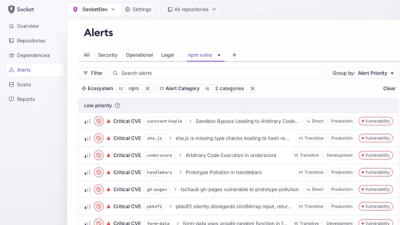
Create and share saved alert views with custom tabs on the org alerts page, making it easier for teams to return to consistent, named filter sets.