

Product
Socket for Jira Is Now Available
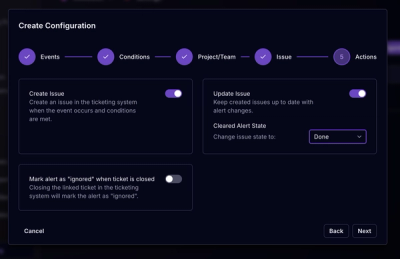
Socket for Jira lets teams turn alerts into Jira tickets with manual creation, automated ticketing rules, and two-way sync.
By Jeppe Hasseriis - Apr 20, 2026
immersed-react
Advanced tools
Immer based application state management
any.Both of these are patterns to achieve mostly the same goal, to provide a structure to manage the state of your application in a way that is understandable and observable. Redux separates the intent to modify the state (actions) from the updating of the state (reducers). In immersed, there are no actions, action creators, or reducers. Instead, you use update to modify the current state and produce the next state.
Setup:
npx create-react-app cra --template typescript
cd cra
npm install --save immersed-react
Create a new file src/State.ts. In this file we'll declare the type of our application state, and initialize immersed with an initial state.
import { init } from 'immersed-react';
export type MyState = {
  clickCount: number,
}
const initialState: MyState = {
  clickCount: 0,
}
const { useSelector, update, addListener, removeListener, enableDevTool } = init<MyState>(initialState);
enableDevTool(); // comment this out if you don't want to use the Redux dev tool.
export { useSelector, update, addListener, removeListener };
In the src/App.tsx file, import useSelector and update from src/State.ts
import { useSelector, update } from './State';
At the top of the App function, add your useSelector call. We'll pass it a selector that returns the clickCount from the state store.
const clickCount = useSelector(s => s.clickCount);
Below, just before the the </header> element, add a button that displays the click count and increments the clickCount.
<button onClick={() => update((s) => {
  s.clickCount++;
})}>
  Clicked {clickCount} times
</button>
The entire App.tsx should look like this:
import React from 'react';
import logo from './logo.svg';
import './App.css';
import { useSelector, update } from './State';

function App() {
  const clickCount = useSelector(s => s.clickCount);
  return (
    <div className="App">
      <header className="App-header">
        <img src={logo} className="App-logo" alt="logo" />
        <p>
          Edit <code>src/App.tsx</code> and save to reload.
        </p>
        <a
          className="App-link"
          href="https://reactjs.org"
          target="_blank"
          rel="noopener noreferrer"
        >
          Learn React
        </a>
        <button onClick={() => update((s) => {
          s.clickCount++;
        })}>
          Clicked {clickCount} times
        </button>
      </header>
    </div>
  );
}
export default App;
Now run:
npm start
Create react app will start up, and you'll have a button beneath the Learn react link that you can click to update.
This small example is not any better than using the useState hook, since there's only one place in the code that reads and updates the state. However, unlike with useState this pattern can used from anywhere with the application, React component or otherwise to safely share that piece of state, and whenever the clickCount property is changed via a call to update any/all components that use useSelector will rerender with the new value.
Immersed is not tied to React. You can use update and addListener from anywhere.
This function allows you to listen for changes to the state via a selector function (first arg). Any time an update causes the state selected by the selector function value to change, the activation function is called with the value from the selector.
Some quick ideas for what you might do:
import { addListener } from 'src/State';

// The selector function looks at the value of clickCount.
// The activation function is called with the value of clickCount, whenever clickCount changes.
// This function sets the clickCount value into localStorage.
addListener(s => s.clickCount, clickCount => localStorage.setItem('clickCount', clickCount));
import { addListener } from 'src/State';

// The selector function looks at the value of clickCount.
// The activation function is called with the value of clickCount, whenever clickCount changes.
// This function posts to a /clickCount endpoint with the value.
addListener(
  s => s.clickCount,
  async (clickCount) => {
    await fetch('/clickCount', { method: 'POST', body: { clickCount } });
  }
);
FAQs
Immer based application state management
We found that immersed-react demonstrated a healthy version release cadence and project activity because the last version was released less than a year ago. It has 1 open source maintainer collaborating on the project.
Did you know?

Socket for GitHub automatically highlights issues in each pull request and monitors the health of all your open source dependencies. Discover the contents of your packages and block harmful activity before you install or update your dependencies.
Product
Socket for Jira lets teams turn alerts into Jira tickets with manual creation, automated ticketing rules, and two-way sync.
Company News
Socket won two 2026 Reppy Awards from RepVue, ranking in the top 5% of all sales orgs. AE Alexandra Lister shares what it's like to grow a sales career here.

Security News
NIST will stop enriching most CVEs under a new risk-based model, narrowing the NVD's scope as vulnerability submissions continue to surge.