

Product
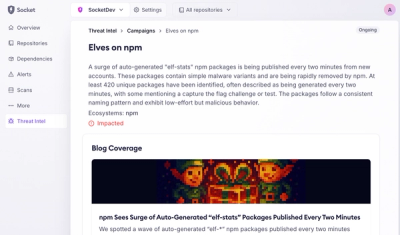
Introducing Supply Chain Attack Campaigns Tracking in the Socket Dashboard
Campaign-level threat intelligence in Socket now shows when active supply chain attacks affect your repositories and packages.
By Philipp Burckhardt - Jan 21, 2026
indexed-bitfield
Advanced tools
Indexed bitfield that allows you to search for bits efficiently
npm install indexed-bitfield
const bitfield = require('indexed-bitfield')

// allocate a bitfield with one billion bits
const bits = bitfield(1e9)

// set bit number one million to true
bits.set(1000000, true)

// returns true
console.log(bits.get(10000000))

const ite = bits.iterator()

// returns 10000000
console.log(ite.next(true))

// returns -1 (no more true bits)
console.log(ite.next(true))
bits = bitfield(maxBits)Make a new bitfield. Can contain at max maxBits bits.
Will in total use 32/248 * maxBits bytes of memory (so indexing 1.000.000 bits take up roughly 100kb of memory).
updated = bits.set(index, bit)Set an index to true or false. Returns true if the underlying bit was flipped
and false if it was already set to bit.
This operation runs in O(log32(bitfield.length)) time worst case but often in O(1).
bit = bits.get(index)Get the bit at index.
This operation runs in O(1).
bits.lengthThe length (or max amount of bits) of the bitfield.
bool = bits.some(bit)Returns true if the bitfield contains at least one bit.
This operation runs in O(1)
boot = bits.every(bit)Returns true if all bits in the bitfield are set to bit.
This operation runs in O(1)
iterator = bits.iterator()Create a bit iterator.
index = iterator.next(bit)Return the next index bit is stored at.
If none found -1 is returned.
This operation runs in O(log32(bitfield.length)) time.
iterator.seek(index)Move the iterator to a specific index.
This operation runs in O(1) time.
iterator.random(bit)Returns the position of a random bit of value bit (after the current seek index)
The bitfield index works by using Math.clz32 to count how many leading zeros bytes per 32 bit integer
and builds a bit search tree using that. The tree is very compact as it only needs one bit of index
per 32 bits of data per level in the tree. This also makes all search operation runs in log32 time.
There is a benchmark included that searches for a single true bit in a 100.000.000 length bitfield.
On my machine (Dell XPS) it returns the following: (YMVV)
npm run bench
30211 searches/ms
(or roughly 30.000.000 searches per second)
MIT
FAQs
Indexed bitfield that allows you to search for bits efficiently
We found that indexed-bitfield demonstrated a not healthy version release cadence and project activity because the last version was released a year ago. It has 1 open source maintainer collaborating on the project.
Did you know?

Socket for GitHub automatically highlights issues in each pull request and monitors the health of all your open source dependencies. Discover the contents of your packages and block harmful activity before you install or update your dependencies.
Product
Campaign-level threat intelligence in Socket now shows when active supply chain attacks affect your repositories and packages.

Research
Malicious PyPI package sympy-dev targets SymPy users, a Python symbolic math library with 85 million monthly downloads.

Security News
Node.js 25.4.0 makes require(esm) stable, formalizing CommonJS and ESM compatibility across supported Node versions.