iov
This repository began as a GitHub fork of tj/n.
Simple flavour of node binary management, no subshells, no profile setup, no convoluted api, just simple.
Installation
$ npm install -g iov
or
$ make install
to $HOME. Prefix later calls to iov with N_PREFIX=$HOME
$ PREFIX=$HOME make install
Installing Binaries
Install a few nodes:
$ iov 0.8.14
$ iov 0.8.17
$ iov 0.9.6
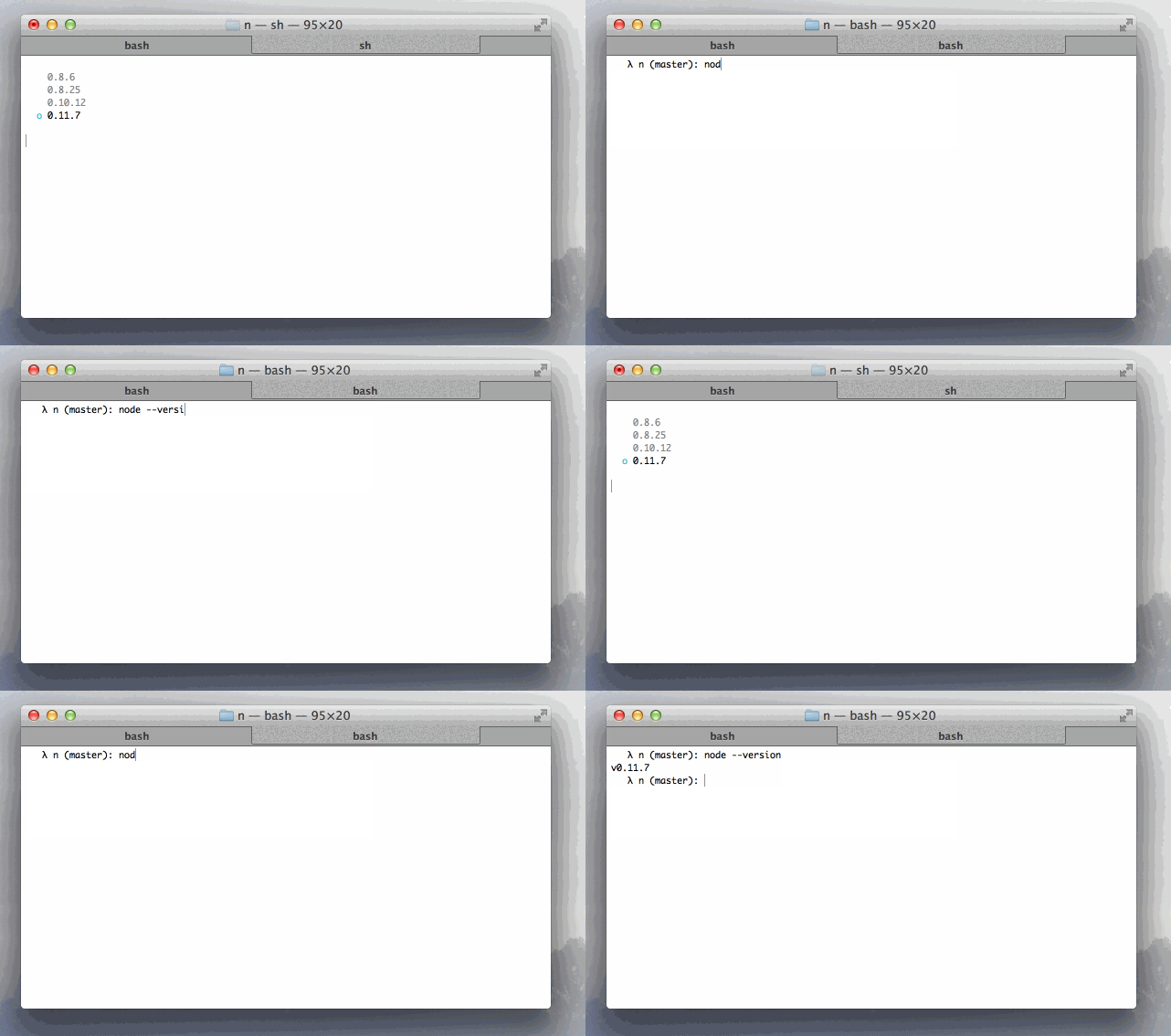
Type iov to prompt selection of an installed node. Use the up /
down arrow to navigate, and press enter or the right arrow to
select, or ^C to cancel:
$ iov

  1.0.0
ο 1.0.1
  1.1.1
Use or install the latest official release:
$ iov latest
Use or install the stable official release:
$ iov stable
Switch to the previous version you were using:
$ iov prev
Removing Binaries
Remove some versions:
$ iov rm 1.0.0 v1.0.1
Instead of using rm we can simply use -:
$ n - 1.0.0
Binary Usage
When running multiple versions of node, we can target
them directly by asking n for the binary path:
$ n bin 1.0.0
/usr/local/n/versions/1.0.0/bin/iojs
Or by using a specific version through n's use sub-command:
$ n use 1.0.0 some.js
with flags:
$ n as 1.0.0 --debug some.js
Usage
Output from iov --help:
Usage: iov [options] [COMMAND] [args]

Commands:

  iov                            Output versions installed
  iov latest                     Install or activate the latest node release
  iov stable                     Install or activate the latest stable node release
  iov <version>                  Install node <version>
  iov use <version> [args ...]   Execute node <version> with [args ...]
  iov bin <version>              Output bin path for <version>
  iov rm <version ...>           Remove the given version(s)
  iov --latest                   Output the latest node version available
  iov --stable                   Output the latest stable node version available
  iov ls                         Output the versions of node available

Options:

  -V, --version   Output current version of n
  -h, --help      Display help information

Aliases:

  which   bin
  use     as
  list    ls
  -       rm
Details
iov by default installs node to /usr/local/n/versions, from
which it can see what you have currently installed, and activate previously installed versions of node when iov <version> is invoked again.
Activated nodes are then installed to the prefix /usr/local, which of course may be altered via the N_PREFIX environment variable.
To alter where iov operates simply export N_PREFIX to whatever you prefer.
License
(The MIT License)
Copyright (c) 2014 TJ Holowaychuk <tj@vision-media.ca>
Permission is hereby granted, free of charge, to any person obtaining
a copy of this software and associated documentation files (the
'Software'), to deal in the Software without restriction, including
without limitation the rights to use, copy, modify, merge, publish,
distribute, sublicense, and/or sell copies of the Software, and to
permit persons to whom the Software is furnished to do so, subject to
the following conditions:
The above copyright notice and this permission notice shall be
included in all copies or substantial portions of the Software.
THE SOFTWARE IS PROVIDED 'AS IS', WITHOUT WARRANTY OF ANY KIND,
EXPRESS OR IMPLIED, INCLUDING BUT NOT LIMITED TO THE WARRANTIES OF
MERCHANTABILITY, FITNESS FOR A PARTICULAR PURPOSE AND NONINFRINGEMENT.
IN NO EVENT SHALL THE AUTHORS OR COPYRIGHT HOLDERS BE LIABLE FOR ANY
CLAIM, DAMAGES OR OTHER LIABILITY, WHETHER IN AN ACTION OF CONTRACT,
TORT OR OTHERWISE, ARISING FROM, OUT OF OR IN CONNECTION WITH THE
SOFTWARE OR THE USE OR OTHER DEALINGS IN THE SOFTWARE.





