Security News
Insecure Agents Podcast: Certified Patches, Supply Chain Security, and AI Agents
Socket CEO Feross Aboukhadijeh joins Insecure Agents to discuss CVE remediation and why supply chain attacks require a different security approach.
ip-toolkit
Advanced tools
This is a tool library that implements IPv4 adn IPv6 address operations, providing functions like IP address conversion, validation, subnet calculation, etc. It can facilitate various IP address processing tasks in network programming.
# Using npm
$ npm install --save ip-toolkit
# or Using yarn
$ yarn install --save ip-toolkit
const { IP } = require('ip-toolkit')
// Get IP address version
IP.version("192.168.0.1") // "IPv4"
IP.version("::ffff:ffff") // "IPv6"
IP.version("::f1fff:ffff") // "invalid"
// Convert IPv4 or IPv6 address string to number
IP.ip2long("192.168.0.1") // 3232235521
IP.ip2long('::ffff:ffff') // 4294967295n
// Convert IPv4 or IPv6 number to address string
IP.long2ip(3232235521) // "192.168.0.1"
IP.long2ip(4294967295n) // '::ffff:ffff'
// Verify if the IPv4 or IPv6 address is valid
IP.isValidIP('172.16.1.1') // true
IP.isValidIP('f16c:f7ec::36b8') // true
// Verify if the IPv4 or IPv6 CIDR address is valid
IP.isCIDR('172.16.1.1/0') // true
IP.isCIDR('ff::99:ff/64') // true
// Verify if a set of IPv4 or IPv6 CIDR ranges have conflicts
IP.isConflict(['192.168.1.0/24', '192.168.0.0/16']) // true
IP.isConflict(['2001:1db8::/32', '2001:1db8::/16']) // true
// Verify if the IPv4 or IPv6 address is within the CIDR range
IP.contains('192.168.1.0/24', '192.168.1.5') // true
IP.contains('2001:db8::1/64', '2001:db8::11') // true
const { IPv4 } = require('ip-toolkit')
// Convert IP address string to number
IPv4.ip2long("192.168.0.1") // 3232235521
IPv4.ip2long("192.168.0.257") // false
// Convert IP number to address string
IPv4.long2ip(3232235521) // 192.168.0.1
IPv4.long2ip(-1) // false
// Verify if the IP address is valid
IPv4.isValidIP('172.16.1.1') // true
IPv4.isValidIP('172.16.01.1') // true
IPv4.isValidIP('172.16.01.1', {strict: true}) // false
// Verify if the CIDR address is valid
IPv4.isCIDR('172.16.1.1/0') // true
IPv4.isCIDR('172.16.0.1/32') // true
IPv4.isCIDR('172.16.1.1/33') // false
IPv4.isCIDR('172.16.01.1/32') // false
// Verify if two IP address are equal
IPv4.isEqual('192.168.0.1', 3232235521) // true
IPv4.isEqual('192.168.1.10', '192.168.1.10') // true
// Verify if the IP address is within the CIDR range
IPv4.contains('192.168.1.0/24', '192.168.1.5') // true
IPv4.contains('192.168.1.0/24', '192.168.2.5') // false
// Verify if an IP address is private
IPv4.isPrivate('192.168.0.1') // returns true
IPv4.isPrivate('114.114.114.114') // returns false
// Verify if the subnet mask is valid
IPv4.isValidMask(24) // true
IPv4.isValidMask('255.255.255.0') // true
IPv4.isValidMask('255.255.256.0') // false
// Verify if a set of CIDR ranges have conflicts
IPv4.isConflict(['192.168.1.0/24', '192.168.0.0/16']) // true
IPv4.isConflict(['192.168.1.0/24', '192.168.2.0/24']) // false
IPv4.isConflict(['192.168.1.0/24', '192.168.2.0/24', '192.168.3.0/16']) // true
IPv4.isConflict(['192.168.1.0/24', '192.168.2.0/24', '192.168.3.0/24']) // false
// Convert IPv4 address to binary and hex
IPv4.toBinHex('172.16.0.1');
// {
// hex: '0xac100001',
// decimal: 2886729729,
// binary: '10101100000100000000000000000001'
// }
// Converts IPv4 address to IPv6 format
IPv4.toIPv6Format('192.168.1.1');
// {
// mapped: '::ffff:192.168.1.1',
// comperssed: "::ffff:c0a8:101"
// expanded: '0000:0000:0000:0000:0000:ffff:c0a8:0101',
// }
// Calculate the inverse mask of a subnet mask
IPv4.toInverseMask(24); // '0.0.0.255'
IPv4.toInverseMask(16); // '0.0.255.255'
IPv4.toInverseMask('255.255.255.0'); // '0.0.0.255'
IPv4.toInverseMask('255.255.0.0'); // '0.0.255.255'
// Convert subnet mask string to mask length number
IPv4.toMaskLength('255.255.255.0') // 24
IPv4.toMaskLength('255.255.256.0') // false
// Convert mask length to subnet mask string
IPv4.toSubnetMask(0) // 0.0.0.0
IPv4.toSubnetMask(8) // 255.0.0.0
IPv4.toSubnetMask(16) // 255.255.0.0
IPv4.toSubnetMask(24) // 255.255.255.0
// Verify if two IP address are on the same subnet
IPv4.isSameSubnet('192.168.1.10', '192.168.1.100', '255.255.255.0'); // true
IPv4.isSameSubnet('192.168.1.10', '192.168.2.100', '255.255.255.0'); // true
// Parse IPv4 CIDR address to get address range info
IPv4.parseCIDR('192.168.0.1/24')
// {
// ipCount: 256,
// usableCount: 254,
// cidrMask: 24,
// subnetMask: '255.255.255.0',
// firstHost: '192.168.0.1',
// lastHost: '192.168.0.254',
// networkAddress: '192.168.1.0',
// broadcastAddress: '192.168.1.255'
// }
// Parse IP address and subnet mask into CIDR info
IPv4.parseSubnet('192.168.0.1', '255.255.255.0')
// {
// ipCount: 256,
// usableCount: 254,
// cidrMask: 24,
// subnetMask: '255.255.255.0',
// firstHost: '192.168.0.1',
// lastHost: '192.168.0.254',
// networkAddress: '192.168.0.0',
// broadcastAddress: '192.168.0.255'
// }
// Create ipRange instance from start and end IPv4 integers
const range1 = IPv4.ipRange.fromLong(3232235777, 3232235876);
IPv4.range1.ipCount(); // 100
IPv4.range1.contains('192.168.1.11'); // true
IPv4.range1.long2ip() // [ '192.168.1.1', '192.168.1.100' ]
// Create ipRange instance from start and end IPv4 strings
const range2 = IPv4.ipRange.fromString('192.168.1.1', '192.168.1.100');
IPv4.range2.ipCount() // 100
IPv4.range2.contains('192.168.1.11'); // true
IPv4.range2.ip2long() // [ 3232235777, 3232235876 ]
const { IPv6 } = require('ip-toolkit')
// Convert IPv6 address string to number
IPv6.ip2long('::ffff:ffff') // 4294967295n
// Convert IPv6 address number to string
IPv6.ip2long(4294967295n) // ::ffff:ffff
// Verify if the IPv6 address is valid
IPv6.isValidIP('f16c:f7ec:cfa2:e1c5:9a3c:cb08:801f:36b8') // true
// Verify if the IPv6 CIDR address is valid
IPv6.isCIDR('::9999:ffff/0') // true
IPv6.isCIDR('::9999:ffff/128') // true
IPv6.isCIDR('::9999:ffff/291') // false
// Verify if a set of CIDR ranges have conflicts
IPv6.isConflict(['2001:db8::1/120', '2001:db8::1/122']) // true
IPv6.isConflict(['2001:db8::11/64', '2001:db8::11/48']) // true
// Expands an abbreviated IPv6 address string into its full representation.
IPv6.expandedForm('2001:db8::1') // '2001:0db8:0000:0000:0000:0000:0000:0001'
// Compresses an expanded IPv6 address into shortened form.
IPv6.compressedForm('2001:0db8:0000:0000:0000:0000:0000:0001') // '2001:db8::1'
// Parse CIDR format address into address range info
IPv6.parseCIDR('::9999:ffff/118')
// {
// ipCount: 1024n,
// cidrMask: 118,
// firstHost: '::9999:fc00',
// lastHost: '::9999:ffff',
// }
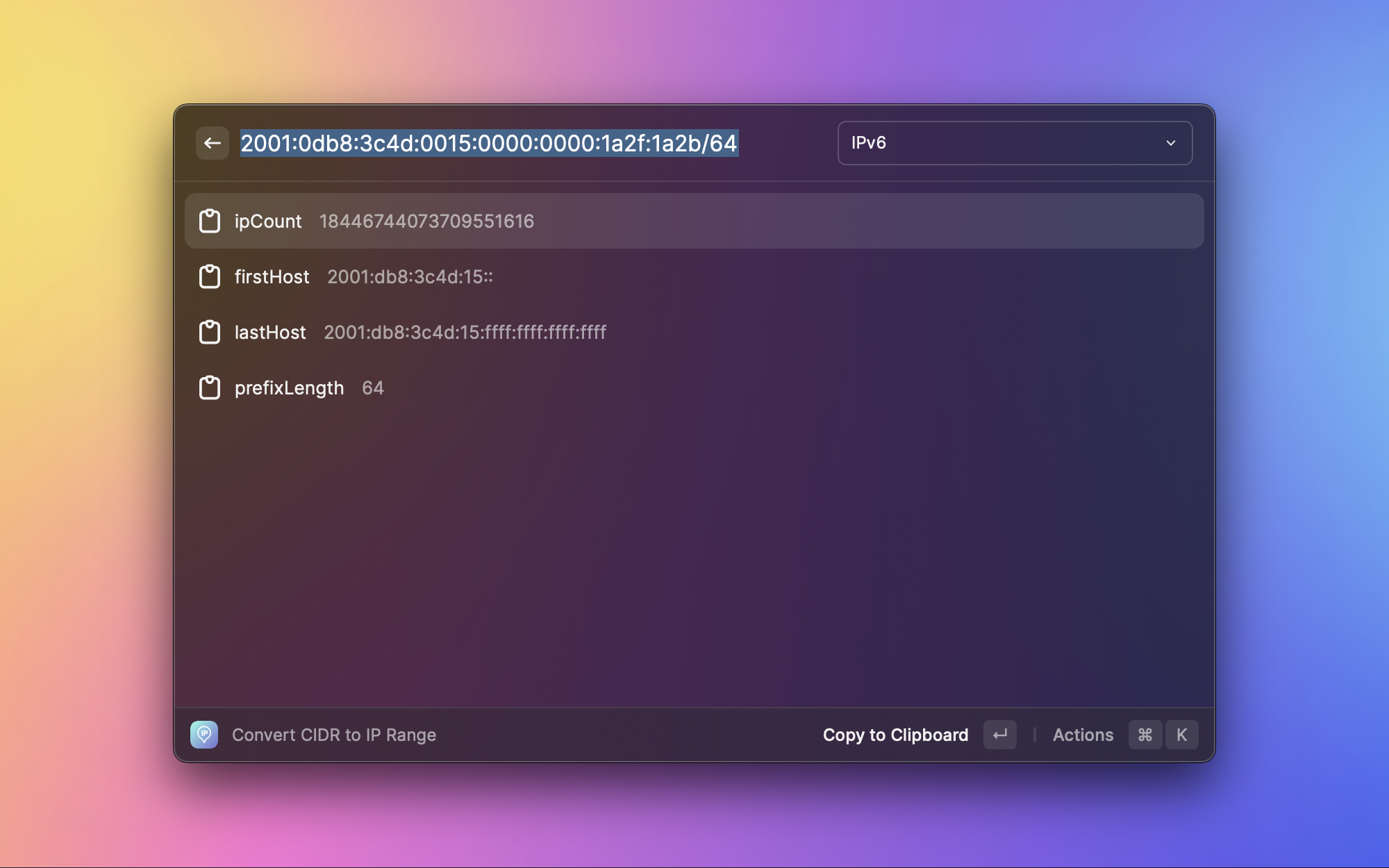
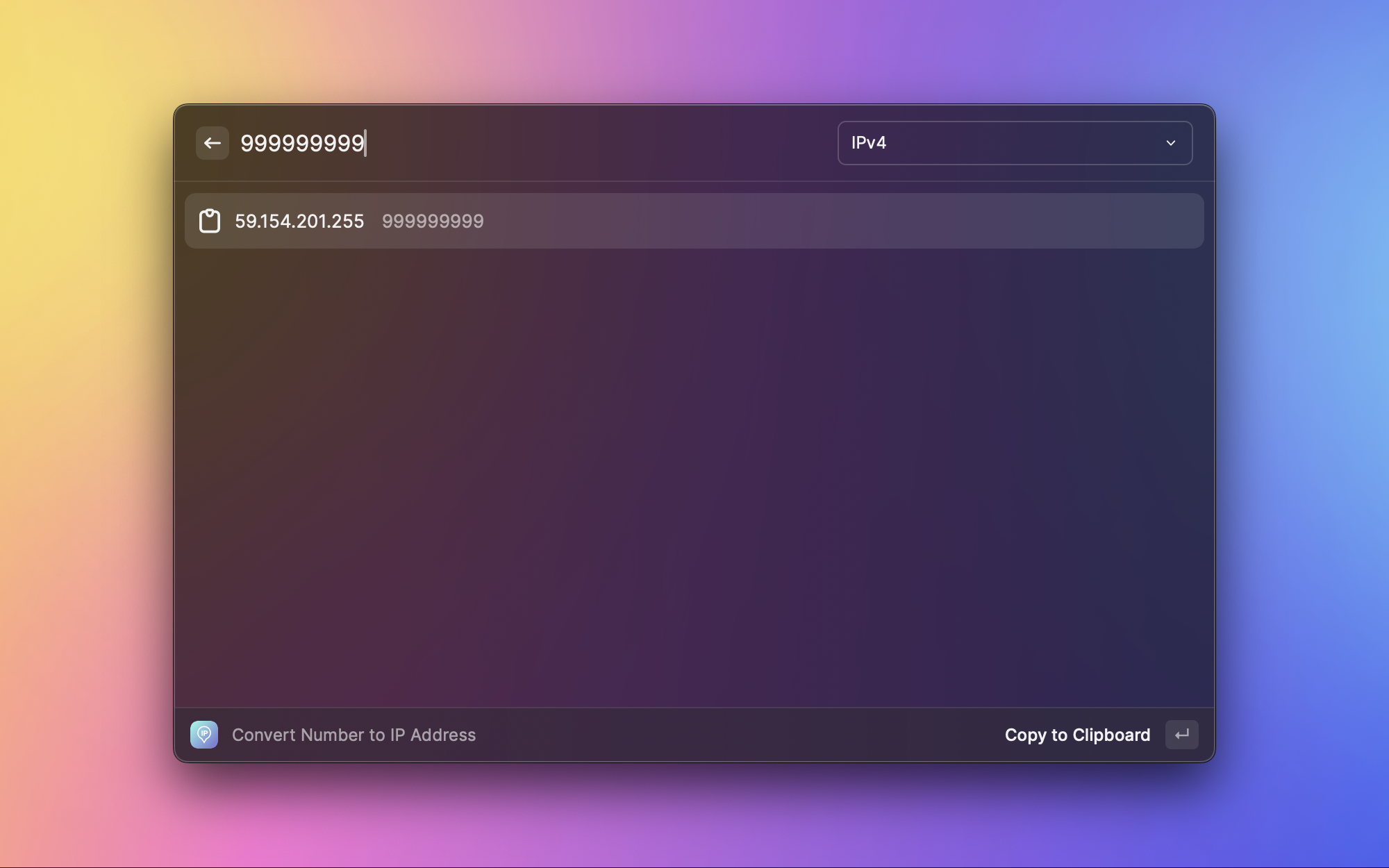
This project has already released an extension plugin on Raycast !
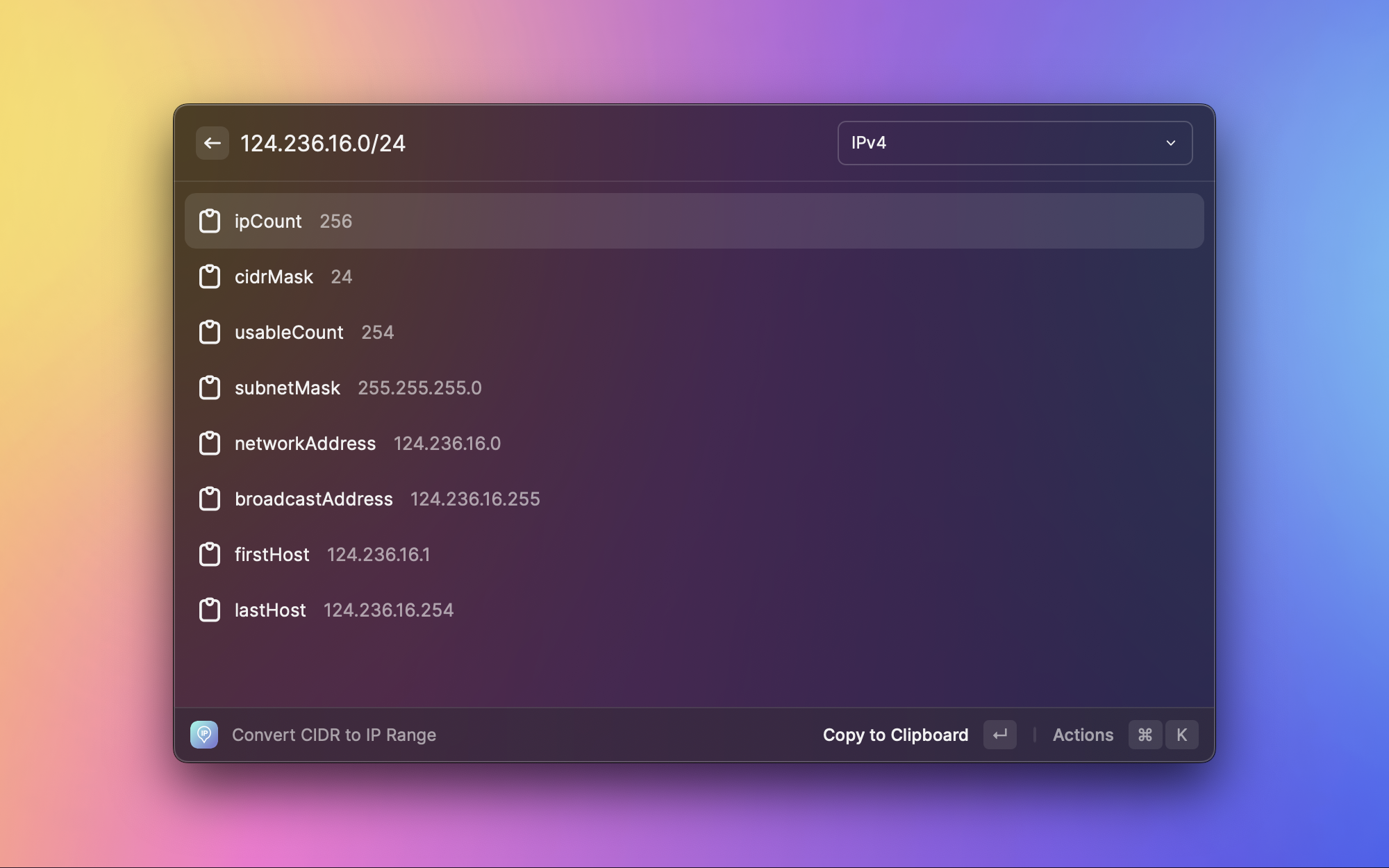
Issues and pull requests are welcome!
If you find this project useful, please star it on GitHub !
This project is under the MIT License.

FAQs
A utility library for manipulating IPv4 and IPv6 address in Node.js.
We found that ip-toolkit demonstrated a not healthy version release cadence and project activity because the last version was released a year ago. It has 1 open source maintainer collaborating on the project.
Did you know?

Socket for GitHub automatically highlights issues in each pull request and monitors the health of all your open source dependencies. Discover the contents of your packages and block harmful activity before you install or update your dependencies.

Security News
Socket CEO Feross Aboukhadijeh joins Insecure Agents to discuss CVE remediation and why supply chain attacks require a different security approach.

Security News
Tailwind Labs laid off 75% of its engineering team after revenue dropped 80%, as LLMs redirect traffic away from documentation where developers discover paid products.

Security News
The planned feature introduces a review step before releases go live, following the Shai-Hulud attacks and a rocky migration off classic tokens that disrupted maintainer workflows.