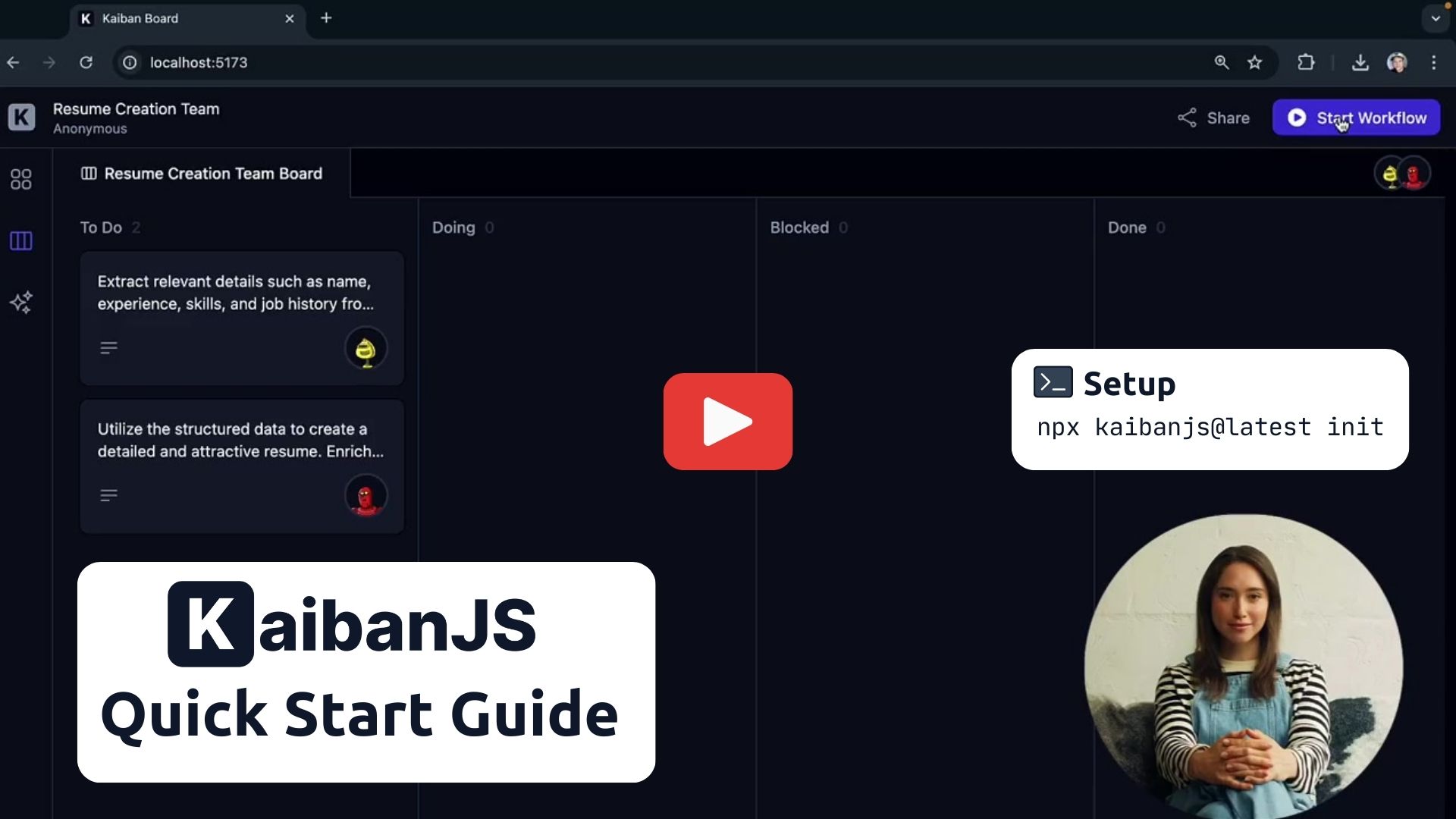
KaibanJS is inspired by the tried-and-true Kanban methodology, which is well-known for helping teams organize and manage their work. We've adapted these concepts to meet the unique challenges of AI agent management.
If you've used tools like Trello, Jira, or ClickUp, you'll be familiar with how Kanban helps manage tasks. Now, KaibanJS uses that same system to help you manage AI agents and their tasks in real time.
With KaibanJS, you can:
🔨 Create, visualize, and manage AI agents, tasks, tools, and teams
🎯 Orchestrate AI workflows seamlessly
📊 Visualize workflows in real-time
🔍 Track progress as tasks move through different stages
1. Run the KaibanJS initializer in your project directory:
npx kaibanjs@latest init
2. Add your AI service API key to the .env file:
VITE_OPENAI_API_KEY=your-api-key-here
3. Restart your Kaiban Board:
npm run kaiban
Using Your Kaiban Board
Click "Start Workflow" to run the default example.
Watch agents complete tasks in real-time on the Task Board.
View the final output in the Results Overview.
Flexible Integration
KaibanJS isn't limited to the Kaiban Board. You can integrate it directly into your projects, create custom UIs, or run agents without a UI. Explore our tutorials for React and Node.js integration to unleash the full potential of KaibanJS in various development contexts.
Manual Installation and Usage
If you prefer to set up KaibanJS manually follow these steps:
1. Install KaibanJS via npm:
npm install kaibanjs
2. Import KaibanJS in your JavaScript file:
// Using ES6 import syntax for NextJS, React, etc.import { Agent, Task, Team } from'kaibanjs';
// Using CommonJS syntax for NodeJSconst { Agent, Task, Team } = require('kaibanjs');
3. Basic Usage Example
// Define an agentconst researchAgent = newAgent({
name: 'Researcher',
role: 'Information Gatherer',
goal: 'Find relevant information on a given topic',
});
// Create a taskconst researchTask = newTask({
description: 'Research recent AI developments',
agent: researchAgent,
});
// Set up a teamconst team = newTeam({
name: 'AI Research Team',
agents: [researchAgent],
tasks: [researchTask],
env: { OPENAI_API_KEY: 'your-api-key-here' },
});
// Start the workflow
team
.start()
.then((output) => {
console.log('Workflow completed:', output.result);
})
.catch((error) => {
console.error('Workflow error:', error);
});
Basic Concepts
Agents
Agents are autonomous entities designed to perform specific roles and achieve goals based on the tasks assigned to them. They are like super-powered LLMs that can execute tasks in a loop until they arrive at the final answer.
Tasks
Tasks define the specific actions each agent must take, their expected outputs, and mark critical outputs as deliverables if they are the final products.
Team
The Team coordinates the agents and their tasks. It starts with an initial input and manages the flow of information between tasks.
Watch this video to learn more about the concepts: KaibanJS Concepts
Key Features
The Kaiban Board
Kanban boards are excellent tools for showcasing team workflows in real time, providing a clear and interactive snapshot of each member's progress.
We've adapted this concept for AI agents.
Now, you can visualize the workflow of your AI agents as team members, with tasks moving from "To Do" to "Done" right before your eyes. This visual representation simplifies understanding and managing complex AI operations, making it accessible to anyone, anywhere.
Role-Based Agent Design
Harness the power of specialization by configuring AI agents to excel in distinct, critical functions within your projects. This approach enhances the effectiveness and efficiency of each task, moving beyond the limitations of generic AI.
In this example, our software development team is powered by three specialized AI agents: Dave, Ella, and Quinn. Each agent is expertly tailored to its specific role, ensuring efficient task handling and synergy that accelerates the development cycle.
import { Agent } from'kaibanjs';
const daveLoper = newAgent({
name: 'Dave Loper',
role: 'Developer',
goal: 'Write and review code',
background: 'Experienced in JavaScript, React, and Node.js',
});
const ella = newAgent({
name: 'Ella',
role: 'Product Manager',
goal: 'Define product vision and manage roadmap',
background: 'Skilled in market analysis and product strategy',
});
const quinn = newAgent({
name: 'Quinn',
role: 'QA Specialist',
goal: 'Ensure quality and consistency',
background: 'Expert in testing, automation, and bug tracking',
});
Tool Integration
Just as professionals use specific tools to excel in their tasks, enable your AI agents to utilize tools like search engines, calculators, and more to perform specialized tasks with greater precision and efficiency.
In this example, one of the AI agents, Peter Atlas, leverages the Tavily Search Results tool to enhance his ability to select the best cities for travel. This tool allows Peter to analyze travel data considering weather, prices, and seasonality, ensuring the most suitable recommendations.
import { Agent, Tool } from'kaibanjs';
const tavilySearchResults = newTool({
name: 'Tavily Search Results',
maxResults: 1,
apiKey: 'ENV_TRAVILY_API_KEY',
});
const peterAtlas = newAgent({
name: 'Peter Atlas',
role: 'City Selector',
goal: 'Choose the best city based on comprehensive travel data',
background: 'Experienced in geographical data analysis and travel trends',
tools: [tavilySearchResults],
});
KaibanJS supports all LangchainJS-compatible tools, offering a versatile approach to tool integration. For further details, visit the documentation.
Task Result Passing
Enable sophisticated workflows by passing results between tasks, allowing agents to build upon each other's work. This feature is essential for creating complex, multi-step processes where each task's output becomes input for subsequent tasks.
In this example, a content creation team demonstrates how tasks can share and build upon results, creating a seamless workflow from research to final content production.
import { Agent, Task, Team } from'kaibanjs';
// Define tasks with result passingconst researchTask = newTask({
description: 'Research the topic: {topic}',
expectedOutput: 'Key research points in JSON format',
agent: researcher,
});
const writingTask = newTask({
description: `Write an article using this research data: {taskResult:task1}
Focus on key insights and maintain professional tone.`,
expectedOutput: 'Draft article in markdown format',
agent: writer,
});
const editingTask = newTask({
description: `Edit and improve this article: {taskResult:task2}
Enhance clarity and engagement.`,
expectedOutput: 'Final polished article',
agent: editor,
});
// Create a team with the tasksconst team = newTeam({
name: 'Content Creation Team',
agents: [researcher, writer, editor],
tasks: [researchTask, writingTask, editingTask],
inputs: { topic: 'AI Trends 2024' },
});
Task results are automatically passed between tasks using the {taskResult:taskN} syntax, where N represents the task's position in the workflow (1-based indexing). For more details and advanced usage, visit our Task Result Passing Guide.
Memory Management
KaibanJS provides sophisticated memory management at the team level, giving you control over how task results flow through your workflows. This feature allows you to optimize performance and manage context in complex multi-agent systems.
Here's an example of configuring team memory:
const team = newTeam({
name: 'Content Creation Team',
agents: [researcher, writer, editor],
tasks: [researchTask, writingTask, editingTask],
memory: true, // Enable automatic access to all previous task results
});
// Or disable memory for explicit result managementconst performanceTeam = newTeam({
name: 'High-Performance Team',
agents: [analyst, processor],
tasks: [analysisTask, processingTask],
memory: false, // Require explicit result references
});
For detailed information about memory management, visit our documentation.
Multiple LLMs Support
Optimize your AI solutions by integrating a range of specialized AI models, each tailored to excel in distinct aspects of your projects.
In this example, the agents—Emma, Lucas, and Mia—use diverse AI models to handle specific stages of feature specification development. This targeted use of AI models not only maximizes efficiency but also ensures that each task is aligned with the most cost-effective and appropriate AI resources.
For further details on integrating diverse AI models with KaibanJS, please visit the documentation.
Robust State Management
KaibanJS employs a Redux-inspired architecture, enabling a unified approach to manage the states of AI agents, tasks, and overall flow within your applications. This method ensures consistent state management across complex agent interactions, providing enhanced clarity and control.
Here's a simplified example demonstrating how to integrate KaibanJS with state management in a React application:
For a deeper dive into state management with KaibanJS, visit the documentation.
Integrate with Your Preferred JavaScript Frameworks
Easily add AI capabilities to your NextJS, React, Vue, Angular, and Node.js projects.
KaibanJS is designed for seamless integration across a diverse range of JavaScript environments. Whether you're enhancing user interfaces in React, Vue, or Angular, building scalable applications with NextJS, or implementing server-side solutions in Node.js, the framework integrates smoothly into your existing workflow.
Built into KaibanJS, the observability features enable you to track every state change with detailed stats and logs, ensuring full transparency and control. This functionality provides real-time insights into token usage, operational costs, and state changes, enhancing system reliability and enabling informed decision-making through comprehensive data visibility.
The following code snippet demonstrates how the state management approach is utilized to monitor and react to changes in workflow logs, providing granular control and deep insights into the operational dynamics of your AI agents:
const useStore = myAgentsTeam.useStore();

useStore.subscribe(
  (state) => state.workflowLogs,
  (newLogs, previousLogs) => {
    if (newLogs.length > previousLogs.length) {
      const { task, agent, metadata } = newLogs[newLogs.length - 1];
      if (newLogs[newLogs.length - 1].logType === 'TaskStatusUpdate') {
        switch (task.status) {
          case TASK_STATUS_enum.DONE:
            console.log('Task Completed', {
              taskDescription: task.description,
              agentName: agent.name,
              agentModel: agent.llmConfig.model,
              duration: metadata.duration,
              llmUsageStats: metadata.llmUsageStats,
              costDetails: metadata.costDetails,
            });
            break;
          case TASK_STATUS_enum.DOING:
          case TASK_STATUS_enum.BLOCKED:
          case TASK_STATUS_enum.REVISE:
          case TASK_STATUS_enum.TODO:
            console.log('Task Status Update', {
              taskDescription: task.description,
              taskStatus: task.status,
              agentName: agent.name,
            });
            break;
          default:
            console.warn('Encountered an unexpected task status:', task.status);
            break;
        }
      }
    }
  }
);
For more details on how to utilize observability features in KaibanJS, please visit the documentation.
WorkflowDrivenAgent
The `WorkflowDrivenAgent` is a specialized agent that executes workflows instead of using LLM-based reasoning. This agent maintains workflow state and can handle suspension and resumption operations for long-running workflows, providing a deterministic approach to task execution.
In this example, a WorkflowDrivenAgent is created to execute a workflow that processes data through defined steps, allowing for complex multi-step operations without LLM calls.
import { Agent } from'kaibanjs';
import { createStep, createWorkflow } from'@kaibanjs/workflow';
import { z } from'zod';
// Create workflow stepsconst processStep = createStep({
id: 'process',
inputSchema: z.object({ data: z.string() }),
outputSchema: z.object({ result: z.string() }),
execute: async ({ inputData }) => {
const { data } = inputData as { data: string };
return { result: data.toUpperCase() };
},
});
// Create the workflowconst workflow = createWorkflow({
id: 'example-workflow',
inputSchema: z.object({ data: z.string() }),
outputSchema: z.object({ result: z.string() }),
});
workflow.then(processStep);
workflow.commit();
// Create the agent using the Agent wrapperconst agent = newAgent({
type: 'WorkflowDrivenAgent',
name: 'Workflow Agent',
workflow: workflow,
});
// Use the agent in a teamconst team = newTeam({
name: 'Workflow Team',
agents: [agent],
tasks: [
newTask({
description: 'Process the input data using workflow',
expectedOutput: 'Processed data result',
agent: agent,
}),
],
});
The WorkflowDrivenAgent integrates seamlessly with the existing team system, supports workflows with suspension for manual intervention, and provides detailed logging for workflow events. For more information, visit the WorkflowDrivenAgent documentation.
KaibanJS aims to be compatible with major front-end frameworks like React, Vue, Angular, and NextJS, making it a versatile choice for developers. The JavaScript ecosystem is a "bit complex...". If you have any problems, please tell us and we'll help you fix them.
Why KaibanJS?
There are about 20 million JavaScript developers worldwide, yet most AI frameworks are originally written in Python. Others are mere adaptations for JavaScript.
This puts all of us JavaScript developers at a disadvantage in the AI race. But not anymore...
KaibanJS changes the game by aiming to offer a robust, easy-to-use AI multi-agent framework designed specifically for the JavaScript ecosystem.
const writtenBy = `Another JS Dev Who Doesn't Want to Learn Python to do meaningful AI Stuff.`;
console.log(writtenBy);
Community and Support
Join the Discord community to connect with other developers and get support. Follow us on Twitter for the latest updates.
Contributing
We welcome contributions from the community. Please read the contributing guidelines before submitting pull requests.
We found that kaibanjs demonstrated a healthy version release cadence and project activity because the last version was released less than a year ago.It has 2 open source maintainers collaborating on the project.
Package last updated on 12 Dec 2025
Did you know?
Socket for GitHub automatically highlights issues in each pull request and monitors the health of all your open source dependencies. Discover the contents of your packages and block harmful activity before you install or update your dependencies.