

Product
Socket for Jira Is Now Available
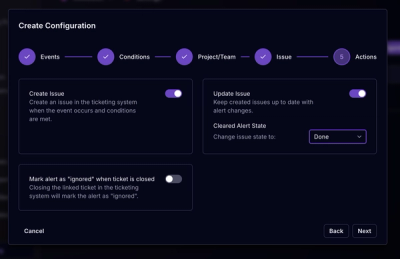
Socket for Jira lets teams turn alerts into Jira tickets with manual creation, automated ticketing rules, and two-way sync.
By Jeppe Hasseriis - Apr 20, 2026
list-exports
Advanced tools
Given a package name and a version number, or a path to a package.json, what specifiers does it expose?




Given a path to a package.json, what specifiers does it expose?
The package export defaults an async function. It takes a path to a package.json as the only required argument.
It fulfills with an object with the following structure:
name the package nameversion: the package versionengines: the package's engines requirementsproblems: a Set of strings describing problems or validation issues encountered during exports traversal. Note that these errors do not necessarily interfere with the listed entry points being accessible at runtime.exports: an object with the following structure:
binaries: a Map of executable program names, to the relative file path that name will execute.latest: a string describing the latest “category” in the given node version range. This category will be present in the following list....categories: each category that the node version range overlaps will have an object with this structure:
import: a Map of import specifier, to relative file pathrequire: a Map of require specifier, to relative file pathfiles: a Set of relative file paths that are included in import and/or requiretree: a Map. Its keys are filenames (no leading ./), whose values are a Set of import or require specifiers that point to it; or, directory names, whose values are a Map of the same recursive structure as tree itself.pre-exports: this category will always be present, whether it's in the above list or not, with the above structure.In addition to the required package.json path, it also takes a second argument, an options object. This object supports the following properties:
node: either true, which reads the engines.node field in package.json, or a valid semver range of node versions to target. Defaults to the current node version.conditions: either true, a string, or an array of strings specifying additional export conditions to recognize, similar to Node.js's --conditions flag. When true, auto-detects conditions from Node's --conditions/-C flag (via process.execArgv or NODE_OPTIONS). For example, { conditions: ['browser'] } will include exports mapped to the browser condition.This package tracks the conditions that Node.js recognizes in the exports field. Node.js supports the following conditions:
Standard conditions (all categories with exports support):
default - Fallback condition, always evaluated lastnode - Matches when running in Node.jsrequire - Matches for CommonJS require() callsimport - Matches for ESM import statements/expressionsAdditional conditions (added in later versions):
node-addons - For native addon modules (added in v14.19/v16.10, pattern-trailers category and later)module-sync - For ESM files that can be synchronously required (added in v22.12, require-esm category and later)Conditions NOT recognized by Node.js by default (commonly used but require bundlers/tooling):
browser - For browser environments (handled by bundlers like webpack, Rollup)types - For TypeScript type definitions (handled by TypeScript)development / production - Environment-specific (handled by bundlers)--conditions flagBy default, list-exports matches Node.js behavior and skips conditions not recognized by the target Node.js version. To include additional conditions, use the conditions option (equivalent to Node.js's --conditions flag).
const expected = {
	name: 'list-exports',
	version: '1.1.0',
	engines: { node: '^18.17.0 || >=20.5.0' },
	problems: new Set(),
	exports: {
		binaries: {},
		latest: 'pattern-trailers-no-dir-slash',
		'pattern-trailers-no-dir-slash': {
			import: new Map([
				['.', './index.js'],
			]),
			require: new Map([
				['.', './index.js'],
				['./package.json', './package.json'],
			]),
			files: new Set([
				'./index.js',
				'./package.json',
			]),
			tree: new Map([
				['index.js', new Set(['.'])],
				['package.json', new Set(['./package.json'])],
			]),
		},
		'pre-exports': {
			import: new Map(),
			require: new Map([
				['.', './index.js'],
				['./', './index.js'],
				['./index', './index.js'],
				['./index.js', './index.js'],
				['./package', './package.json'],
				['./package.json', './package.json'],
			]),
			files: new Set([
				'./index.js',
				'./package.json',
			]),
			tree: new Map([
				['index.js', new Set([
					'.',
					'./',
					'./index.js',
					'./index',
				])],
				['package.json', new Set([
					'./package.json',
					'./package',
				])],
			]),
		},
	},
};
const assert = require('assert');
const path = require('path');
const listExports = require('list-exports');

listExports('./package.json', { node: true }).then((data) => {
	assert.deepEqual(data, expected);
}).catch((e) => {
	console.error(e);
	process.exit(1);
});
FAQs
Given a package name and a version number, or a path to a package.json, what specifiers does it expose?
We found that list-exports demonstrated a healthy version release cadence and project activity because the last version was released less than a year ago. It has 1 open source maintainer collaborating on the project.
Did you know?

Socket for GitHub automatically highlights issues in each pull request and monitors the health of all your open source dependencies. Discover the contents of your packages and block harmful activity before you install or update your dependencies.
Product
Socket for Jira lets teams turn alerts into Jira tickets with manual creation, automated ticketing rules, and two-way sync.
Company News
Socket won two 2026 Reppy Awards from RepVue, ranking in the top 5% of all sales orgs. AE Alexandra Lister shares what it's like to grow a sales career here.

Security News
NIST will stop enriching most CVEs under a new risk-based model, narrowing the NVD's scope as vulnerability submissions continue to surge.