

Product
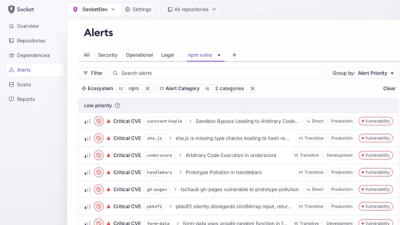
Introducing Custom Tabs for Org Alerts
Create and share saved alert views with custom tabs on the org alerts page, making it easier for teams to return to consistent, named filter sets.
By André Staltz - Jan 20, 2026
load-options
Advanced tools
Load Assemble options from a config file, object, glob patterns, or any combination of those. Fallback on defaults if options aren't defined, or you can override or extend the defaults.

Load Assemble options from a config file, object, glob patterns, or any combination of those. Fallback on defaults if options aren't defined, or you can override or extend the defaults.
Install with npm:
npm i load-options --save-dev
Load default options, define an object, pass JSON/YAML file(s) or glob pattern(s) to extend the defaults.
Example:
Use the defaults:
var assemble = require('assemble');
var opts = require('load-options');

// Override `default` layout with `blog` layout
assemble.options(opts({layout: 'blog'}));
assemble.task('site', function() {
  assemble.src(opts.src)
    .pipe(assemble.dest(opts.dest));
});
options {Object}return {Object}Add options
Define new options by passing an object:
var options = require('load-options')({foo: 'bar'});
Reset options
If there is an option defined that you want to reset or "turn off", just pass an empty value:
var options = require('load-options')({plugins: []});
Override the default value with a new value:
var options = require('load-options')({plugins: ['foo/bar/*.js']});
Extend options
Extend the defaults by using lodash templates (e.g. keep the defaults AND add your own). Just reference a property on the _default object that corresponds to the option want to extend:
var loadOpts = require('load-options');
var options = loadOpts({
  plugins: ['<%= _default.plugins %>', 'foo/bar/*.js']
});
.assemblerc.yml
Extend the default options with user-defined options in .assemblerc.yml:
var options = require('load-options')('.assemblerc.yml');
// paths shortened using ~ to make the example more readable
{ dest: '_gh_pages',
  assets: '_gh_pages/assets',
  flatten: true,
  engine: 'handlebars',
  ext: '.html',
  data: {},
  plasma: {},
  layoutdir: 'test/fixtures/templates/layouts',
  layout: 'foo',
  layoutext: '.hbs',
  pages:
   [ '~/test/fixtures/templates/pages/about.hbs',
     '~/test/fixtures/templates/pages/index.hbs' ],
  partials:
   [ '~/test/fixtures/templates/partials/alert.hbs',
     '~/test/fixtures/templates/partials/nav.hbs',
     '~/test/fixtures/templates/partials/tooltip.hbs' ],
  plugins: [],
  middleware:
   [ '~/test/fixtures/extensions/middleware/a.js',
     '~/test/fixtures/extensions/middleware/b.js',
     '~/test/fixtures/extensions/middleware/c.js' ],
  helpers:
   [ '~/test/fixtures/extensions/helpers/a.js',
     '~/test/fixtures/extensions/helpers/b.js',
     '~/test/fixtures/extensions/helpers/c.js' ],
  mixins:
   [ '~/test/fixtures/extensions/mixins/a.js',
     '~/test/fixtures/extensions/mixins/b.js',
     '~/test/fixtures/extensions/mixins/c.js' ],
  extensions: 'test/fixtures/extensions',
  templates: 'test/fixtures/templates',
  filters:
   [ '~/test/fixtures/extensions/filters/a.js',
     '~/test/fixtures/extensions/filters/b.js',
     '~/test/fixtures/extensions/filters/c.js' ],
  _default:
   { dest: '_gh_pages',
     assets: '_gh_pages/assets',
     flatten: true,
     engine: 'handlebars',
     ext: '.html',
     data: [ 'data/*.{json,yml}' ],
     plasma: null,
     layoutdir: 'test/fixtures/templates/layouts',
     layout: 'default',
     layoutext: '.hbs',
     pages: [ 'test/fixtures/templates/pages/*.hbs' ],
     partials: [ 'test/fixtures/templates/{partials,includes}/*.hbs' ],
     plugins: [ 'test/fixtures/extensions/plugins/*.js' ],
     middleware: [ 'test/fixtures/extensions/middleware/*.js' ],
     helpers: [ 'test/fixtures/extensions/helpers/*.js' ],
     mixins: [ 'test/fixtures/extensions/mixins/*.js' ] } }
Jon Schlinkert
Copyright (c) 2014 Jon Schlinkert, contributors.
Released under the MIT license
This file was generated by verb-cli on July 19, 2014.
FAQs
Load Assemble options from a config file, object, glob patterns, or any combination of those. Fallback on defaults if options aren't defined, or you can override or extend the defaults.
We found that load-options demonstrated a not healthy version release cadence and project activity because the last version was released a year ago. It has 1 open source maintainer collaborating on the project.
Did you know?

Socket for GitHub automatically highlights issues in each pull request and monitors the health of all your open source dependencies. Discover the contents of your packages and block harmful activity before you install or update your dependencies.
Product
Create and share saved alert views with custom tabs on the org alerts page, making it easier for teams to return to consistent, named filter sets.
Product
Socket’s Rust and Cargo support is now generally available, providing dependency analysis and supply chain visibility for Rust projects.

Security News
Chrome 144 introduces the Temporal API, a modern approach to date and time handling designed to fix long-standing issues with JavaScript’s Date object.