loadam
Point loadam at an OpenAPI spec. Get back a working k6 load test, a Schemathesis contract suite, and an MCP server for agents — in one command. OSS, Apache 2.0.
npm i -g loadam
loadam test ./openapi.yaml --target https://api.example.com
loadam report --open
That's it. One spec → three production-grade rigs plus a session archive and an HTML report. One engine, two surfaces:
- Test surface — adversarial. Break the API: load, perf, contract drift.
- Agent surface — cooperative. Let LLM agents use the API safely via MCP (stdio + HTTP).
Both are compiled from the same Intermediate Representation (IR) built from your spec.
What's new in 0.2.4 — branded HTML report with a per-endpoint sidebar (live p95 + status-code distribution), filter chips (All / Failed / Flaky / Passed), three-tier overall status (passed ≥ 99% · flaky ≥ 95% · failed < 95%), and per-op latency/status sub-metrics emitted by generated k6 scripts. See the CHANGELOG for the full list.
Install
npm i -g loadam
npx loadam <command>
npm i -D loadam && npx loadam <command>
Once installed globally, all examples below work as loadam <command> (no npx prefix).
Requires Node.js 20+. The generated rigs have their own runtime requirements: k6 for load tests, Python 3.10+ for contract tests, Node.js 20+ for the MCP server.
30-second quickstart
loadam init ./openapi.yaml
loadam test ./openapi.yaml --target https://api.example.com
loadam history
loadam show latest
loadam report latest --open
loadam contract ./openapi.yaml --target https://api.example.com
cd loadam-out/contract && pip install -e . && pytest
loadam mcp ./openapi.yaml
cd loadam-out/mcp && npm install && node bin.js
node bin.js --http
loadam diff ./openapi.yaml --target https://api.example.com -o drift.md
Every command supports --json for CI, and --no-interactive to skip prompts:
loadam test ./openapi.yaml --target $LOADAM_TARGET --no-interactive --json | jq .sessionId
Set LOADAM_TARGET once per shell to drop the --target flag from every invocation.
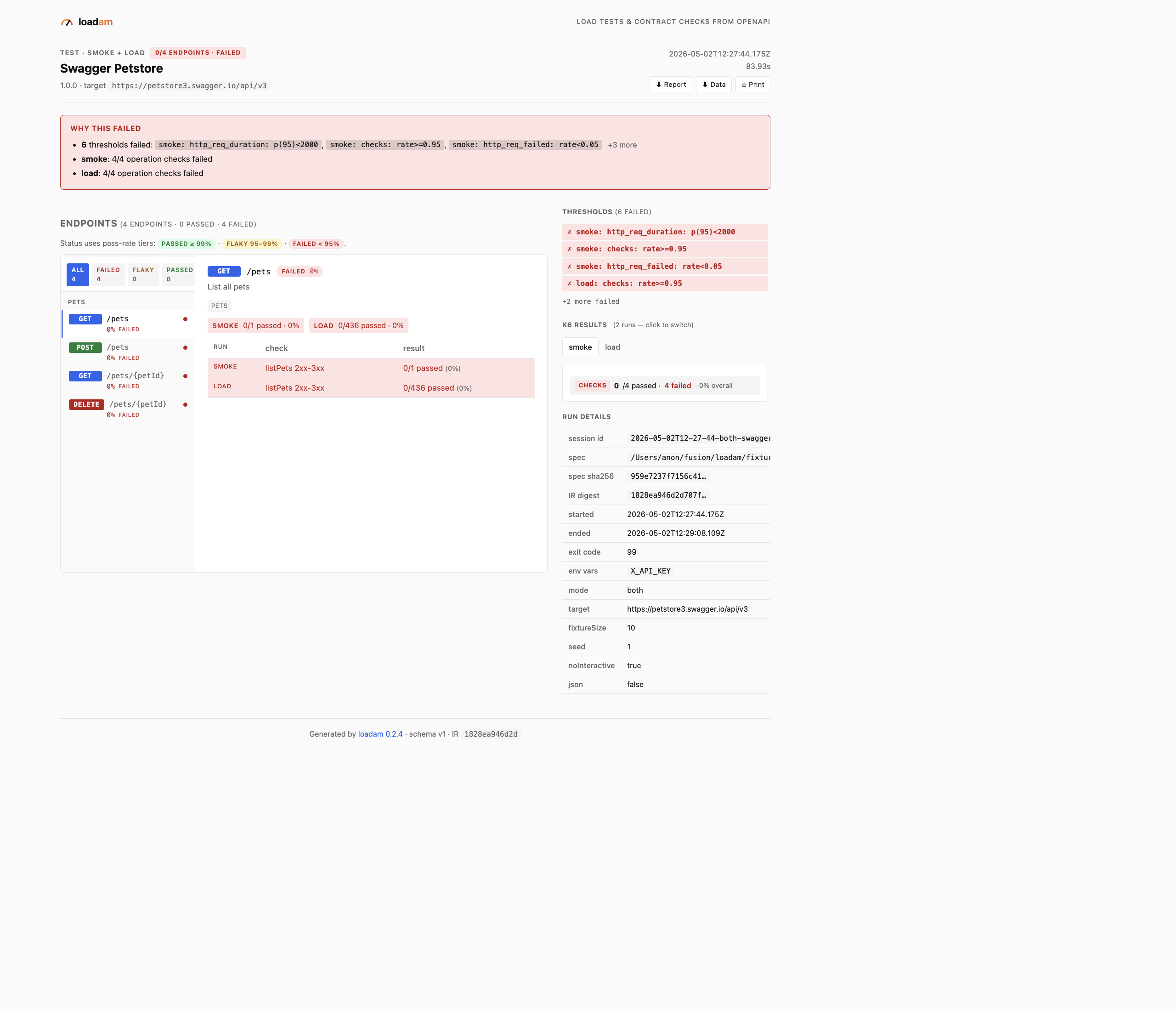
The single-file HTML report — branded header, per-endpoint sidebar, filter chips, threshold panel.
Commands
loadam init <spec> | Parse spec → IR with inferred resource graph | loadam.ir.json |
loadam test <spec> | Compile + (optionally) run k6 smoke / load; archives the session | loadam-out/k6/ + session |
loadam contract <spec> | Compile to a Schemathesis pytest project | loadam-out/contract/ + session |
loadam mcp <spec> | Compile to a runnable MCP server (stdio + HTTP) | loadam-out/mcp/ |
loadam diff <spec> | Probe a live API and report spec-vs-reality drift | Markdown + session |
loadam history | List archived sessions (newest first) | table or --json |
loadam show <id|latest> | Show a session's metadata + inline k6/drift summary | text or --json |
loadam report <id|latest> | Render a single-file HTML report (charts, threshold table) | report.html (--open to view) |
loadam clean | Prune session archive (--older-than 7d, --dry-run by default) | text or --json |
loadam auth import | Infer an auth profile from a curl command | JSON / pretty |
loadam update | Check npm for a newer version of loadam | text or --json |
loadam completion | Print bash/zsh/fish completion script | stdout |
Use --no-interactive on test to skip prompts (CI-safe), and set LOADAM_TARGET to avoid repeating --target.
What you get from loadam mcp
- A self-contained npm project (8 files, ESM JS, no build step required).
- One MCP tool per safe HTTP operation. Read-only by default; opt in with
--writes.
- stdio transport (Claude Desktop, Cursor) and Streamable HTTP transport on the same binary.
- Auth read from environment variables — secrets are never inlined into generated code.
- Path-param substitution, JSON body marshalling, response framing as MCP tool content.
// Drop into ~/Library/Application Support/Claude/claude_desktop_config.json:
{
 "mcpServers": {
  "petstore": {
   "command": "node",
   "args": ["/abs/path/to/loadam-out/mcp/bin.js"],
   "env": { "BASE_URL": "https://petstore.swagger.io/v1", "X_API_KEY": "..." },
  },
 },
}
Session archive & HTML reports
Every loadam test, loadam contract, and loadam diff invocation is archived to ./loadam-out/sessions/<id>/ with the parsed IR, the exact spec source, command flags, exit code, and any artefacts the run produced (k6 summary JSON, drift markdown, contract findings). The archive is local-only — it never leaves disk.
loadam history
loadam show latest
loadam report latest --open
loadam clean --older-than 7d --apply
The HTML report is a single self-contained file (no external CDNs, no JS dependencies) and is safe to drop into a CI artefact store, gh-pages, or Slack. It includes a per-endpoint sidebar with live p95 and status-code distribution, filter chips (All / Failed / Flaky / Passed), and a three-tier overall status (passed · flaky · failed) so you can tell at a glance whether a run is genuinely broken or just noisy.
Why loadam
Most teams have an OpenAPI spec sitting in a repo and none of the rigs that should fall out of it. They wire each one by hand, badly, and then drift. Loadam treats the spec as the source of truth and emits everything once: load, contract, drift, agent. One shape of input, four shapes of output, zero hand-rolled boilerplate.
Privacy & telemetry
Zero telemetry. No analytics, no crash reporting, no phone-home. The CLI only makes network requests when you explicitly run loadam diff --target <url>. Generated rigs talk only to whatever target you configure. See SECURITY.md for the full guarantee.
Shell completion
loadam completion bash > ~/.loadam-completion.bash && echo 'source ~/.loadam-completion.bash' >> ~/.bashrc
loadam completion zsh > "${fpath[1]}/_loadam"
loadam completion fish > ~/.config/fish/completions/loadam.fish
Project layout
packages/
  core/          IR (Zod schemas) + OpenAPI adapter
  graph/         Resource graph inference (Pet → Order → User)
  data/          Stateful faker (json-schema-faker + registry overlay)
  auth/          Profile types + curl tokenizer
  test-k6/       k6 compiler — emits smoke.js + load.js + fixtures
  test-contract/ Schemathesis compiler — emits pytest project
  test-drift/    Live probe + Markdown diff report
  mcp/           MCP compiler — emits stdio + HTTP server
  report/        Pure-function HTML report renderer (no DOM dependency)
  cli/           commander-based CLI tying it all together
Status
V1 (this) targets petstore-class specs end-to-end. Stripe-class specs (polymorphism, discriminators, recursive $refs) graduate in V1.1.
| OpenAPI 3.x | ✅ | |
| Postman / HAR / curl | curl only | Postman + HAR |
| k6 smoke + load | ✅ | |
| Schemathesis contract | ✅ | |
| Drift report | ✅ | |
| MCP server (stdio + HTTP) | ✅ read-only default | per-op --writes opt-in |
| Auth | bearer, apiKey, basic | OAuth2 PKCE, AWS sigv4, mTLS |
| Spec scale | ~10 ops | ~600 ops + polymorphism |
Examples
Development
pnpm install
pnpm -r build
pnpm -r test
Conventions:
- TypeScript strict + ESM; Node 20+; pnpm 9.15+.
- Biome for formatting (1-space indent, single quotes). Run
pnpm fix.
- Vitest for tests. Every package ships with goldens against the petstore fixture.
Documentation
License
Apache 2.0. Permissive on purpose — the value is the IR + scenario synthesis, not the runner.