

Product
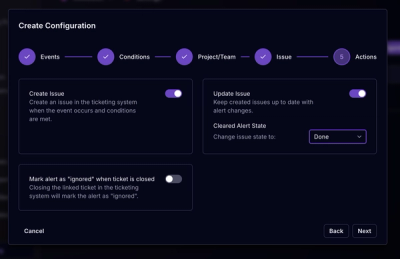
Socket for Jira Is Now Available
Socket for Jira lets teams turn alerts into Jira tickets with manual creation, automated ticketing rules, and two-way sync.
By Jeppe Hasseriis - Apr 20, 2026
mcp-data-extractor
Advanced tools
A Model Context Protocol server that extracts embedded data (such as i18n translations or key/value configurations) from TypeScript/JavaScript source code into structured JSON configuration files.
Data Extraction:
Hello, {{name}}!)SVG Extraction:
Add to your MCP Client configuration:
{
  "mcpServers": {
    "data-extractor": {
      "command": "npx",
      "args": [
        "-y",
        "mcp-data-extractor"
      ],
      "disabled": false,
      "autoApprove": [
        "extract_data",
        "extract_svg"
      ]
    }
  }
}
The server provides two tools:
Use extract_data to extract data (like i18n translations) from source files:
<use_mcp_tool>
<server_name>data-extractor</server_name>
<tool_name>extract_data</tool_name>
<arguments>
{
  "sourcePath": "src/translations.ts",
  "targetPath": "src/translations.json"
}
</arguments>
</use_mcp_tool>
Use extract_svg to extract SVG components into individual files:
<use_mcp_tool>
<server_name>data-extractor</server_name>
<tool_name>extract_svg</tool_name>
<arguments>
{
  "sourcePath": "src/components/icons/InspectionIcon.tsx",
  "targetDir": "src/assets/icons"
}
</arguments>
</use_mcp_tool>
By default, after successful extraction, the server will replace the content of the source file with:
This helps track which files have already been processed and prevents duplicate extraction. It also makes it easy for LLMs and developers to see where the extracted data now lives when they encounter the source file later.
To disable this behavior, set the DISABLE_SOURCE_REPLACEMENT environment variable to true in your MCP configuration:
{
  "mcpServers": {
    "data-extractor": {
      "command": "npx",
      "args": [
        "-y",
        "mcp-data-extractor"
      ],
      "env": {
        "DISABLE_SOURCE_REPLACEMENT": "true"
      },
      "disabled": false,
      "autoApprove": [
        "extract_data",
        "extract_svg"
      ]
    }
  }
}
The data extractor supports various patterns commonly used in TypeScript/JavaScript applications:
export default {
  welcome: "Welcome to our app",
  greeting: "Hello, {name}!",
  submit: "Submit form"
};
export default {
  header: {
    title: "Book Your Flight",
    subtitle: "Find the best deals"
  },
  footer: {
    content: [
      "Please refer to {{privacyPolicyUrl}} for details",
      "© {{year}} {{companyName}}"
    ]
  }
};
export default {
  faq: {
    heading: "Common questions",
    content: [
      {
        heading: "What if I need to change my flight?",
        content: "You can change your flight online if:",
        list: [
          "You have a flexible fare type",
          "Your flight is more than 24 hours away"
        ]
      }
    ]
  }
};
export default {
  greeting: `Hello, {{username}}!`,
  message: `Welcome to {{appName}}`
};
The extracted data is saved as a JSON file with dot notation for nested structures:
{
  "welcome": "Welcome to our app",
  "header.title": "Book Your Flight",
  "footer.content.0": "Please refer to {{privacyPolicyUrl}} for details",
  "footer.content.1": "© {{year}} {{companyName}}",
  "faq.content.0.heading": "What if I need to change my flight?"
}
SVG components are extracted into individual .svg files, with React-specific code removed. For example:
Input (React component):
const InspectionIcon: React.FC<InspectionIconProps> = ({ title }) => (
  <svg className="c-tab__icon" width="40px" id="Layer_1" data-name="Layer 1" xmlns="http://www.w3.org/2000/svg" viewBox="0 0 32 32">
    <title>{title}</title>
    <path className="cls-1" d="M18.89,12.74a3.18,3.18,0,0,1-3.24-3.11..." />
  </svg>
);
Output (InspectionIcon.svg):
<svg width="40px" id="Layer_1" data-name="Layer 1" xmlns="http://www.w3.org/2000/svg" viewBox="0 0 32 32">
    <path class="cls-1" d="M18.89,12.74a3.18,3.18,0,0,1-3.24-3.11..." />
</svg>
The extractor uses Babel to parse and traverse the AST (Abstract Syntax Tree) of your source files. You can extend the supported patterns by modifying the source code:
extractStringValue method in src/index.ts handles different types of string values. Extend it to support new node types:private extractStringValue(node: t.Node): string | null {
if (t.isStringLiteral(node)) {
return node.value;
} else if (t.isTemplateLiteral(node)) {
return node.quasis.map(quasi => quasi.value.raw).join('{{}}');
}
// Add support for new node types here
return null;
}
processValue method handles different value types (strings, arrays, objects). Extend it to support new value types or custom processing:private processValue(value: t.Node, currentPath: string[]): void {
if (t.isStringLiteral(value) || t.isTemplateLiteral(value)) {
// Process string values
} else if (t.isArrayExpression(value)) {
// Process arrays
} else if (t.isObjectExpression(value)) {
// Process objects
}
// Add support for new value types here
}
traverse(ast, {
  ExportDefaultDeclaration(path: NodePath<t.ExportDefaultDeclaration>) {
    // Handle default exports
  },
  // Add new visitors here
});
Install dependencies:
npm install
Build the server:
npm run build
For development with auto-rebuild:
npm run watch
Since MCP servers communicate over stdio, debugging can be challenging. We recommend using the MCP Inspector, which is available as a package script:
npm run inspector
The Inspector will provide a URL to access debugging tools in your browser.
This project is licensed under the MIT License - see the LICENSE file for details.
FAQs
MCP server to migrate data out of code (ts/js) into config (json)
The npm package mcp-data-extractor receives a total of 26 weekly downloads. As such, mcp-data-extractor popularity was classified as not popular.
We found that mcp-data-extractor demonstrated a not healthy version release cadence and project activity because the last version was released a year ago. It has 0 open source maintainers collaborating on the project.
Did you know?

Socket for GitHub automatically highlights issues in each pull request and monitors the health of all your open source dependencies. Discover the contents of your packages and block harmful activity before you install or update your dependencies.
Product
Socket for Jira lets teams turn alerts into Jira tickets with manual creation, automated ticketing rules, and two-way sync.
Company News
Socket won two 2026 Reppy Awards from RepVue, ranking in the top 5% of all sales orgs. AE Alexandra Lister shares what it's like to grow a sales career here.

Security News
NIST will stop enriching most CVEs under a new risk-based model, narrowing the NVD's scope as vulnerability submissions continue to surge.