


Security News
Deno 2.6 + Socket: Supply Chain Defense In Your CLI
Deno 2.6 introduces deno audit with a new --socket flag that plugs directly into Socket to bring supply chain security checks into the Deno CLI.
By Sarah Gooding - Dec 12, 2025
This repository implements a TypeScript CLI (mcpusage) that reproduces the workflow described in
Measuring Token Cost of MCP Tool Advertisements in TypeScript. It fetches every tool definition
from an MCP server, serializes the resulting “tool surface”, and measures how many tokens that block
would occupy for one or more OpenAI and Anthropic models (starting with GPT-5 / GPT-5.1 families,
Codex variants, and Claude Sonnet).
list_tools responses so the entire tool surface is counted._meta stripping).@dqbd/tiktoken (OpenAI models) and @anthropic-ai/tokenizer (Claude family) for token accounting with model-aware or custom encoding fallbacks; Anthropic API mode reports official counts and includes the local tokenizer total alongside for comparison.npm install
npm run build # compiles the CLI to dist/cli.js
Or install from npm (Node.js 20+):
# quick, no global install
npx mcpusage --help

# or install globally
npm install -g mcpusage
mcpusage --help
For rapid iteration you can run the CLI directly from TypeScript:
npm run dev -- --help
After building, invoke the binary via:
node dist/cli.js --help
# or install globally / link if desired:
npm link
mcpusage --help
mcpusage \
  --stdio npx -y @modelcontextprotocol/server-filesystem ./sample_files \
  --model gpt-5 --model gpt-5.1-codex
mcpusage \
  --url https://mcp.example.com/mcp \
  --header Authorization:"Bearer <token>" \
  --transport streamable \
  --dump-tools ./snapshots/server-a.json
mcpusage --stdio-shell "poetry run python ./scripts/server.py" --format json
--stdio <cmd...> / --stdio-shell <string>: launch a server via stdio; combine with --stdio-cwd, --stdio-env, and --stdio-echo-stderr (stdout is always silent, stderr is suppressed unless you opt in).--url <url>: connect to a remote MCP server via Streamable HTTP (default) or SSE (--transport).--model <name>: repeatable; defaults to gpt-5, gpt-5.1, gpt-5-codex, gpt-5.1-codex, and claude-sonnet-4-5-20250929. When you omit this flag the CLI shows totals only; specify one or more models to focus on and the output will include detailed per-tool breakdowns for those models.--anthropic-mode local|api plus --anthropic-key (or ANTHROPIC_API_KEY) lets you switch Claude measurements from local approximation to Anthropic’s official count_tokens endpoint so you can mirror Claude Code exactly (API mode issues one request per tool and the summary shows the local tokenizer total alongside the API count for comparison). Use --anthropic-tool-prefix <id> to optionally mirror Claude Code’s mcp__<id>__tool renaming in the request payload (defaults to the MCP server name when available).--dump-tools <file> / --print-schema: write the tool advertisement out (to a file or stdout). When paired with --format json, --print-schema embeds the schema directly in the JSON payload.--include-meta: keep _meta fragments in the snapshot (off by default to reduce noise).--format table|json: human-friendly table or machine-readable JSON output.--timeout <ms> / --max-retries <n>: fine-tune list_tools and HTTP retry behaviour.Run mcpusage --help to view the full set of switches.
To inspect Claude’s accounting without other noise, we ship a deterministic MCP server under fixtures/minimal-mcp:
cd fixtures/minimal-mcp
npm install
npm run build # optional; npm run dev works too
You can point the CLI at it:
# Local tokenizer baseline
node dist/cli.js \
  --stdio-shell "cd fixtures/minimal-mcp && node dist/server.js" \
  --model claude-sonnet-4-5-20250929 --anthropic-mode local

# Anthropic `count_tokens` (mirrors Claude Code exactly; requires API key)
ANTHROPIC_API_KEY=sk-your-key node dist/cli.js \
  --stdio-shell "cd fixtures/minimal-mcp && node dist/server.js" \
  --model claude-sonnet-4-5-20250929 --anthropic-mode api
Because the server exposes only one tool, you can register it inside Claude Code, run /context, and compare the “MCP tools” usage to these known totals. Any extra tokens Claude attributes to the tool demonstrate the constant prompt overhead being bundled into their measurements.
list_tools, following pagination until nextCursor is empty.JSON.stringify.@dqbd/tiktoken support; GPT-5.1
and Codex variants currently map to o200k_base until OpenAI publishes official tokenizers.This mirrors the PDF’s guidance for pre-computing an agent’s “tool surface” cost so you can budget prompt tokens before invoking the actual model.
--format json remains clean on stdout.FAQs
CLI for measuring MCP server tool advertisement token usage
We found that mcpusage demonstrated a healthy version release cadence and project activity because the last version was released less than a year ago. It has 1 open source maintainer collaborating on the project.
Did you know?

Socket for GitHub automatically highlights issues in each pull request and monitors the health of all your open source dependencies. Discover the contents of your packages and block harmful activity before you install or update your dependencies.
Security News
Deno 2.6 introduces deno audit with a new --socket flag that plugs directly into Socket to bring supply chain security checks into the Deno CLI.
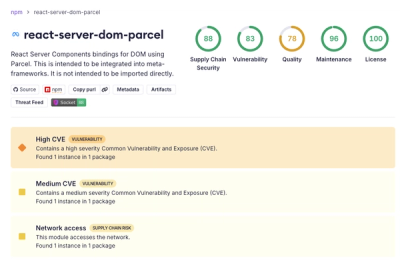
Security News
New DoS and source code exposure bugs in React Server Components and Next.js: what’s affected and how to update safely.

Security News
Socket CEO Feross Aboukhadijeh joins Software Engineering Daily to discuss modern software supply chain attacks and rising AI-driven security risks.