


Research
Malicious fezbox npm Package Steals Browser Passwords from Cookies via Innovative QR Code Steganographic Technique
A malicious package uses a QR code as steganography in an innovative technique.
By Olivia Brown - Sep 22, 2025
memlab is a framework that analyzes memory and finds memory leaks in JavaScript applications.
memlab is an end-to-end testing and analysis framework for identifying JavaScript memory leaks and optimization opportunities.
Online Resources:
Features:
Install the CLI
npm install -g memlab
To find memory leaks in Google Maps, you can create a
scenario file defining how
to interact with the Google Maps, let's name it test-google-maps.js:
// initial page load url: Google Maps
function url() {
  return 'https://www.google.com/maps/@37.386427,-122.0428214,11z';
}

// action where we want to detect memory leaks: click the Hotels button
async function action(page) {
  // puppeteer page API
  await page.click('text/Hotels');
}

// action where we want to go back to the step before: click clear search
async function back(page) {
  // puppeteer page API
  await page.click('[aria-label="Close"]');
}

module.exports = {action, back, url};
Now run memlab with the scenario file, memlab will interact with the web page and detect memory leaks with built-in leak detectors:
memlab run --scenario test-google-maps.js
memlab will print memory leak results showing one representative retainer trace for each cluster of leaked objects.
Retainer traces: This is the result from an example website, the retainer trace is an object reference chain from the GC root to a leaked object. The trace shows why and how a leaked object is still kept alive in memory. Breaking the reference chain means the leaked object will no longer be reachable from the GC root, and therefore can be garbage collected. By following the leak trace one step at a time, you will be able to find a reference that should be set to null (but it wasn't due to a bug).
MemLab found 46 leak(s)
--Similar leaks in this run: 4--
--Retained size of leaked objects: 8.3MB--
[Window] (native) @35847 [8.3MB]
  --20 (element)--->  [InternalNode] (native) @130981728 [8.3MB]
  --8 (element)--->  [InternalNode] (native) @130980288 [8.3MB]
  --1 (element)--->  [EventListener] (native) @131009888 [8.3MB]
  --1 (element)--->  [V8EventListener] (native) @224808192 [8.3MB]
  --1 (element)--->  [eventHandler] (closure) @168079 [8.3MB]
  --context (internal)--->  [<function scope>] (object) @181905 [8.3MB]
  --bigArray (variable)--->  [Array] (object) @182925 [8.3MB]
  --elements (internal)--->  [(object elements)] (array) @182929 [8.3MB]
...
To get readable trace, the web site under test needs to serve non-minified code (or at least minified code with readable variables, function name, and property names on objects).
Alternatively, you can debug the leak by loading the heap snapshot taken by memlab (saved in $(memlab get-default-work-dir)/data/cur)
in Chrome DevTool and search for the leaked object ID (@182929).
View Retainer Trace Interactively
View memory issues detected by memlab based on a single JavaScript heap snapshot taken from Chromium, Hermes, memlab, or any node.js or Electron.js program:
memlab view-heap --snapshot <PATH TO .heapsnapshot FILE>
You can optionally specify a specific heap object with the object's id: --node-id @28173 to pinpoint a specific object.
Self-defined leak detector: If you want to use a self-defined leak detector, add a leakFilter callback
(doc)
in the scenario file. filterLeak will be called for every unreleased heap
object (node) allocated by the target interaction.
function leakFilter(node, heap) {
  // ... your leak detector logic
  // return true to mark the node as a memory leak
}
heap is the graph representation of the final JavaScript heap snapshot.
For more details, view the
doc site.
View which object keeps growing in size during interaction in the previous run:
memlab analyze unbound-object
Analyze pre-fetched V8/hermes .heapsnapshot files:
memlab analyze unbound-object --snapshot-dir <DIR_OF_SNAPSHOT_FILES>
Use memlab analyze to view all built-in memory analyses.
For extension, view the doc site.
View retainer trace of a particular object:
memlab trace --node-id <HEAP_OBJECT_ID>
Use memlab help to view all CLI commands.
Use the memlab npm package to start a E2E run in browser and detect memory leaks.
const memlab = require('memlab');

const scenario = {
  // initial page load url
  url: () => 'https://www.google.com/maps/@37.386427,-122.0428214,11z',

  // action where we want to detect memory leaks
  action: async page => await page.click('text/Hotels'),

  // action where we want to go back to the step before
  back: async page => await page.click('[aria-label="Close"]'),
};
memlab.run({scenario});
memlab makes it possible to enable a unit test or running node.js program to take a heap snapshot of its own state, and write advanced memory assertions:
// save as example.test.ts
import type {IHeapSnapshot, Nullable} from '@memlab/core';
import {config, takeNodeMinimalHeap} from '@memlab/core';

class TestObject {
  public arr1 = [1, 2, 3];
  public arr2 = ['1', '2', '3'];
}

test('memory test with heap assertion', async () => {
  config.muteConsole = true; // no console output

  let obj: Nullable<TestObject> = new TestObject();
  // get a heap snapshot of the current program state
  let heap: IHeapSnapshot = await takeNodeMinimalHeap();

  // call some function that may add references to obj
  rabbitHole(obj);

  expect(heap.hasObjectWithClassName('TestObject')).toBe(true);
  obj = null;

  heap = await takeNodeMinimalHeap();
  // if rabbitHole does not have any side effect that
  // adds new references to obj, then obj can be GCed
  expect(heap.hasObjectWithClassName('TestObject')).toBe(false);
}, 30000);
For other APIs check out the API documentation.
FAQs
memlab is a framework that analyzes memory and finds memory leaks in JavaScript applications.
The npm package memlab receives a total of 100,550 weekly downloads. As such, memlab popularity was classified as popular.
We found that memlab demonstrated a healthy version release cadence and project activity because the last version was released less than a year ago. It has 2 open source maintainers collaborating on the project.
Did you know?

Socket for GitHub automatically highlights issues in each pull request and monitors the health of all your open source dependencies. Discover the contents of your packages and block harmful activity before you install or update your dependencies.
Research
A malicious package uses a QR code as steganography in an innovative technique.

Research
/Security News
Socket identified 80 fake candidates targeting engineering roles, including suspected North Korean operators, exposing the new reality of hiring as a security function.
Application Security
/Research
/Security News
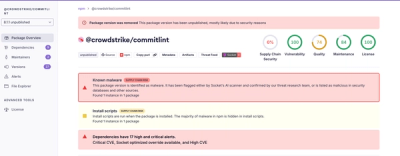
Socket detected multiple compromised CrowdStrike npm packages, continuing the "Shai-Hulud" supply chain attack that has now impacted nearly 500 packages.