


Security News
Deno 2.6 + Socket: Supply Chain Defense In Your CLI
Deno 2.6 introduces deno audit with a new --socket flag that plugs directly into Socket to bring supply chain security checks into the Deno CLI.
By Sarah Gooding - Dec 12, 2025
message-format-inline
Advanced tools
Write default messages inline. Optionally transpile translations.
Write default messages inline. Optionally transpile translations.



npm install message-format-inline --save adds the library to node_modules. You can
then use it as follows:
var format = require('message-format-inline');

var message = format('Hello { place }!', { place:'World' });
Your source code does not need to be transpiled in order to work properly, so
you can use format in server-side code, and transpile your source for better
performance in repeated use on the client.
message-format-inline relies on Intl.NumberFormat and Intl.DateTimeFormat
for formatting number, date, and time arguments. If you are in an
environment missing these (like node <= 0.12, IE < 11, or Safari) you'll
need to use a polyfill.
The ICU Message Format is a great format for user-visible strings, and includes simple placeholders, number and date placeholders, and selecting among submessages for gender and plural arguments. The format is used in apis in C++, PHP, and Java.
message-format-inline provides a way to write your default (often English) messages as literals in your source, and then scrape out the default patterns and transpile your source with fast inline code for formatting the translated message patterns.
This relies on message-format for parsing and formatting ICU messages, and recast for transpiling the source code.
See message-format for supported ICU formats.
See the ICU site and message-format for details on how to escape special characters in your messages.
message-format-inline supports plurals for all CLDR languages. Locale-aware
formatting of number, date, and time are delegated to the Intl objects,
and select is the same across all locales. You don't need to load any extra
files for particular locales for message-format-inline.
formatvar format = require('message-format-inline')
// or
import format from 'message-format-inline'
format(pattern[, args[, locales]])
Translate and format the message with the given pattern and arguments.
Parameters
pattern is a properly formatted ICU Message Format pattern. A poorly formatted pattern will cause an Error to be thrown.
translate function you provide in configuration, and is also used as the fallback if no translation is returned, or translate has not been configuredpattern is not a string literal, the function cannot be transpiled at build time.args is an object containing the values to replace placeholders with. Required if the pattern contains placeholders.locales is an optional string with a BCP 47 language tag, or an array of such strings.
translate function and indicate the desired destination language.locales is not a string literal, the function cannot be transpiled at build time.format.setupformat.setup(options)
Configure format behavior for subsequent calls. This should be called before
any code that uses format.
Parameters
options is an object containing the following config values:
cache is whether message, number, and date formatters are cached. Defaults to truelocale is the default locale to use when no locale is passed to format. Defaults to "en".translate(pattern, locales) is a function to translate messages. It should return the pattern translated for the specified locale.
pattern is the message pattern to translate.locale is a string with a BCP 47 language tag, or an array of such strings.format.number, format.date, and format.time are used internally and are
not intended for external use. Because these appear in the transpiled code,
transpiling does not remove the need to properly define format through
require or import.
The examples provide sample transpiler output. This output is not meant to be 100% exact, but to give a general idea of what the transpiler does.
format('My Collections')

// transpiles to translated literal
"Minhas Coleções"
format('Welcome, {name}!', { name:'Bob' });

// non-trivial messages transpile to self-invoking function
(function(locale, args) {
  return "Bem Vindo, " +
    args["name"] +
    "!";
})("pt-BR", { name:'Bob' });
format('You took {n,number} pictures since {d,date} {d,time}', { n:4000, d:new Date() });
// en-US: "You took 4,000 pictures since Jan 1, 2015 9:33:04 AM"

format('{ n, number, percent }', { n:0.1 });
// en-US: "10%"

format('{ shorty, date, short }', { shorty:new Date() });
// en-US: "1/1/15"
import format from 'message-format-inline'

// using a template string for multiline, no interpolation
let format(`On { date, date, short } {name} ate {
  numBananas, plural,
       =0 {no bananas}
       =1 {a banana}
       =2 {a pair of bananas}
    other {# bananas}
  } {
  gender, select,
      male {at his house.}
    female {at her house.}
     other {at their house.}
  }`, {
  date: new Date(),
  name: 'Curious George',
  gender: 'male',
  numBananas: 27
})
// en-US: "On 1/1/15 Curious George ate 27 bananas at his house."
message-format lint [options] [files...]find message patterns in files and verify there are no obvious problems
-h, --help                  output usage information
-n, --function-name [name]  find function calls with this name [format]
-k, --key-type [type]       derived key from source pattern literal|normalized|underscored|underscored_crc32 [underscored_crc32]
-t, --translations [path]   location of the JSON file with message translations, if specified, translations are also checked for errors
-f, --filename [filename]   filename to use when reading from stdin - this will be used in source-maps, errors etc [stdin]
lint the src js files, with __ as the function name used instead of format
message-format lint -n __ src/**/*.js
lint the src js files and translations
message-format lint -t i18n/pt-BR.json src/**/*.js
message-format extract [options] [files...]find and list all message patterns in files
-h, --help                  output usage information
-n, --function-name [name]  find function calls with this name [format]
-k, --key-type [type]       derived key from source pattern (literal | normalized | underscored | underscored_crc32) [underscored_crc32]
-l, --locale [locale]       BCP 47 language tags specifying the source default locale [en]
-o, --out-file [out]        write messages JSON object to this file instead of to stdout
extract patterns from src js files, dump json to stdout. This can be helpful
to get familiar with how --key-type and --locale change the json output.
message-format extract src/**/*.js
extract patterns from stdin, dump to file.
someTranspiler src/*.js | message-format extract -o locales/en.json
message-format inline [options] [files...]find and replace message pattern calls in files with translations
-h, --help                  output usage information
-n, --function-name [name]  find function calls with this name [format]
-k, --key-type [type]       derived key from source pattern (literal | normalized | underscored | underscored_crc32) [underscored_crc32]
-l, --locale [locale]       BCP 47 language tags specifying the target locale [en]
-t, --translations [path]   location of the JSON file with message translations
-i, --source-maps-inline    append sourceMappingURL comment to bottom of code
-s, --source-maps           save source map alongside the compiled code
-f, --filename [filename]   filename to use when reading from stdin - this will be used in source-maps, errors etc [stdin]
-o, --out-file [out]        compile all input files into a single file
-d, --out-dir [out]         compile an input directory of modules into an output directory
-r, --root [path]           remove root path for source filename in output directory [cwd]
create locale-specific client bundles with source maps
message-format inline src/**/*.js -s -l de -t translations.json -o dist/bundle.de.js
message-format inline src/**/*.js -s -l en -t translations.json -o dist/bundle.en.js
message-format inline src/**/*.js -s -l es -t translations.json -o dist/bundle.es.js
message-format inline src/**/*.js -s -l pt -t translations.json -o dist/bundle.pt.js
	...
inline without translating multiple files that used var __ = require('mesage-format-inline')
message-format inline -d dist -r src -n __ src/*.js lib/*.js component/**/*.js
This software is free to use under the MIT license. See the LICENSE-MIT file for license text and copyright information.
FAQs
Write default messages inline. Optionally transpile translations.
We found that message-format-inline demonstrated a not healthy version release cadence and project activity because the last version was released a year ago. It has 1 open source maintainer collaborating on the project.
Did you know?

Socket for GitHub automatically highlights issues in each pull request and monitors the health of all your open source dependencies. Discover the contents of your packages and block harmful activity before you install or update your dependencies.
Security News
Deno 2.6 introduces deno audit with a new --socket flag that plugs directly into Socket to bring supply chain security checks into the Deno CLI.
Security News
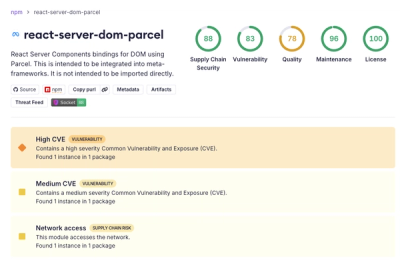
New DoS and source code exposure bugs in React Server Components and Next.js: what’s affected and how to update safely.

Security News
Socket CEO Feross Aboukhadijeh joins Software Engineering Daily to discuss modern software supply chain attacks and rising AI-driven security risks.