

Product
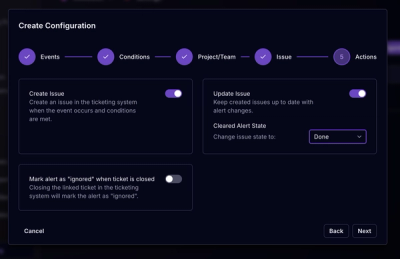
Socket for Jira Is Now Available
Socket for Jira lets teams turn alerts into Jira tickets with manual creation, automated ticketing rules, and two-way sync.
By Jeppe Hasseriis - Apr 20, 2026
node-red-contrib-lwm2m
Advanced tools



This node offers OMA LwM2M client functionalities and allows you to create your own OMA LwM2M client applications on top of Node-RED.
This node internally spawns a wakatiwaiclient process, which is a revised version of Eclipse Wakaama executable, and starts inter-process communication (IPC) over stdin and stdout. The wakatiwaiclient executable is slightly different from Wakaama's implementation, some of management objects are stripped. This node allows you to describe your own management objects as well.
When the parent process (i.e. Node-RED) exits, this node tries to emit a De-registration message to LwM2M server so that the server knows the client is gone.
This node restarts a new process when the child process exits after a given interval time passes.
CoAP over DTLS is supported but disabled by default. Users are able to enable DTLS if necessary. However, supported security mechanism is only pre-shared key(PSK). RPK and X.509 are not supported.
The supported message format is TLV rather than JSON
Security Notice:
Keep in mind that the inter-process communication over stdin/stdio is NOT encrypted and does NOT have any authentication mechanism.
lwm2m client ... a LwM2M client configuration node, having LwM2M server host, port and other connection settings as well as custom management objectslwm2m client in ... a Node-RED node emitting LwM2M server events and/or internal object query resultslwm2m client out ... a Node-RED node accepting a Write/Execute operation message from the input portAll errors are propagated to Catch-all node.
The input and output nodes show the following connection status.
lwm2m client in node with Subscribe LwM2M Object Events checkedreadwriteexecuteobservediscovercreatedeleteThe following objects are implemented in Javascript. They can be overlaid with user defined object JSON (see below).
Security ObjectServer ObjectAccess Control ObjectDevice ObjectSecurity Notice) The project depends on systeminformation package to collect system information. This package is excellent but it can expose sensitive information like serial number, device model and OS version to a LwM2M server. In order to avoid unexpected exposure to a public sandbox server, Hide sensitive device info. property is checked by default. So you need to uncheck it prior to sending entire device information from the node.
This node allows you to create new objects and overlay bundled objects (not predefined objects).
With the powerful Node-RED JSON editor, you can easily manipulate your own management objects.
† Not compatible with LwM2M JSON data format
{
    "0": {                         => Object ID (M)
        "0": {                     => Instance ID (M)
            "0": {                 => Resource ID (M)
                "type": "...",     => Resource Type (see below) (M)
                "acl": "...",      => Resource ACL (see below) (O)
                "sensitive": true, => true if the value is sensitive (O)
                "value": "..."     => Resource Value (O)
            }
        }
    }
}
Supported resource types are as follows:
STRING ... StringOPAQUE ... Buffer (byte array)INTEGER ... 64bit integerFLOAT ... doubleBOOLEAN ... boolean (STRING value 1, INTEGER value 1, and OPAQUE 1st byte 1 are all translated into true)OBJECT_LINK ... Object LinkMULTIPLE_RESOURCE ... Resource ArrayFUNCTION ... This is NOT a LwM2M Resource Type. Used for defining execute operation ResourceSTRING{
"type": "STRING",
"value": "Lorem ipsum"
}
or
"Lorem ipsum"
OPAQUE{
"type": "OPAQUE",
"value": "Lorem ipsum"
}
or
{
    "type": "OPAQUE",
    "value": "base64:TG9yZW0gaXBzdW0="
}
or
{
    "type": "OPAQUE",
    "value": "hex:4c6f72656d20697073756d"
}
or
{
    "type": "OPAQUE",
    "value": [76,111,114,101,109,32,105,112,115,117,109]
}
or
{
    "type": "OPAQUE",
    "value": {
        "type": "Buffer",
        "data": [76,111,114,101,109,32,105,112,115,117,109]
    }
}
INTEGER{
"type": "INTEGER",
"value": 1234567890
}
or
1234567890
"value" property value is assumed as an empty packet by default when the property is missing.FLOAT{
"type": "FLOAT",
"value": 987654.321
}
or
987654.321
"value" property value is assumed as an empty packet by default when the property is missing.BOOLEAN{
"type": "BOOLEAN",
"value": false
}
or
true
"value" property value is assumed as an empty packet by default when the property is missing.OBJECT_LINK{
"type": "OBJECT_LINK",
"value": {
"objectId": 999,
"objectInstanceId": 0
}
}
MULTIPLE_RESOURCEThe type is a collection having Resource Instance ID and Resource value pairs.
{
    "type": "MULTIPLE_RESOURCE",
    "value": {
        "100": 999,
        "101": true,
        "999": {
            "type": "FLOAT",
            "value": 987654.321
        }
    }
}
If the Resource Instance ID starts with "0" and its following IDs are 1,2,3... (increases by 1), you can provide a JSON Array like this.
{
    "type": "MULTIPLE_RESOURCE",
    "value": [
        123,
        false,
        {
            "type": "FLOAT",
            "value": 1234.567
        }
    ]
}
This is equivalent to:
{
    "type": "MULTIPLE_RESOURCE",
    "value": {
        "0": 123,
        "1": false,
        "2": {
            "type": "FLOAT",
            "value": 1234.567
        }
    }
}
FUNCTIONThis type is out of OMA LwM2M specification scope. Used for defining an executable resource data. value property is always ignored and acl is always assumed as E(other values are silently ignored).
{
    "type": "FUNCTION"
}
ACL characters and allowed operations are shown below.
R ... Read, Observe, Discover, Write-AttributesW ... WriteE ... ExecuteD ... DeleteC ... CreateNote that LwM2M Bootstrap server will try to remove all predefined objects during bootstrapping process. Set ACL properly if you'd like to preserve your objects.
You can add your own systemwide custom objects by describing them in your settings.js or RED.settings objects.
You can also add your own object definition to objectDefinitions property.
With objectDefinitions property, you can provide a collection of a template resource object, which will be copied to a new resource object when creating it.
Here's an example for providing the predefined manufacturer name.
settings.js
{
    lwm2m: {
        objects : {
            '3': {
                '0': {
                    '0': 'ACME Corporation'
                }
            }
        },
        objectDefinitions: {
            '123456': {
                '0': 'My String',
                '1': 9876
            }
        }
    }
}
You can choose the way to handle an empty string/null resource value by describing them in your settings.js or RED.settings objects.
'') and transmitted it to LwM2M server as an empty byte array (0-size packet). This is default. Set '' to emptyValue property or omit the property.0 for INTEGER and FLOAT types and false for BOOLEAN type. Set auto to emptyValue property.Here's an example for providing the predefined manufacturer name.
settings.js
{
    lwm2m: {
        emptyValue: 'auto'
    }
}
The Block1 Transfer works only for downlink communication, e.g. Write operation from a LwM2M server.
The Block1 Transfer parameters used in the underlying lwm2m client are as follows.
The both values are larger than Wakaama's default ones but they offer more efficient data transfer on non-narrow network with a linux single board computer.
Relating this function, the entire receivable packet size at once is increased as well.
The value is user-configurable but it's usually not necessary to do so unless a LwM2M server sends larger size of CoAP headers than expected.
You can enable Observe, Read and Write command debug log (stdout or /var/log/syslog) by setting logging level to debug at logging.console.logging in settings.js. For CANDY RED users, modify CANDY_RED_LOG_LEVEL in $(npm -g root)/services/systemd/environment file.
The example output is shown below.
Jul 24 03:13:38 raspberrypi start_systemd.sh[8524]: 24 Jul 03:13:38 - [debug] [lwm2m client:67a2f34a.15b424] [Observe] # of updated uris:3
Jul 24 03:13:38 raspberrypi start_systemd.sh[8524]: 24 Jul 03:13:38 - [debug] [lwm2m client:67a2f34a.15b424] <Read> uris=>^/3304/0/5700$, response=>[{"uri":"/3304/0/5700","value":{"type":"FLOAT","acl":"R","value":45.97}}]
Jul 24 03:13:38 raspberrypi start_systemd.sh[8524]: 24 Jul 03:13:38 - [debug] [lwm2m client:67a2f34a.15b424] <Read> uris=>^/3303/0/5700$, response=>[{"uri":"/3303/0/5700","value":{"type":"FLOAT","acl":"R","value":38.67}}]
With a new option Dump LwM2M messages, message hex dump is now available.
All messages between client and server are displayed in console (not the debug tab) as shown below when Dump LwM2M messages is checked.
Sending 51 bytes to [127.0.0.1]:5684
17 FE FD 00  01 00 00 00  00 00 10 00  26 00 01 00   ............&...
00 00 00 00  10 5C 30 F4  0D 78 00 25  1D 5D D5 AD   .....\0..x.%.]..
E8 64 32 F9  F0 7B A4 61  3A 15 AE C9  9B 2F CA 1C   .d2..{.a:..../..
D9 F4 3F                                             ..?

37 bytes received from [127.0.0.1]:5684
17 FE FD 00  01 00 00 00  00 00 10 00  18 00 01 00   ................
00 00 00 00  10 AC 42 8B  93 D2 E1 4E  40 6B F8 7F   ......B....N@k..
76 E5 AA 9E  85                                      v....
The lwm2m server is able to modify this client's lifetime with Write command to Lifetime resource in Server Object.
When the client detects the lifetime change, the interval between the registration update requests is updated as well at the coming registration update request. The client appends the lifetime query (lt=<new lifetime>) in the registration update request in order to notify the latest lifetime to the server.
This node offers extra features for embedded mode, which allows the host application to interact with this node via EventEmitter object named internalEventBus defined in RED.settings object.
However, this feature is disabled by default (opt-in). In order to enable it, ask users to check Allow internal event propagation property in lwm2m config node.
Pseudo code:
const EventEmitter = require('events').EventEmitter;
const RED = ...;
const server = ...;

const bus = new EventEmitter();
bus.on('object-event', (ev) => {
    // You can receive LwM2M object events here
    if (ev.eventType === 'updated') {
        ...
    }
});
// Create the settings object - see default settings.js file for other options
const settings = {
    ...
    lwm2m: {
        internalEventBus: bus, // set your own EventEmitter object
        objects : {
            '3': {
                '0': {
                    '0': "ACME Corporation"
                }
            },
            '99999': {
                '0': {
                    '0': 'ABCD'
                }
            }
        }
    },
    ...
};

RED.init(server, settings);
...

bus.emit('object-read', { id: '022eb56240784b43', topic: '/3/0/0' }); // 'Read' operation for retrieving Manufacturer
// Use a one-time listener (once)
bus.once('object-read-022eb56240784b43', (msg) => {
    if (/* boolean */ msg.error) {
        console.error(msg.payload); // error info
    } else {
        let man = msg.payload[0].value; // '/3/0/0' resource object
        ...
    }
});
This node should work on Unix and Linux OS. Windows is not supported.
Node.js v10/12
The prebuilt binaries are available for the following OS and architectures:
Other users need to install the following software manually:
Use Manage palette menu to install this node.
Or run the following commands in a terminal:
cd ~/.node-red
npm install --production node-red-contrib-lwm2m
Then restart Node-RED process.
Use Manage palette menu to install this node.
Or run the following commands in a terminal:
cd /opt/candy-red/.node-red
sudo npm install --unsafe-perm --production node-red-contrib-lwm2m
Then restart candy-red service.
sudo systemctl restart candy-red
You can import example flows available under examples folder on Node-RED UI.
Install dependencies.
$ npm install
Then run the following commands to build source code.
# make configure  # Configure the build
$ make debugbuild # Build for Debug
$ make build      # Build for Release

$ make debug      # Rebuild for Debug
$ make verbose    # Rebuild with verbose logs for Release
In order to build JS code, run the following commands.
$ npm run build
With Wakaama LwM2M Server, you can test this node on your localhost. The instruction for building the executable file is described here.
localhost5683 (DTLS is NOT supported)Run the following command to start LwM2M Server to accept localhost address.
lwm2mserver -4
Enter help on the lwm2mserver console for supported commands.
Provide the following host and port for your lwm2m client config node to connect to Public Leshan Server.
leshan.eclipseprojects.io5683 for plain UDP or 5684 for DTLS with checking Enable DTLSYou can manage your client info from the following URL.
https://leshan.eclipseprojects.io/#/clients
For Bootstrapping:
leshan.eclipseprojects.io5783 for plain UDP or 5784 for DTLS with checking Enable DTLSYou can create your bootstrapping info from the following URL.
https://leshan.eclipseprojects.io/bs/
Copyright (c) 2019 CANDY LINE INC.
Licensed under the Apache License, Version 2.0 (the "License"); you may not use this file except in compliance with the License. You may obtain a copy of the License at
http://www.apache.org/licenses/LICENSE-2.0
Unless required by applicable law or agreed to in writing, software distributed under the License is distributed on an "AS IS" BASIS, WITHOUT WARRANTIES OR CONDITIONS OF ANY KIND, either express or implied. See the License for the specific language governing permissions and limitations under the License.
npm run testnpm publishgit checkout mastergit commit --allow-empty -m "[publish binary]"export NODE_PRE_GYP_GITHUB_TOKEN=... && make clean && make configure && make && make package && make publishFAQs
Node-RED nodes for OMA LwM2M
We found that node-red-contrib-lwm2m demonstrated a not healthy version release cadence and project activity because the last version was released a year ago. It has 1 open source maintainer collaborating on the project.
Did you know?

Socket for GitHub automatically highlights issues in each pull request and monitors the health of all your open source dependencies. Discover the contents of your packages and block harmful activity before you install or update your dependencies.
Product
Socket for Jira lets teams turn alerts into Jira tickets with manual creation, automated ticketing rules, and two-way sync.
Company News
Socket won two 2026 Reppy Awards from RepVue, ranking in the top 5% of all sales orgs. AE Alexandra Lister shares what it's like to grow a sales career here.

Security News
NIST will stop enriching most CVEs under a new risk-based model, narrowing the NVD's scope as vulnerability submissions continue to surge.