node-resquebus


Acknowledgments
What?
ResqueBus is a plugin for Resque (we use node-resque for this project) which transforms Resque into a distributed message bus. This allows more than one application to share workloads on the bus, and for events/jobs to fan out to more than one application. Perhaps you want the user_created event to be consumed by the analytics and email applications... then ResqueBus is for you.
This application is a port of the main ruby project to node.js. This project is likley to be behind the Ruby project. However, this package aims to be 100% compatible with the Ruby version, and can fill a driver, worker, or scheduler role within that same ecosystm (more information below).
Ecosystem
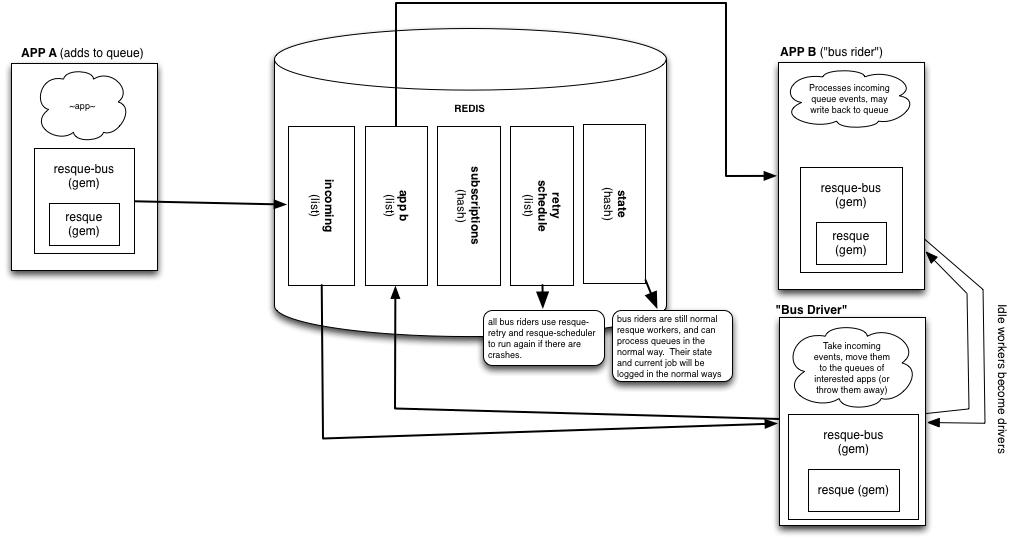
There are a few roles which are required to use the resquebus:
- Publisher
- Driver
- Scheduler
- Worker
The publishing application sends an event (bus.publish()). This event is entered into an incomming resque queue. The Driver then inspects subscriptions and sends the event over to queues for application which have registered interest in the event. Then, finally, workers for those events consume the jobs in a normal resque way. You can also delay a publication bus.publishAt(), and in that case, a Scheduler is required to coordinate. To learn more about the worker, visit the node-resque project.
Subscribing and Publishing.
We use the 'bus' object to both subscribe and publish events. It should be passed your connectionDetails and optionally jobs
var BusPrototype = require("node-resquebus").bus;
var bus = new BusPrototype({connection: connectionDetails}, jobs, function(){
var appKey = 'exampleApp';
var priority = 'default';
var job = 'remoteEventAdd'
var matcher = { bus_event_type : /^.*add.*/ }
bus.subscribe(appKey, priority, job, matcher, function(error, bus_queue){
});
});
Once your bus is connected, you can publish events. You must always define 'bus_event_type' and then an optional hash of data:
bus.publish('add', {
    a: 5,
    b: 10,
  });

bus.publishIn(1000, 'subtract', {
  a: 10,
  b: 5,
});

bus.publishAt((new Date.getTime() + 1000), 'multiply', {
  a: 10,
  b: 5,
});
Methods:
bus.subscriptions(callback(error, subsciptions, count))bus.subscribe(callback(appKey, priority, job, matcher, callback(error, queue_name)))bus.unsubscribe(callback(appKey, priority, job, callback))bus.unsubscribeAdd(callback(appKey, callback))bus.publish(bus_event_type, args, callback(error, toRun))bus.publishAt(timestamp, bus_event_type, args, callback(error, toRun))bus.publishIn(delay, bus_event_type, args, callback(error, toRun))
Keep in mind that if you use publishAt or publishIn, you will need to have a Scheduler running in your ecosystem.
Matching and Special Keys
You can use a single string { bus_event_type: 'add' } or regex { bus_event_type : /^.*add.*/ } to match events in your subscription. There are also special keys you can use:
bus_special_value_key (key is not null)bus_special_value_blank (key exists but is blank (''))bus_special_value_empty (key is null)bus_special_value_nil (key is undefined)bus_special_value_value (key is not null)bus_special_value_present (key is not null and has a length > 0)
For example, a matcher like { first_name: 'bus_special_value_present' } would match all events where the field 'first_name' is present.
Subsciption Notes
- Be sure to subscribe before you start working.
- Subscribing returns
error and worker_queue to the callback. You can then use worker_queue to tell your worker what queues to work.
- When subscribing,
appKey will always be lowercased, and all spaces will be replaced with "_"
- You can subscribe any number of times with no adverse effects. Feel free to do it from every server at boot.
- All times should be in JS micoseconds (unix timestamp * 1000). This project will convert them to unix timesamps to match Ruby when needed.
Driver
Running a driver will take items from the incomming queue and fan them out to registered applications. The driver inherits from a node-resque worker, and opperates the same way:
var driver = new DriverPrototype({connection: connectionDetails}, jobs, function(){
driver.workerCleanup();
driver.start();
});
You can optionally configure some additional options:
options = {
  looping: true,
  timeout: 5000,
  name:    os.hostname() + ":" + process.pid
}
Driver Notes
- Unlike the ruby driver, the node driver will cache the subscriptions for a few seconds. This if configurable.
- When using a regexp matcher, we will attempt to convert JS's RegExp to a ruby regular expression. This conversion is less than perfect, and there are liley to be problems with more complex matchers. Please let us know if you find something wrong and open a GitHub issue.
Data
When an event is passed though the entire bus, metadata is added by both the publisher and the driver. You can overwrite any of these fields in your attributes hash. A simple event like bus.publish('add', {a: 5, b: 10}) will yeild:
{
   "class":"remoteEventSubtract",
   "queue":"exampleapp_default",
   "args":{
      "bus_driven_at":1392251619,
      "bus_rider_queue":"exampleapp_default",
      "bus_rider_app_key":"exampleapp",
      "bus_rider_sub_key":"exampleapp_default_remoteEventSubtract",
      "bus_rider_class_name":"remoteEventSubtract",
      "bus_event_type":"subtract",
      "bus_created_at":1392251614,
      "bus_published_at":1392251614,
      "bus_id":"1392251614-6a3d3a00-9cde-4877-9e53-9c580a0caa07",
      "bus_app_hostname":"OpsimusPrime.local",
      "a":5,
      "b":10
   }
}
Full Example
var BusPrototype = require("node-resquebus").bus;
var DriverPrototype = require("node-resquebus").driver;
var SchedulerPrototype = require("node-resque").scheduler;
var WorkerPrototype = require("node-resque").worker;
var connectionDetails = {
package: "redis",
host: "127.0.0.1",
password: "",
port: 6379,
database: 0,
}
var jobs = {
"remoteEventAdd": {
perform: function(payload, callback){
var answer = payload.a + payload.b;
callback(null, answer);
jobsToComplete--;
shutdown();
},
},
"remoteEventSubtract": {
perform: function(payload, callback){
var answer = payload.a - payload.b;
callback(null, answer);
jobsToComplete--;
shutdown();
},
},
};
var scheduler = new SchedulerPrototype({connection: connectionDetails}, function(){
scheduler.start();
});
var driver = new DriverPrototype({connection: connectionDetails}, jobs, function(){
driver.workerCleanup();
driver.start();
});
var bus = new BusPrototype({connection: connectionDetails}, jobs, function(){
var appKey = 'exampleApp';
var priority = 'default';
var bus_queue = 'exampleapp_default';
bus.subscribe(appKey, priority, 'remoteEventAdd', { bus_event_type : /^.*add.*/ } )
bus.subscribe(appKey, priority, 'remoteEventSubtract', { bus_event_type : /^.*subtract.*/ })
worker = new WorkerPrototype({connection: connectionDetails, queues: [bus_queue]}, jobs, function(){
worker.workerCleanup();
worker.start();
});
driver.on('start', function(){ console.log("driver started"); })
driver.on('end', function(){ console.log("driver ended"); })
driver.on('cleaning_worker', function(worker, pid){ console.log("cleaning old driver " + worker); })
driver.on('poll', function(queue){ console.log("driver polling " + queue); })
driver.on('job', function(queue, job){ console.log("working job " + queue + " " + JSON.stringify(job)); })
driver.on('reEnqueue', function(queue, job, plugin){ console.log("reEnqueue job (" + plugin + ") " + queue + " " + JSON.stringify(job)); })
driver.on('success', function(queue, job, result){ console.log("job success " + queue + " " + JSON.stringify(job) + " >> " + result); })
driver.on('error', function(queue, job, error){ console.log("job failed " + queue + " " + JSON.stringify(job) + " >> " + error); })
driver.on('pause', function(){ console.log("driver paused"); })
worker.on('start', function(){ console.log("worker started"); })
worker.on('end', function(){ console.log("worker ended"); })
worker.on('cleaning_worker', function(worker, pid){ console.log("cleaning old worker " + worker); })
worker.on('poll', function(queue){ console.log("worker polling " + queue); })
worker.on('job', function(queue, job){ console.log("working job " + queue + " " + JSON.stringify(job)); })
worker.on('reEnqueue', function(queue, job, plugin){ console.log("reEnqueue job (" + plugin + ") " + queue + " " + JSON.stringify(job)); })
worker.on('success', function(queue, job, result){ console.log("job success " + queue + " " + JSON.stringify(job) + " >> " + result); })
worker.on('error', function(queue, job, error){ console.log("job failed " + queue + " " + JSON.stringify(job) + " >> " + error); })
worker.on('pause', function(){ console.log("worker paused"); })
scheduler.on('start', function(){ console.log("scheduler started"); })
scheduler.on('end', function(){ console.log("scheduler ended"); })
scheduler.on('poll', function(){ console.log("scheduler polling"); })
scheduler.on('working_timestamp', function(timestamp){ console.log("scheduler working timestamp " + timestamp); })
scheduler.on('transferred_job', function(timestamp, job){ console.log("scheduler enquing job " + timestamp + " >> " + JSON.stringify(job)); })
bus.publish('add', {
a: 5,
b: 10,
});
bus.publishAt(1000, 'subtract', {
a: 10,
b: 5,
});
});
var jobsToComplete = 2;
var shutdown = function(){
if(jobsToComplete === 0){
setTimeout(function(){
scheduler.end(function(){
worker.end(function(){
driver.end(function(){
process.exit();
});
});
});
}, 500);
}
}





