nodesaga
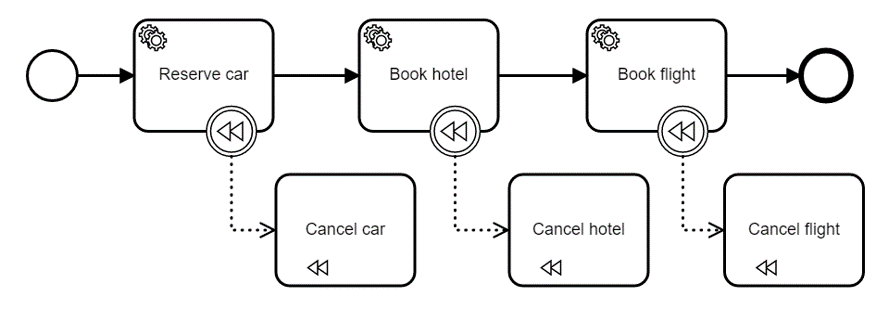
Saga implementation in Node.JS. It's done to prevent overhead for long transaction processes and call functions of constious microservices related to it depending on each other in a queue execution and run fallbacks if one of them is unsuccessful.
You can define your custom transaction and their respective fallbacks.
Please read below carefully. For better understanding you can reach me out.
Thanks!
HOW TO INSTALL
npm install nodesaga --save
HOW TO USE
import { Saga } from "nodesaga";
const task1 = function(a, b, c, callback){
if(true){
return callback(null, "Task one executed successfully.");
}else{
return callback(new Error("Task one could not be executed successfully."), null);
}
}
const task2 = function(a, b, c, callback){
if(true){
return callback(null, "Task two executed successfully.");
}else{
return callback(new Error("Task two could not be executed successfully."), null);
}
}
const task3 = function(a, b, c, callback){
if(false){
return callback(null, "Task three executed successfully.");
}else{
return callback(new Error("Task three could not be executed successfully."), null);
}
}
const fallback1 = function(a, b, c){
console.log("Fallback one called");
}
const fallback2 = function(a, b, c){
console.log("Fallback two called");
}
const fallback3 = function(a, b, c){
console.log("Fallback three called");
}
const saga = new Saga();
saga.StartTransaction([
{task : task1, fallback : fallback1, args : {task : ['a', 'b', 'c'], fallback : ['d', 'e', 'f']}},
{task : task2, fallback : fallback2, args : {task : ['g', 'h', 'i'], fallback : ['j', 'k', 'l']}},
{task : task3, fallback : fallback3, args : {task : ['g', 'h', 'i'], fallback : ['j', 'k', 'l']}}
], function(err, done){
if(err){
console.log("Err is : ", err);
}else{
console.log("Message is : ", done);
}
});
{task : task1, fallback : fallback1, args : {task : ['a', 'b', 'c'], fallback : ['d', 'e', 'f']}}
args : {
task : ['a', 'b', 'c'],
fallback : ['d', 'e', 'f']
}
task1 is the service function, fallback1 is it's fallback service function
const task1 = function(a, b, c, callback){
if(true){
return callback(null, "Task one executed successfully.");
}else{
return callback(new Error("Task one could not be executed successfully."), null);
}
}
const fallback1 = function(a, b, c){
console.log("Fallback one called");
}
While writing the tasks last argument must be a callback with err as first argument and message or data as second argument as per Node.JS convention, in fallback functions I have not implemented callback because it's not needed.
Here we can give a transaction in form of pipelines. All will run one after another :)
Here in the above figure the transaction has tasks and their specific fallbacks.
It's all maintained by a central system. If all goes "yes" the whole transaction is successfull. If anyone of the inbetween task or pipeline fails all the previous fallbacks are called and data get's reverted as if nothing happened.





