Research
/Security News
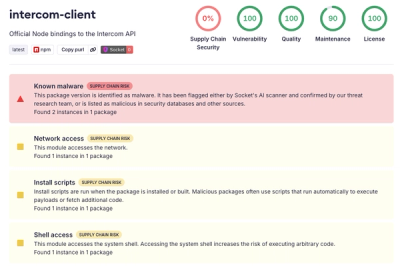
Intercom’s npm Package Compromised in Ongoing Mini Shai-Hulud Worm Attack
Compromised intercom-client@7.0.4 npm package is tied to the ongoing Mini Shai-Hulud worm attack targeting developer and CI/CD secrets.
Node Package Editor: a CLI for one-off inspection and editing of properties in package.json files.

Node Package Editor: a CLI for one-off inspection and editing of properties in package.json files.
See also dot-json, a CLI for editing any JSON file.
npm install npe --global
cd some/node/project
# Get stuff from package.json
npe name
npe scripts
npe scripts.test
npe repository.url
open $(npe repository.url)
# Set stuff in package.json
npe name foo
npe scripts.start "node index.js"
# Keywords string will be turned into an array
# If commas are present, they'll be the delimiter. Otherwise spaces.
npe keywords "foo, bar, cheese whiz"
npe keywords "foo bar baz"
# The current working directory's package.json is used by default,
# but you can point to another package file with a flag:
npe name --package=some/other/package.json
npe name other --package=some/other/package.json
MIT
FAQs
Node Package Editor: a CLI for one-off inspection and editing of properties in package.json files.
The npm package npe receives a total of 2,408 weekly downloads. As such, npe popularity was classified as popular.
We found that npe demonstrated a not healthy version release cadence and project activity because the last version was released a year ago. It has 1 open source maintainer collaborating on the project.
Did you know?

Socket for GitHub automatically highlights issues in each pull request and monitors the health of all your open source dependencies. Discover the contents of your packages and block harmful activity before you install or update your dependencies.

Research
/Security News
Compromised intercom-client@7.0.4 npm package is tied to the ongoing Mini Shai-Hulud worm attack targeting developer and CI/CD secrets.

Research
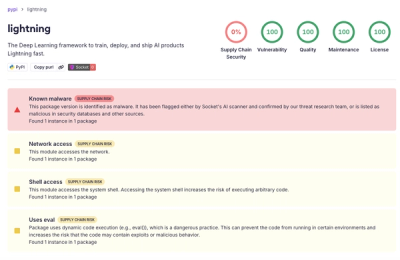
Socket detected a malicious supply chain attack on PyPI package lightning versions 2.6.2 and 2.6.3, which execute credential-stealing malware on import.

Research
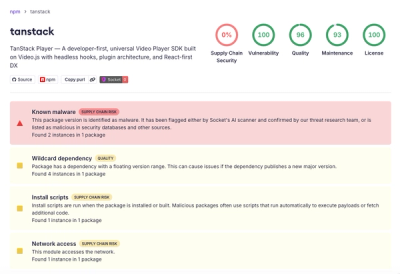
A brand-squatted TanStack npm package used postinstall scripts to steal .env files and exfiltrate developer secrets to an attacker-controlled endpoint.