


Research
PyPI Package Impersonates SymPy to Deliver Cryptomining Malware
Malicious PyPI package sympy-dev targets SymPy users, a Python symbolic math library with 85 million monthly downloads.
By Kirill Boychenko - Jan 21, 2026
Parse Server-Sent Events (SSE) from a Response
A lightweight, spec-compliant parser for Server-Sent Events that works with the native Fetch API. Returns a standard ReadableStream for maximum composability.
Perfect for consuming streaming APIs from OpenAI, Anthropic, and other services.
npm install parse-sse
import {parseServerSentEvents} from 'parse-sse';

const response = await fetch('https://api.example.com/events');

for await (const event of parseServerSentEvents(response)) {
	console.log(event.type);        // Event type (default: 'message')
	console.log(event.data);        // Event data
	console.log(event.lastEventId); // Last event ID (always present as string)
	console.log(event.retry);       // Retry interval in ms (if specified)
}
import {parseServerSentEvents} from 'parse-sse';
import ky from 'ky';

const response = await ky('https://api.example.com/events');

for await (const event of parseServerSentEvents(response)) {
	const data = JSON.parse(event.data);
	console.log(data);
}
import {parseServerSentEvents} from 'parse-sse';

const response = await fetch('https://api.openai.com/v1/chat/completions', {
	method: 'POST',
	headers: {
		'Content-Type': 'application/json',
		'Authorization': `Bearer ${apiKey}`,
	},
	body: JSON.stringify({
		model: 'gpt-4',
		messages: [{role: 'user', content: 'Hello!'}],
		stream: true,
	}),
});

for await (const event of parseServerSentEvents(response)) {
	if (event.data === '[DONE]') {
		break;
	}

	const data = JSON.parse(event.data);
	console.log(data.choices[0]?.delta?.content);
}
import {parseServerSentEvents} from 'parse-sse';

const response = await fetch('https://api.example.com/events');

for await (const event of parseServerSentEvents(response)) {
	switch (event.type) {
		case 'update':
			console.log('Update:', event.data);
			break;
		case 'complete':
			console.log('Complete:', event.data);
			break;
		case 'error':
			console.error('Error:', event.data);
			break;
		default:
			console.log('Message:', event.data);
	}
}
Since parseServerSentEvents() returns a standard ReadableStream, you can use all stream methods:
import {parseServerSentEvents} from 'parse-sse';

const response = await fetch('https://api.example.com/events');
const eventStream = parseServerSentEvents(response);

// Tee the stream to consume it twice
const [stream1, stream2] = eventStream.tee();

// Process both streams in parallel
await Promise.all([
	(async () => {
		for await (const event of stream1) {
			console.log('Stream 1:', event.data);
		}
	})(),
	(async () => {
		for await (const event of stream2) {
			console.log('Stream 2:', event.data);
		}
	})(),
]);
For advanced use cases, you can use ServerSentEventTransformStream directly for custom stream pipelines:
import {ServerSentEventTransformStream} from 'parse-sse';

// Custom pipeline
myTextStream
	.pipeThrough(new ServerSentEventTransformStream())
	.pipeTo(myWritableStream);
import {ServerSentEventTransformStream} from 'parse-sse';

// With custom decoder
response.body
	.pipeThrough(new MyCustomDecoderStream())
	.pipeThrough(new ServerSentEventTransformStream());
import {ServerSentEventTransformStream} from 'parse-sse';

// Filter events in a pipeline
fetch(url)
	.then(r => r.body)
	.pipeThrough(new TextDecoderStream())
	.pipeThrough(new ServerSentEventTransformStream())
	.pipeThrough(new TransformStream({
		transform(event, controller) {
			if (event.type === 'update') {
				controller.enqueue(event);
			}
		}
	}));
Parse a Server-Sent Events (SSE) stream from a Response object.
Returns a ReadableStream that yields parsed events as they arrive. The stream can be consumed using async iteration (for await...of) or stream methods like .pipeTo(), .pipeThrough(), and .tee().
Type: Response
A Response object with a text/event-stream body.
Type: ReadableStream<ServerSentEvent>
A stream of parsed events that can be consumed using async iteration or standard stream methods.
TransformStream that parses Server-Sent Events.
Use this for advanced stream composition or when you have a text stream that's already decoded.
Important: This expects string chunks as input. If you have a byte stream, pipe it through TextDecoderStream first.
import {ServerSentEventTransformStream} from 'parse-sse';

// Correct - with TextDecoderStream for bytes
response.body
	.pipeThrough(new TextDecoderStream())
	.pipeThrough(new ServerSentEventTransformStream());

// Correct - if you already have text chunks
myTextStream
	.pipeThrough(new ServerSentEventTransformStream());
Type: string
Text chunks (already decoded from bytes). If you pass byte chunks, a TypeError will be thrown.
Type: ServerSentEvent
Parsed SSE events.
A parsed Server-Sent Event.
Type: object
Type: string
Default: 'message'
The event type.
Type: string
The event data.
Multiple data: fields are joined with newlines.
Type: string
The last event ID in the stream.
This is connection-scoped state that persists across events. When an event includes an id: field, this value is updated and persists for all subsequent events until changed again.
Always present as a string (empty string if no ID has been set). Matches browser MessageEvent.lastEventId behavior.
Used for reconnection with Last-Event-ID header.
Type: number | undefined
The retry interval in milliseconds, if specified.
Indicates how long to wait before reconnecting.
EventSource?The browser's built-in EventSource API has several limitations:
Authorization)fetch implementationsThis package works with any Response object, giving you full control over the request.
Most SSE parsers either:
This package focuses on doing one thing well: parsing SSE from a standard Response object using web platform standards (ReadableStream, TransformStream).
Yes! Any HTTP client that returns a standard Response object will work:
// With Ky
import ky from 'ky';

const response = await ky(url);

// With native fetch
const response = await fetch(url);

// Both work the same way
for await (const event of parseServerSentEvents(response)) {
	console.log(event.data);
}
FAQs
Parse Server-Sent Events (SSE) from a Response
We found that parse-sse demonstrated a healthy version release cadence and project activity because the last version was released less than a year ago. It has 1 open source maintainer collaborating on the project.
Did you know?

Socket for GitHub automatically highlights issues in each pull request and monitors the health of all your open source dependencies. Discover the contents of your packages and block harmful activity before you install or update your dependencies.
Research
Malicious PyPI package sympy-dev targets SymPy users, a Python symbolic math library with 85 million monthly downloads.

Security News
Node.js 25.4.0 makes require(esm) stable, formalizing CommonJS and ESM compatibility across supported Node versions.
Product
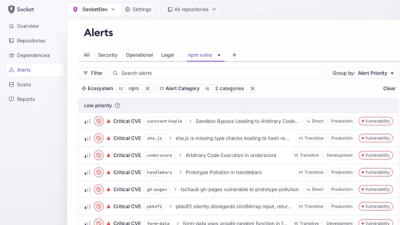
Create and share saved alert views with custom tabs on the org alerts page, making it easier for teams to return to consistent, named filter sets.