

Product
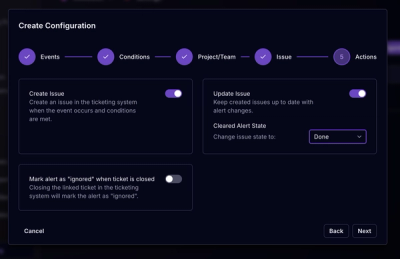
Socket for Jira Is Now Available
Socket for Jira lets teams turn alerts into Jira tickets with manual creation, automated ticketing rules, and two-way sync.
By Jeppe Hasseriis - Apr 20, 2026
persistent-cache
Advanced tools
A simple Node module to persistently store/cache arbitrary data.
Just run
npm install persistent-cache
add the --save option to add persistent-cache to the dependencies in your package.json
var cache = require('persistent-cache');

var cats = cache();
cats is now a cache with the default options, meaning it is a persistent
cache utilizing memory caching for performance, it has the name cache, caches
data forever and is located in the cache-directory of the current main module.
For all available options, see the bottom of this page.
An empty cache of cats is kind of sad. Let's bring some life to it.
//Asynchronous
cats.put('Cindy', {color: 'red'}, someCallback);

//Synchronous
cats.putSync('babies', ['Ron', 'Emily']);
Now our cats-cache has an entry Cindy containing an object {color: 'red'} and an entry babies containing an array of some names (strings).
cache.put(key, data, cb) will store any arbitrary data in the cache under the provided key and call the provided callback when done (passing err as the first argument, following node convention). cache.putSync(key, data) is the synchronous counterpart (throwing possible errors).
If there is already an entry for the provided key, cache.put will overwrite it.
Argh, my dog quit the program. I miss my cats :-( Lets retrieve them from the cache.
cats.get('babies', function(err, babies) {
    //check err for errors

    console.log(babies); //['Ron', 'Emily']
});

console.log(cats.getSync('Cindy')); //{ color: 'red' }
There they are :D
cache.get(key, cb) will get the data saved under key from the cache and call the provided callback when done, passing the retrieved data as the second argument (again, passing error first following node convention). cache.getSync is the synchronous counterpart, returning the data. If there is no (valid) cache entry for the provided key, undefined will be returned/passed.
I forgot which cats I put in my cache. Fortunately I can look it up:
cats.keys(function(err, keys) {
    //Handle errors

    console.log(keys); //['Cindy', 'babies']
});

console.log(cats.keysSync()); //['Cindy', 'babies']
keys (and its synchronous counterpart keysSync) finds all available keys in a cache.
I found a new owner for my cute cat babies. So I need to remove them from my cache.
cats.delete('babies', function(err) {
    //Handle errors

    console.log('babies removed from cache');
});
I safely removed my cat babies from the cache. Yey!
cache.delete(key, cb) will remove the provided key from the cache and call the provided callback when done. cache.deleteSync is the synchronous counterpart.
If you want to delete the folder and files of a persistent cache, simply call unlink on it:
cache.unlink(function(err) {
    //The cache folder and files are gone now
})
A persistent cache will obviously not work anymore after unlinking it.
var someCache = cache({
    base: 'some/folder',
    name: 'foo',
    duration: 1000 * 3600 * 24 //one day
});
When creating a new cache, you may pass an options object, with the following available properties:
options.baseThe base directory where persistent-cache will save its caches.
Defaults to the main modules directory
options.nameThe name of the cache. Determines the name of the created folder where the data is stored, which is just base + name.
Defaults to cache
options.durationThe amount of milliseconds a cache entry should be valid for. If not set, cache entries are not invalidated (stay until deleted).
Defaults to undefined (infinite)
options.memoryWhether the cache should use memory caching or not (mirrors all cache data in the ram, saving disk I/O and increasing performance).
Defaults to true
options.persistWhether the cache should be persistent, aka if it should write its data to the disk
for later use or not. Set this to false to create a memory-only cache.
Defaults to true
FAQs
A simple module to persistently store/cache arbitrary data.
We found that persistent-cache demonstrated a not healthy version release cadence and project activity because the last version was released a year ago. It has 1 open source maintainer collaborating on the project.
Did you know?

Socket for GitHub automatically highlights issues in each pull request and monitors the health of all your open source dependencies. Discover the contents of your packages and block harmful activity before you install or update your dependencies.
Product
Socket for Jira lets teams turn alerts into Jira tickets with manual creation, automated ticketing rules, and two-way sync.

Company News
Socket won two 2026 Reppy Awards from RepVue, ranking in the top 5% of all sales orgs. AE Alexandra Lister shares what it's like to grow a sales career here.

Security News
NIST will stop enriching most CVEs under a new risk-based model, narrowing the NVD's scope as vulnerability submissions continue to surge.