

Product
Introducing Reports: An Extensible Reporting Framework for Socket Data
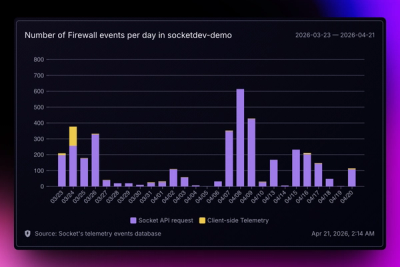
Explore exportable charts for vulnerabilities, dependencies, and usage with Reports, Socket’s new extensible reporting framework.
By André Staltz - Apr 21, 2026
prisma-mock
Advanced tools
A comprehensive mock of the Prisma API intended for unit testing. All data is stored in memory, providing fast and reliable test execution without external dependencies.
The library optionally uses jest-mock-extended or vitest-mock-extended if you provide a mock client. If functionality you need is not implemented yet, you can mock it yourself.
npm install prisma-mock --save-dev
# or
yarn add prisma-mock --dev
With Prisma 7, you typically generate your client to a custom output directory (such as ./generated/client), and import the generated Prisma namespace from your generated files. Use the prisma-mock/client entry point and pass the Prisma namespace when
initializing your mock client.
Note: You will also need to configure and use the DMMF Generator to produce the necessary metadata for mocking.
import createPrismaMock from "prisma-mock/client"
import { Prisma } from "./generated/client"
import * as dmmf from "./generated/dmmf"

let client

beforeEach(() => {
  client = createPrismaMock(Prisma, {
    datamodel: dmmf,
  })
})
Simple example of how to create a prisma mock instance using the default (node_module) export:
import createPrismaMock from "prisma-mock"

let client

beforeEach(() => {
  client = createPrismaMock()
})
You can optionally start with pre-filled data:
import createPrismaMock from "prisma-mock"

const client = createPrismaMock({
  data: {
    user: [
      {
        id: 1,
        name: "John Doe",
        accountId: 1,
      },
    ],
    account: [
      {
        id: 1,
        name: "Company",
      },
    ],
  },
})
Example of how to mock a global prisma instance, for instance when it's the default export in a "db" directory (like in BlitzJS):
import createPrismaMock from "prisma-mock"
import { mockDeep, mockReset } from "jest-mock-extended"

jest.mock("db", () => ({
  __esModule: true,
  ...jest.requireActual("db"),
  default: mockDeep(),
}))

import db from "db"

beforeEach(() => {
  mockReset(db)
  createPrismaMock({ mockClient: db })
})
The library provides three different exports:
prisma-mock (default): The recommended way to use the library. Automatically uses the Prisma client from @prisma/client/default, so you don't need to pass Prisma as an argument.prisma-mock/client: Use this when you need to explicitly pass the Prisma namespace.prisma-mock/legacy: The old API for backward compatibility. This export is deprecated but maintained for existing codebases.prisma-mock)createPrismaMock<P extends PrismaClient = PrismaClient>(
options?: {
data?: PrismaMockData<P>
datamodel?: Prisma.DMMF.Datamodel
mockClient?: DeepMockApi
caseInsensitive?: boolean
enableIndexes?: boolean
}
): P & {
$getInternalState: () => Required<PrismaMockData<P>>
$setInternalState: (state: Required<PrismaMockData<P>>) => void
$clear: () => void
}
options (optional): Configuration options (see below)data (optional): Initial mock data for the Prisma models. An object containing keys for tables and values as arrays of objects.datamodel (optional): The Prisma datamodel, typically Prisma.dmmf.datamodel (default).mockClient (optional): A jest-mock-extended or vitest-mock-extended instance. If not provided, a plain object is used instead.caseInsensitive (boolean, default: false): If true, all string comparisons are case insensitiveenableIndexes (boolean, default: true) If true, enables indexing for better query performance on primary keys, unique fields, and foreign keysReturns a mock Prisma client with all standard model methods plus:
$getInternalState(): Method to access the internal data state for testing/debugging$setInternalState(state): Method to replace the entire internal data state. Useful for resetting state to a specific snapshot or setting up complex test scenarios. The state is deep copied to avoid reference issues.$clear(): Method to reset the internal state back to the initial stateprisma-mock/client)createPrismaMock<PClient extends PrismaClient, P extends typeof Prisma = typeof Prisma>(
prisma: P,
options?: {
data?: PrismaMockData<PClient>
datamodel?: P["dmmf"]["datamodel"]
mockClient?: DeepMockApi
caseInsensitive?: boolean
enableIndexes?: boolean
}
): PClient & {
$getInternalState: () => Required<PrismaMockData<PClient>>
$setInternalState: (state: Required<PrismaMockData<PClient>>) => void
$clear: () => void
}
prisma (required): The Prisma namespace (e.g., Prisma from @prisma/client). This is used to access the datamodel and type information.options (optional): Configuration options. Same as the default export, with the exception of the datamodel not being optional.prisma-mock/legacy)The legacy export maintains the old API signature for backward compatibility:
import createPrismaMock from "prisma-mock/legacy"
import { mockDeep } from "jest-mock-extended"

const client = createPrismaMock(
  { user: [{ id: 1, name: "John" }] }, // data
  Prisma.dmmf.datamodel, // datamodel (optional)
  mockDeep(), // mockClient (optional)
  { enableIndexes: true } // options (optional)
)
Note: If you're starting a new project, use the default export instead. The legacy export is only for maintaining existing codebases that haven't migrated yet.
The library includes a Prisma generator that can be used to generate the datamodel separately. This is useful when you need to use the datamodel without having the full Prisma client available, or when you want to use a specific version of the datamodel.
You typically need the DMMF generator when:
Add the generator to your schema.prisma file:
generator client {
  provider = "prisma-client-js"
}

generator dmmf {
  provider = "prisma-mock"
  output   = "./generated/dmmf"
}
After running prisma generate, the datamodel will be exported to the specified output path. You can then import and use it:
import createPrismaMock from "prisma-mock/client"
import { Prisma } from "@prisma/client"
import * as dmmf from "./generated/dmmf"

const client = createPrismaMock(Prisma, {
  datamodel: dmmf,
})
Note: In most cases, you don't need the generator. The library will automatically use Prisma.dmmf.datamodel from your Prisma client if you don't provide a custom datamodel.
findUnique / findUniqueOrThrowfindManyfindFirst / findFirstOrThrowcreatecreateManydeleteupdatedeleteManyupdateManyupsertcountaggregategroupBydistinctincludewhereselectorderByselect: _countcreatecreateManyupdateupdateManydeletedeleteManyconnectdisconnectsetupsertequalsgt, gte, lt, ltenotin, notIncontains, startsWith, endsWithAND, OR, NOTmode (for case-insensitive matching)someeverynoneincrementdecrementmultiplydividesetpathstring_containsstring_starts_withstring_ends_witharray_containsarray_starts_witharray_ends_with@@id (Primary keys)@default (Default values)@unique (Unique constraints)@@unique (Compound unique constraints)@relation (Relationships)@updatedAt (Partially supported - set at creation)autoincrement()auto() (MongoDB ObjectId)cuid()uuid()now()onDelete: SetNullonDelete: Cascade$transaction (Array of promises)$transaction (Interactive transactions with rollback)$connect$disconnectThe following features are planned but not yet implemented:
connectOrCreatesearch (Full-text search)issetpushhashasEveryhasSomeisEmptyequalsonDelete: RestrictonDelete: NoActiononDelete: SetDefaultonUpdate actions$use (Middleware)Indexing is enabled by default for better query performance. Indexes are automatically created for:
This can significantly improve query performance for large datasets.
The mock client throws appropriate Prisma errors with correct error codes:
P2025: Record not found (for findUniqueOrThrow, findFirstOrThrow)P2002: Unique constraint violationP2003: Foreign key constraint violationCreate your tests in the __tests__ directory. You can use snapshot testing with either expect(res).toMatchSnapshot() or expect(res).toMatchInlineSnapshot().
Note: If you choose to use snapshot testing, make sure to first run your tests against the real database to create a snapshot of the expected result.
To run tests against a PostgreSQL database:
yarn run test:postgres
To run tests against prisma-mock (in-memory database):
yarn test
Create a .env-cmdrc file in the root of your project with the following content:
{
  "postgres": {
    "PROVIDER": "postgresql",
    "DATABASE_URL": "postgresql://postgres:postgres@localhost:5432/postgres?schema=public"
  }
}
yarn build
Contributions are welcome! Please feel free to submit a Pull Request. For major changes, please open an issue first to discuss what you would like to change.
MIT
FAQs
Mock prisma for unit testing database
The npm package prisma-mock receives a total of 34,250 weekly downloads. As such, prisma-mock popularity was classified as popular.
We found that prisma-mock demonstrated a healthy version release cadence and project activity because the last version was released less than a year ago. It has 1 open source maintainer collaborating on the project.
Did you know?

Socket for GitHub automatically highlights issues in each pull request and monitors the health of all your open source dependencies. Discover the contents of your packages and block harmful activity before you install or update your dependencies.
Product
Explore exportable charts for vulnerabilities, dependencies, and usage with Reports, Socket’s new extensible reporting framework.
Product
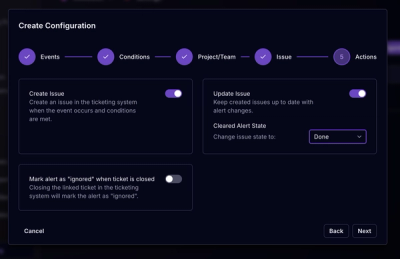
Socket for Jira lets teams turn alerts into Jira tickets with manual creation, automated ticketing rules, and two-way sync.
Company News
Socket won two 2026 Reppy Awards from RepVue, ranking in the top 5% of all sales orgs. AE Alexandra Lister shares what it's like to grow a sales career here.