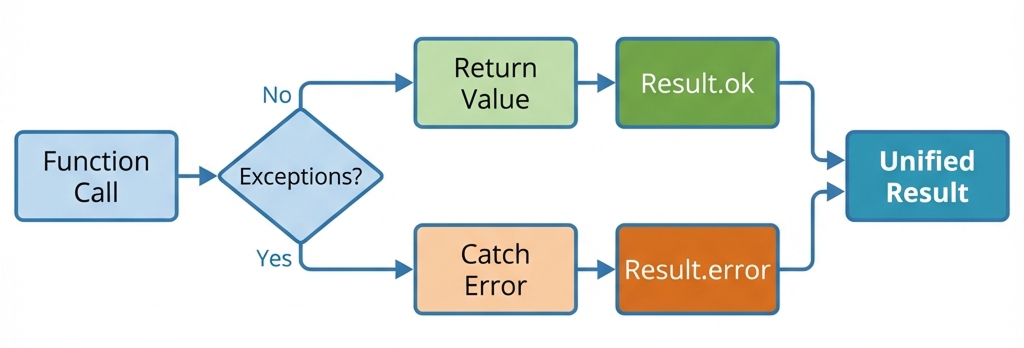
Catches every exception and converts it into a Result object.
Forces you to handle the failure case before accessing the data.
Note: This approach is often called Railway Oriented Programming.
You stay on the "Success Track" until an error switches you to the "Failure Track", but the train never falls off the rails.
Philosophy
Explicit Control Flow - Make the implicit failure path explicit
Defensive Consistency - Handle errors at build time, not in production
Decorate your class methods to automatically catch errors and return Result types.
Note: Requires "experimentalDecorators": true in your tsconfig.json.
import { TryResult, Result, NotFoundError } from"result-try"classUserService {
// Use default mapping (error -> ResultError.from(error))@TryResult()
asyncgetUser(id: string) {
const user = await db.find(id)
if (!user) {
returnNotFoundError.from("User not found")
}
returnResult.ok(user)
}
// Use custom mapping@TryResult((error) =>mapPostgresError(error))
asyncupdateUser(id: string, data: Partial<User>): PromiseResult<User> {
const user = await db.update(id, data)
returnResult.ok(user)
}
}
API Reference
Result Type
A discriminated union that makes it impossible to access value without checking ok.
It also supports array destructuring for a Go-like experience.
// Object accessif (result.ok) {
console.log(result.value)
}
// Array destructuringconst [value, error] = result
if (error) {
console.error(error)
}
typeResult<T, E extendsResultError> =
| { ok: true; value: T }
| { ok: false; error: E }
Result.ok(value): Wraps a value in a success Result. Idempotent — if value is already a Result, it is returned as-is (no double-wrapping). This is similar to how Promise.resolve(promise) returns the same promise.
Result.error(error): Wraps an error in a failure Result. Also idempotent — if error is already a Result, it is returned as-is.
Result.void(): Useful for functions that verify something but return no data.
import { Result, ResultError, ForbiddenError } from"result-try"functionvalidateUser(user: User): Result<void, ResultError> {
if (!user.isActive) {
returnResult.error(ForbiddenError.from("User is inactive"))
}
returnResult.void()
}
Result.unwrap()
Returns the value if ok, otherwise throws the error.
const value = result.unwrap() // Throws if result is error
ResultError & Built-in Errors
result-try treats errors as structured data.
The ResultError class ensures every error has a code, status, and message.
We provide standard HTTP-friendly error classes out of the box:
Error Class
Status
Code
BadRequestError
400
BAD_REQUEST
UnauthorizedError
401
UNAUTHORIZED
PaymentRequiredError
402
PAYMENT_REQUIRED
ForbiddenError
403
FORBIDDEN
NotFoundError
404
NOT_FOUND
MethodNotAllowedError
405
METHOD_NOT_ALLOWED
NotAcceptableError
406
NOT_ACCEPTABLE
TimeoutError
408
TIMEOUT
ConflictError
409
CONFLICT
PreconditionFailedError
412
PRECONDITION_FAILED
PayloadTooLargeError
413
PAYLOAD_TOO_LARGE
UnsupportedMediaTypeError
415
UNSUPPORTED_MEDIA_TYPE
UnprocessableEntityError
422
UNPROCESSABLE_ENTITY
UnprocessableContentError
422
UNPROCESSABLE_CONTENT
TooManyRequestsError
429
TOO_MANY_REQUESTS
ClientClosedRequestError
499
CLIENT_CLOSED_REQUEST
InternalServerError
500
INTERNAL_SERVER_ERROR
NotImplementedError
501
NOT_IMPLEMENTED
BadGatewayError
502
BAD_GATEWAY
ServiceUnavailableError
503
SERVICE_UNAVAILABLE
GatewayTimeoutError
504
GATEWAY_TIMEOUT
You can access these definitions at runtime via HTTP_ERRORS.
Static Factory Methods
All built-in error classes provide two static factory methods for convenient error creation:
from()
Creates an error instance from a message or existing error:
import { ResultError, NotFoundError } from"result-try"// From a string messageconst error1 = ResultError.from("User not found")
// From an existing errortry {
await db.findUser(id)
} catch (error) {
const error2 = NotFoundError.from(error)
}
result()
Creates an error Result directly (shorthand for Result.error(ErrorClass.from(...))):
import { NotFoundError } from"result-try"// ConcisereturnNotFoundError.result("User not found")
// Equivalent toreturnResult.error(NotFoundError.from("User not found"))
inspect Utility
A robust stringification utility designed for logging and debugging.
All built-in error classes use inspect internally to ensure that any error caught is preserved safely.
Why use inspect?
Never crashes: Safe for circular references and deep nesting.
import {
isResultError,
isResultErrorCode,
isResultErrorStatus,
findHTTPErrorFromCode,
getHTTPErrorMessageFromCode
} from"result-try"// Type Guardif (isResultError(someValue)) {
console.log(someValue.code) // Safe access
}
// Check Specific Errors (Safe even if value is unknown)consterror: unknown = result.errorif (isResultErrorCode(result.error, "NOT_FOUND")) {
// Handle specific code
}
if (isResultErrorStatus(result.error, 404)) {
// Handle specific status
}
// Find Error Definition by Codeconst httpError = findHTTPErrorFromCode("NOT_FOUND")
if (httpError) {
console.log(httpError.message) // "The requested resource could not be found."
}
// Get Error Message from Codeconst msg = getHTTPErrorMessageFromCode("BAD_REQUEST", "Fallback message")
Publishing Guide
See docs/PUBLISHING.md for instructions on how to publish this package to npm.
A TypeScript Result type and try-catch wrapper utility
We found that result-try demonstrated a healthy version release cadence and project activity because the last version was released less than a year ago.It has 1 open source maintainer collaborating on the project.
Package last updated on 22 Mar 2026
Did you know?
Socket for GitHub automatically highlights issues in each pull request and monitors the health of all your open source dependencies. Discover the contents of your packages and block harmful activity before you install or update your dependencies.