









High performance set theory.
This library is a collection of functional utilities from set theory,
each of which operate on an arbitrary number of input sets.
Each function accepts variable arguments and operates with the principals of immutability:
none of the input sets are modified in the process of calculation.
Set Operations:
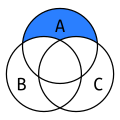
difference: A ∖ B
The difference of sets contains all the elements
of the first set, not contained in other sets.
import { difference } from 'set-utilities';

const differenceAB = difference(setA, setB);
const differenceABC = difference(setA, setB, setC);
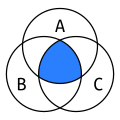
intersection: A ∩ B
The intersection of sets contains all the elements
each contained in every set.
import { intersection } from 'set-utilities';

const intersectionAB = intersection(setA, setB);
const intersectionABC = intersection(setA, setB, setC);
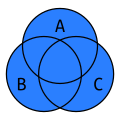
union: A ∪ B
The union of sets contains all the elements
each contained in any set.
import { union } from 'set-utilities';

const unionAB = union(setA, setB);
const unionABC = union(setA, setB, setC);
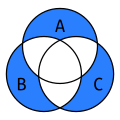
symmetric difference (xor): A ∆ B
The symmetric difference of sets contains
only the unique elements of each set.
import { xor } from 'set-utilities';

const xorAB = xor(setA, setB);
const xorABC = xor(setA, setB, setC);
Set Comparisons:
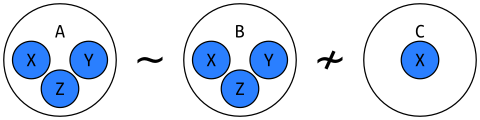
equivalence: A ∼ B
Sets are equivalent if they have the same cardinality,
and there is a bijection between the elements contained in each set.
import { equivalence } from 'set-utilities';

const isEquivalentAB = equivalence(setA, setB);
const isEquivalentABC = equivalence(setA, setB, setC);
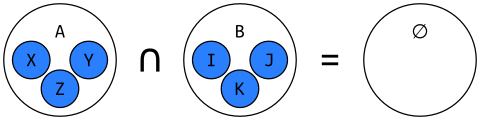
disjoint: A ∩ B = ∅
Sets are disjoint if they have no elements in common.
import { disjoint } from 'set-utilities';

const isDisjointAB = disjoint(setA, setB);
const isDisjointABC = disjoint(setA, setB, setC);
pairwise disjoint: A ∩ B ∩ C = ∅
A family of sets are pairwise disjoint if
none of the sets share any elements in common.

import { pairwiseDisjoint } from 'set-utilities';

const isPairwiseDisjointAB = pairwiseDisjoint(setA, setB);
const isPairwiseDisjointABC = pairwiseDisjoint(setA, setB, setC);
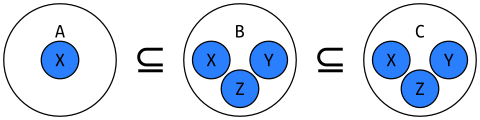
subset: A ⊆ B
A set is a subset of another if all of its elements
are contained in the other set.
import { subset } from 'set-utilities';

const isSubsetAB = subset(setA, setB);
const isSubsetABC = subset(setA, setB, setC);
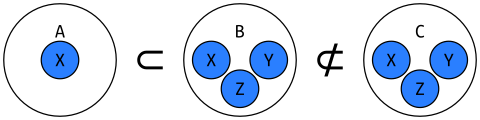
proper subset: A ⊂ B
A set is a proper subset of another if all of its elements
are contained in the other set,
and it has a lower cardinality than the other set.
import { properSubset } from 'set-utilities';

const isProperSubsetAB = properSubset(setA, setB);
const isProperSubsetABC = properSubset(setA, setB, setC);
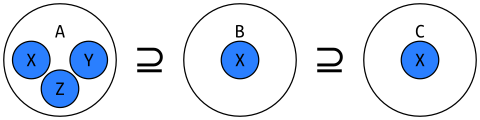
superset: A ⊇ B
A set is a superset of another if it contains
all the elements contained in the other set.
import { superset } from 'set-utilities';

const isSupersetAB = superset(setA, setB);
const isSupersetABC = superset(setA, setB, setC);
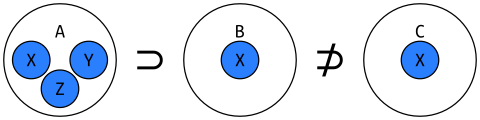
proper superset: A ⊃ B
A set is a proper superset of another if it contains
all the elements contained in the other set,
and it has a greater cardinality than the other set.
import { properSuperset } from 'set-utilities';

const isProperSupersetAB = properSuperset(setA, setB);
const isProperSupersetABC = properSuperset(setA, setB, setC);
Set Ordering:
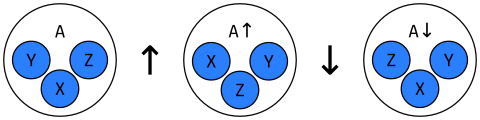
sort: A ⇅
An immutable sorting operation for sets.
import { sort } from 'set-utilities';

const sortedA = sort(setA);
const sortedB = sort(setB, compareFunction);





