


Security News
Deno 2.6 + Socket: Supply Chain Defense In Your CLI
Deno 2.6 introduces deno audit with a new --socket flag that plugs directly into Socket to bring supply chain security checks into the Deno CLI.
By Sarah Gooding - Dec 12, 2025
shopify-nestjs-api
Advanced tools

A wrapper for @shopify/shopify-node-api to setup your Shopify context in a NestJS application.
Install package using NPM:
npm i @shopify/shopify-api shopify-nestjs-api
or using Yarn:
yarn add @shopify/shopify-api shopify-nestjs-api
From your application root module, import the ShopifyApiModule using forRoot, or if you have dynamic config using forRootAsync:
// app.module.ts
@Module({
  imports: [
    ShopifyApiModule.forRoot({
      apiKey: 'foo',
      apiSecret: 'bar',
      apiVersion: ApiVersion.Unstable,
      hostName: 'localhost:8081',
      isEmbeddedApp: true,
      scopes: ['test_scope'],
    }),
  ],
})
export class App {}
or if you want to inject your configuration dynamically (maybe using @nestjs/config), use forRootAsync:
// app.module.ts
import { ConfigService } from '@nestjs/config';

@Module({
  imports: [
    ShopifyApiModule.forRootAsync({
      useFactory: async (configService: ConfigService) => {
        return {
          apiKey: configService.get('SHOPIFY_API_KEY'),
          apiSecret: configService.get('SHOPIFY_API_SECRET'),
          apiVersion: ApiVersion.Unstable,
          hostName: configService.get('HOST').replace(/https:\/\//, ''),
          isEmbeddedApp: true,
          scopes: ['test_scope'],
        };
      },
      inject: [ConfigService],
    }),
  ],
})
export class App {}
The library allows your to inject your own session storage. For instance, if you use Redis based session storage. You could create an @Injectable() class that implements the SessionStorage interface. And use this injected class in your config:
// app.module.ts
import { ConfigService } from '@nestjs/config';
import { MyRedisSessionStorage } from './my-redis-session-storage';

@Module({
  imports: [
    ShopifyApiModule.forRootAsync({
      useFactory: async (
        configService: ConfigService,
        sessionStorage: MyRedisSessionStorage,
      ) => {
        return {
          apiKey: configService.get('SHOPIFY_API_KEY'),
          apiSecret: configService.get('SHOPIFY_API_SECRET'),
          apiVersion: ApiVersion.Unstable,
          hostName: configService.get('HOST').replace(/https:\/\//, ''),
          isEmbeddedApp: true,
          scopes: ['test_scope'],
          sessionStorage,
        };
      },
      provide: [MyRedisSessionStorage],
      inject: [ConfigService, MyRedisSessionStorage],
    }),
  ],
})
export class App {}
// my-redis-session-storage.ts
import { Injectable } from '@nestjs/common';
import {
  SessionStorage,
  SessionInterface,
} from '@shopify/shopify-api/dist/auth/session';

@Injectable()
export class MyRedisSessionStorage implements SessionStorage {
  async storeSession(session: SessionInterface): Promise<boolean> {
    // ... implement your redis store logic
  }

  async loadSession(id: string): Promise<SessionInterface | undefined> {
    // ... implement your redis load logic
  }

  async deleteSession(id: string): Promise<boolean> {
    // ... implement your redis delete logic
  }
}
There is a separate module for registering webhooks called ShopifyWebhookModule. Import this module at the root level after ShopifyApiModule:
// app.module.ts
import { MyHandler } from './my.handler.ts';

@Module({
  imports: [
    ShopifyApiModule.forRoot({
      apiKey: 'foo',
      apiSecret: 'bar',
      apiVersion: ApiVersion.Unstable,
      hostName: 'localhost:8081',
      isEmbeddedApp: true,
      scopes: ['test_scope'],
    }),
    ShopifyWebhookModule.forRoot({
      path: '/webhooks',
      topics: ['PRODUCTS_CREATE', 'CUSTOMERS_UPDATE'],
      handler: new MyHandler(),
    }),
  ],
  providers: [MyHandler],
})
export class App {}
This module requires a handler that will be invoked with a .process() function for every incoming webhook:
// my.handler.ts
import { ShopifyWebhookHandler } from 'shopify-nestjs-api';
import { Injectable } from '@nestjs/common';

@Injectable()
export class MyHandler implements ShopifyWebhookHandler {
  async process(topic: string, shop: string, body: string): Promise<void> {
    switch (topic) {
      case 'PRODUCTS_CREATE':
        // handle product creation logic
        break;
      case 'CUSTOMERS_UPDATE':
        // handle customer update logic
        break;
    }
  }
}
NOTE: this package uses @shopify/shopify-api under the hood. That package requires full control over the req and res of your application. It also means that you need to disable the JSON body parsing logic of NestJS. Here's how you achieve this:
Install the body-parser package:
npm install body-parser
// main.ts
import { NestFactory } from '@nestjs/core';
import { json } from 'body-parser';
import { AppModule } from './app.module';

async function bootstrap() {
  const jsonParseMiddleware = json();
  const app = await NestFactory.create(AppModule, { bodyParser: false });
  app.use((req, res, next) => {
    // NOTE: Make sure this is the same `path` you pass to the `ShopifyWebhookModule`.
    if (req.path.indexOf('/webhooks') === 0) {
      next();
    } else {
      jsonParseMiddleware(req, res, next);
    }
  });

  await app.listen(3000);
}
bootstrap();
This will enable the body parser logic for all routes, except when /webhooks route is called.
You can also import the ShopifyWebhookModule with useFactory, useClass or useExisting when importing the module using .forRootAsync(). This allows you to inject a webhook handler within the context of dependency injection in your application:
// app.module.ts
import { MyHandler } from './my.handler.ts';

@Module({
  imports: [
    ShopifyApiModule.forRoot({
      apiKey: 'foo',
      apiSecret: 'bar',
      apiVersion: ApiVersion.Unstable,
      hostName: 'localhost:8081',
      isEmbeddedApp: true,
      scopes: ['test_scope'],
    }),
    ShopifyWebhookModule.forRootAsync({
      useFactory: (handler: MyHandler) => ({
        path: '/webhooks',
        topics: ['PRODUCTS_CREATE', 'CUSTOMERS_UPDATE'],
        handler,
      }),
      inject: [MyHandler],
    }),
  ],
  providers: [MyHandler],
})
export class App {}
FAQs
Wrapper around @shopify/shopify-api package for NestJS
We found that shopify-nestjs-api demonstrated a not healthy version release cadence and project activity because the last version was released a year ago. It has 1 open source maintainer collaborating on the project.
Did you know?

Socket for GitHub automatically highlights issues in each pull request and monitors the health of all your open source dependencies. Discover the contents of your packages and block harmful activity before you install or update your dependencies.
Security News
Deno 2.6 introduces deno audit with a new --socket flag that plugs directly into Socket to bring supply chain security checks into the Deno CLI.
Security News
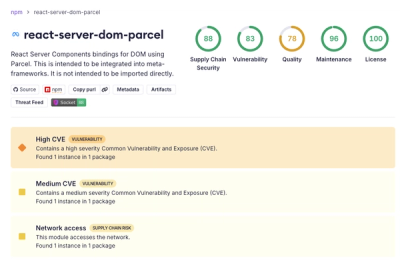
New DoS and source code exposure bugs in React Server Components and Next.js: what’s affected and how to update safely.

Security News
Socket CEO Feross Aboukhadijeh joins Software Engineering Daily to discuss modern software supply chain attacks and rising AI-driven security risks.