

Product
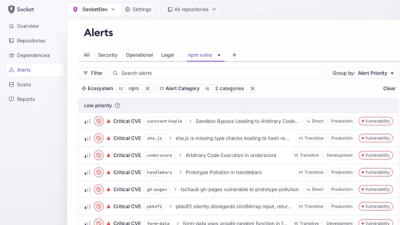
Introducing Custom Tabs for Org Alerts
Create and share saved alert views with custom tabs on the org alerts page, making it easier for teams to return to consistent, named filter sets.
By André Staltz - Jan 20, 2026
spatial-grid
Advanced tools
Spatial queries on simplicial complexes in arbitrary dimensions.
First, install via npm:
npm install spatial-grid
Then you can create grids and query them as follows:
var bunny = require("bunny");
var grid = require("spatial-grid")(bunny.cells, bunny.positions, 0.1);
console.log(grid.closestCells([1.0, 0.0, 0.0]));
Which returns the following data:
{ points: [ [ 1.0520095436290573, 0.2639268057343442, 0.10221864065360134 ] ],
  cells: [ 3507 ],
  distance: 0.2877690079051383 }
The code should work for two dimensional meshes, tetrahedral volume, and other higher dimensional structures.
require("spatial-grid")(cells, positions, tolerance)Creates a spatial grid over the simplicial complex determined by [positions, cells] with cell size = tolerance.
cells is an abstract simplicial complex represented by an array of arrays of indicespositions is an array of positions for the 0-cellstolerance: The resolution of the cell complexReturns a spatial grid for the cell complex.
grid.closestCells(x)Returns information about the closest cell to the point x within the specified tolerance.
x is a pointReturns: If no cell is within tolerance, returns null. Otherwise, returns an object with the following parameters:
cells: An array of cells of approximately equal distance to x (within a tolerance of +/-1e-6 )points: An array of points closest to xdistance: The squared distance to the surface from xgrid.neighborhood(x, radius)Returns all of the cells in the complex which are within radius distance of the point x.
Currently the library is built on top of the FORTRAN code quadprog, which solves the simplex-closest point problem. If this library gets popular enough, I may eventually add faster routines for low dimensional queries. For high dimensions, the search routines used in this library become exponentially less efficient. However the performance should be "good enough" for d <= 3, and it is probably usable up to d<=5.
(c) 2013 Mikola Lysenko. BSD
FAQs
Computes closest points to meshes and polygons
We found that spatial-grid demonstrated a not healthy version release cadence and project activity because the last version was released a year ago. It has 1 open source maintainer collaborating on the project.
Did you know?

Socket for GitHub automatically highlights issues in each pull request and monitors the health of all your open source dependencies. Discover the contents of your packages and block harmful activity before you install or update your dependencies.
Product
Create and share saved alert views with custom tabs on the org alerts page, making it easier for teams to return to consistent, named filter sets.

Product
Socket’s Rust and Cargo support is now generally available, providing dependency analysis and supply chain visibility for Rust projects.

Security News
Chrome 144 introduces the Temporal API, a modern approach to date and time handling designed to fix long-standing issues with JavaScript’s Date object.