

Product
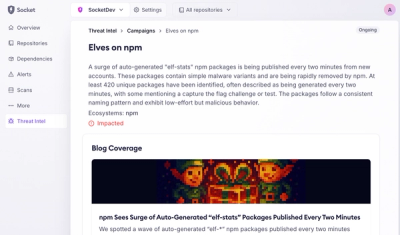
Introducing Supply Chain Attack Campaigns Tracking in the Socket Dashboard
Campaign-level threat intelligence in Socket now shows when active supply chain attacks affect your repositories and packages.
By Philipp Burckhardt - Jan 21, 2026
statsd-librato-backend
Advanced tools




BREAKING CHANGES: Starting with version 2.0.0 statsd-librato-backend requires a Librato account that supports tagged metrics.
If your Librato account doesn't yet support tagged metrics or you are using a heroku addon, please use the 0.1.x version.
This is a pluggable backend for StatsD, which publishes stats to Librato.
$ cd /path/to/statsd
$ npm install statsd-librato-backend
You will need to add the following to your StatsD config file.
librato: {
  email:  "myemail@example.com",
  token:  "ca98e2bc23b1bfd0cbe9041e824f610491129bb952d52ca4ac22cf3eab5a1c32"
}
Example Full Configuration File:
{
  librato: {
    email:  "myemail@example.com",
    token:  "ca98e2bc23b1bfd0cbe9041e824f610491129bb952d52ca4ac22cf3eab5a1c32"
  }
  , backends: ["statsd-librato-backend"]
  , port: 8125
  , keyNameSanitize: false
}
The email and token settings can be found on your Librato account settings page.
Add the statsd-librato-backend backend to the list of StatsD
backends in the StatsD configuration file:
{
  backends: ["statsd-librato-backend"]
}
Start/restart the statsd daemon and your StatsD metrics should now be pushed to your Librato account.
The Librato backend also supports the following optional configuration
options under the top-level librato hash:
| Parameter | Description |
|---|---|
| snapTime | Measurement timestamps are snapped to this interval (specified in seconds). This makes it easier to align measurements sent from multiple statsd instances on a single graph. Default is to use the flush interval time. |
| countersAsGauges | A boolean that controls whether StatsD counters are sent to Librato as gauge values (default) or as counters. When set to true (default), the backend will send the aggregate value of all increment/decrement operations during a flush period as a gauge measurement to Librato. When set to false, the backend will track the running value of all counters and submit the current absolute value to Librato as acounter. This will require some additional memory overhead and processing time to track the running value of all counters. |
| skipInternalMetrics | Boolean of whether to skip publishing of internal statsd metrics. This includes all metrics beginning with 'statsd.' and the metric numStats. Defaults to true, implying they are not sent. |
| retryDelaySecs | How long to wait before retrying a failed request, in seconds. |
| postTimeoutSecs | Max time for POST requests to Librato, in seconds. |
| includeMetrics | An array of JavaScript regular expressions. Only metrics that match any of the regular expressions will be sent to Librato. Defaults to an empty array. {includeMetrics: [/^my.included.metrics/, /^my.specifically.included.metric$/]} |
| excludeMetrics | An array of JavaScript regular expressions. Metrics which match any of the regular expressions will NOT be sent to Librato. If includedMetrics is specified, then patterns will be matched against the resulting list of included metrics. Defaults to an empty array. {excludeMetrics: [/^my.excluded.metrics/, /^my.specifically.excluded.metric$/]} |
| globalPrefix | A string to prepend to all measurement names sent to Librato. If set, a dot will automatically be added as separator between prefix and measurement name. |
| writeToLegacy | Boolean of whether to also send metrics with the legacy source dimension. Defaults to false. Intended for users with hybrid accounts that support both tags and sources to help with the migration to tags. Set the source in the StatsD config file:librato: { email: "myemail@example.com", token: "ca98e2bc23b1bfd0cbe9041e82d52ca4ac22cf3eab5a1c32", source: "unique-per-statsd-instance" } |
By default StatsD will push a zero value for any counter that does not receive an update during a flush interval. Similarly, it will continue to push the last seen value of any gauge that hasn't received an update during the flush interval. This is required for some backend systems that can not handle sporadic metric reports and therefore require a fixed frequency of incoming metrics. However, it requires StatsD to track all known gauges and counters and means that published payloads are inflated with zero-fill data.
Librato can handle sporadic metric publishing at non-fixed frequencies. Any "zero filling" of graphs is handled at display time on the frontend. Therefore, when using the Librato backend it is beneficial for bandwidth and measurement-pricing costs to reduce the amount of data sent to Librato. In the StatsD configuration file it is recommended that you enable the following top-level configuration directive to reduce the amount of zero-fill data StatsD sends:
{
   deleteIdleStats: true
}
You can configure your metric in Librato to display the gaps between sporadic reports in a variety of ways. Visit the knowledge base article to see how to change the display attributes.
You can push metrics to Graphite and Librato simultaneously as
you evaluate Librato. Just include both backends in the backends
variable:
{
  backends: [ "./backends/graphite", "statsd-librato-backend" ],
  ...
}
See the statsd manpage for more information.
If you want to use statsd-librato-backend througth a proxy you should install https-proxy-agent module:
$npm install https-proxy-agent
After that you should add the proxy config to the StatsD config file in the librato configuration section:
{
  "librato" : {
    "proxy" : {
      "uri" : "http://127.0.0.01:8080"
    }
  }
}
That configuration will proxy requests via a proxy listening on localhost on port 8080. You can also use an https proxy by setting the protocol to https in the URI.
Starting in version 2.x.x and higher, this functionality is enabled by default. If you are interested in using this feature but your Librato account is not enabled for tags, please send us an email at support@librato.com and request access. Otherwise, see this branch for the legacy version 0.1.7.
Our backend plugin offers basic tagging support for your metrics you submit to Librato. You can specify what tags you want to submit to Librato using the tags config in the librato configuration section of the StatsD config file:
{
  "librato" : {
    "tags": { "os" : "ubuntu", "host" : "production-web-server-1", ... }
  }
}
Once your config has been updated, all metrics submitted to Librato will include your defined tags.
We also support tags at the per-stat level should you need more detailed tagging. We provide a naming syntax for your stats so you can submit tags for each stat. That syntax is as follows:
metric.name#tag1=value,tag2=value:value
Starting with a #, you would pass in a comma-separated list of tags and we will parse out the tags and values. Given the above example, a stat matching
the above syntax will be submitted as metric to Librato with a name of metric.name, a value of value and with the tags tag1=value and tag2=value. You are welcome to use any statsd client of your choosing.
Please note that in order to use tags, the statsd config option keyNameSanitize must be set to false to properly parse tags out of your stat name.
You may use bin/statsd-librato to easily bootstrap the daemon inside
a container.
Invoking this via CMD or ENTRYPOINT will create a simple
configuration and run the statsd daemon with this backend enabled,
listening on 8125.
The following environment variables are available to customize:
LIBRATO_EMAILLIBRATO_TOKENLIBRATO_SOURCEIf you want to contribute:
yarn installyarn testFAQs
A StatsD backend for Librato Metrics
We found that statsd-librato-backend demonstrated a not healthy version release cadence and project activity because the last version was released a year ago. It has 2 open source maintainers collaborating on the project.
Did you know?

Socket for GitHub automatically highlights issues in each pull request and monitors the health of all your open source dependencies. Discover the contents of your packages and block harmful activity before you install or update your dependencies.
Product
Campaign-level threat intelligence in Socket now shows when active supply chain attacks affect your repositories and packages.

Research
Malicious PyPI package sympy-dev targets SymPy users, a Python symbolic math library with 85 million monthly downloads.

Security News
Node.js 25.4.0 makes require(esm) stable, formalizing CommonJS and ESM compatibility across supported Node versions.