

Product
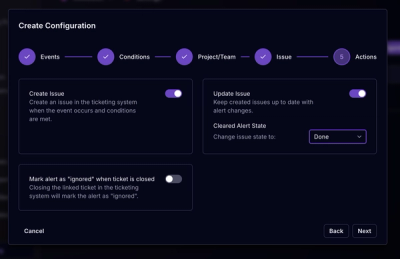
Socket for Jira Is Now Available
Socket for Jira lets teams turn alerts into Jira tickets with manual creation, automated ticketing rules, and two-way sync.
By Jeppe Hasseriis - Apr 20, 2026

Non-blocking, temporal task sequencing. temporal does NOT use setTimeout or setInterval, however there is a cost for using "recursive" setImmediate to create an extremely fast, async execution loop. CPU usage is expected to peak when using temporal, because the internal ticker needs to execute as fast as possible and as many times per second as possible. It's this speed that allows temporal to review the internal schedule for tasks to execute more than once per millisecond, which is needed to create preferential execution cycles for hardware programming.
temporal is for writing timing sensitive programs that are expected to be the primary process running on a given system, where the power source itself is tuned to accommodate that program specifically. Concrete examples include:
temporal allows for sub-millisecond task scheduling through us of the resolution method.
temporal is not good for sparse task scheduling.
npm install temporal
var temporal = require("temporal");

temporal.on("idle", function() {
  console.log("Temporal is idle");
});

// Wait 500 milliseconds, execute a task
temporal.delay(500, function() {

  console.log("500ms later...");

});

// Loop every n milliseconds, executing a task each time
temporal.loop(500, function() {

  console.log("Every 500ms...");

  // |this| is a reference to the temporal instance
  // use it to cancel the loop by calling:
  //
  this.stop();

  // The number of times this loop has been executed:
  this.called; // number

  // The first argument to the callback is the same as |this|
});


// Queue a sequence of tasks: delay, delay
// Each delay time is added to the prior delay times.
temporal.queue([
  {
    delay: 500,
    task: function() {
      // Executes 500ms after temporal.queue(...) is called
    }
  },
  {
    delay: 500,
    task: function() {
      // Executes 1000ms after temporal.queue(...) is called

      // The last "delay" task will emit an "ended" event
    }
  }
]);

// Queue a sequence of tasks: delay then loop
// Each delay time is added to the prior delay times.
temporal.queue([
  {
    delay: 500,
    task: function() {
      // Executes 500ms after temporal.queue(...) is called
    }
  },
  {
    loop: 100,
    task: function() {
      // Executes 600ms after temporal.queue(...) is called

      // Executes every 100ms thereafter.
    }
  }
]);
var temporal = require("temporal");

temporal.on("idle", function() {
  console.log("Temporal is idle");
});

// Set temporal resolution to 0.1ms
temporal.resolution(0.1);

// Wait 0.7 milliseconds, execute a task
temporal.delay(0.7, function() {

  console.log("0.7ms later...");

});
In lieu of a formal styleguide, take care to maintain the existing coding style. Add unit tests for any new or changed functionality. Lint and test your code using grunt.
See LICENSE file.
FAQs
Non-blocking, temporal task sequencing and scheduling.
The npm package temporal receives a total of 1,508 weekly downloads. As such, temporal popularity was classified as popular.
We found that temporal demonstrated a not healthy version release cadence and project activity because the last version was released a year ago. It has 2 open source maintainers collaborating on the project.
Did you know?

Socket for GitHub automatically highlights issues in each pull request and monitors the health of all your open source dependencies. Discover the contents of your packages and block harmful activity before you install or update your dependencies.
Product
Socket for Jira lets teams turn alerts into Jira tickets with manual creation, automated ticketing rules, and two-way sync.
Company News
Socket won two 2026 Reppy Awards from RepVue, ranking in the top 5% of all sales orgs. AE Alexandra Lister shares what it's like to grow a sales career here.

Security News
NIST will stop enriching most CVEs under a new risk-based model, narrowing the NVD's scope as vulnerability submissions continue to surge.