

Product
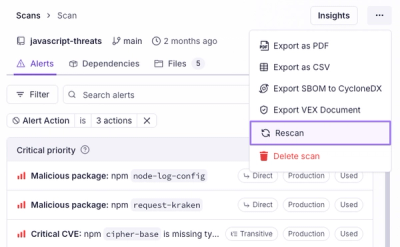
Introducing Immutable Scans
Scan results now load faster and remain consistent over time, with stable URLs and on-demand rescans for fresh security data.
By Nolan Lawson - Jan 23, 2026


Utility for converting textual time periods to time units (milliseconds, seconds, minutes, hours, etc..).
######Due to the lack of precision in floating point numbers arithmetic and the need of keeping the results precise the utility is using the bignumber.js library for arithmetic operations on numbers.
First install the package and save it to package.json using npm:
npm install --save to-time
To require in the browser:
Both files located in lib directory already include the bignumber.js dependency and there is no need to include this module in the browser.
<!-- access using window.toTime -->
<script src="node_modules/to-time/lib/to-time.min.js"></script>
To require when using NodeJS:
const toTime = require('to-time');
Converting from textual time period to time units
toTime('1 hour').seconds(); //3600
//same as:
toTime('1h').seconds(); //3600

toTime('1 Year 365 Days 4 Hours').hours(); //17524
//same as:
toTime('1y 365d 4h').hours(); //17524
Useful for usage in methods such as setInterval and setTimeout which consume the second argument in milliseconds, it is much clearer for someone who will read the code.
//Instead of using 43200000 milliseconds (equivalent to 12 hours) we can do the following
setInterval(() => {
  //Do something here
}, toTime('12h').ms());

//Instead of using 5400000 milliseconds (equivalent to 1.5 hour)
setTimeout(() => {
  //Do something here
}, toTime.fromHours(1.5).ms());
It is also possible to create a a TimeFrame instance by calling the static factory methods. The result will be a TimeFrame object similar to the one that is created by invoking the function with a textual time period.
toTime.fromHours(4).addMinutes(30).hours(); //4.5
toTime.fromYears(4).addWeeks(4).days(); //1488
It is possible to add additional units to the TimeFrame object by invoking one of the appender methods on the returned instance:
toTime('0.5 hour').addMinutes(30).seconds(); //3600
toTime.fromHours(2).addMinutes(30).minutes(); //150
The getter methods are used to get the value of the TimeFrame object in a specific time unit.
It is also possible to use to-time in order to convert time units into human readable format. Example:
const frame = toTime.fromMilliseconds(500005050505005);
frame.humanize(); //15855 Years, 2 Weeks, 6 Days, 11 Hours, 48 Minutes, 25 Seconds, 5 Milliseconds
Make sure to write tests, run new & existing tests using:
npm run test
Check for source code & tests code styling by running eslint:
npm run lint
If tests are passing and eslint doesn't return any error -> Create pull request
MIT
FAQs
Utility for converting textual time periods to time units
We found that to-time demonstrated a not healthy version release cadence and project activity because the last version was released a year ago. It has 1 open source maintainer collaborating on the project.
Did you know?

Socket for GitHub automatically highlights issues in each pull request and monitors the health of all your open source dependencies. Discover the contents of your packages and block harmful activity before you install or update your dependencies.
Product
Scan results now load faster and remain consistent over time, with stable URLs and on-demand rescans for fresh security data.
Product
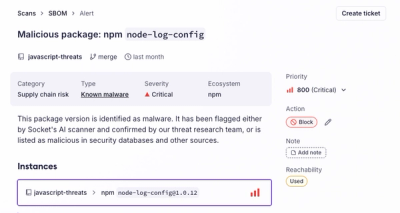
Socket's new Alert Details page is designed to surface more context, with a clearer layout, reachability dependency chains, and structured review.
Product
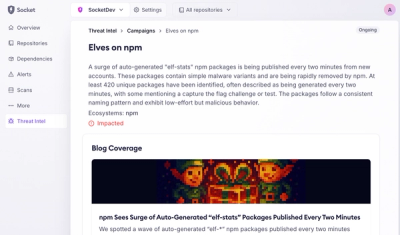
Campaign-level threat intelligence in Socket now shows when active supply chain attacks affect your repositories and packages.