

Security News
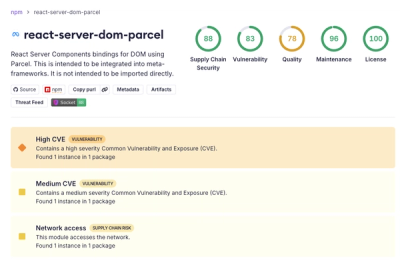
New React Server Components Vulnerabilities: DoS and Source Code Exposure
New DoS and source code exposure bugs in React Server Components and Next.js: what’s affected and how to update safely.
By Sarah Gooding - Dec 12, 2025
tracker-json
Advanced tools
Easily generate a tracker.json file for your Home Assistant custom cards on new releases

Either install tracker-json globally npm i -g tracker-json or locally in your cards project (npm i --save-dev tracker-json).
The command tracker-json then either gets installed in your system or in your project
You configure tracker-json in your custom cards source repo, in its package.json file.
If my custom card project is called awesome-card I could configure it like so:
{
  "tracker-json": {
    "awesome-card": {
      "repo": "nervetattoo/awesome-card",
      "resolve": "gh:release"
    }
  }
}
Now, when you run tracker-json it will generate github repo specific URLs, get the version off of the one in package.json and set the cards update date to today.
You can specify multiple keys in the configuration to create different variations of your custom card.
| Option | Default | Description |
|---|---|---|
| repo | package.json repo field | A repo slug like github-user/repo-name |
| file | package.json file field | The filename to link to inside the repo |
| resolve | gh:repo | Strategy for file locations are resolution |
In the folder you want to store your tracker.json you can run the command tracker-json <semantic-version>. For example:
$ tracker-json.js 1.0.0
✓ tracker.json generated
my-card 1.0.0
I highly recommend using tracker-json with release-it for release handling.
release-it is a one-stop-shop to release a package following semantic versioning and also generate changelogs and publish the release to GitHub and optionally publishing to npm.
Using release-it you would handle cutting a new release with commands like release-it major|minor|patch and it handles everything else for you.
tracker-json currently only supports linking to releases with changelogs on GitHub, so you need to configure release-it with one of its hooks to trigger tracker-json as well as making sure it generates releases on GitHub:
{
  "release-it": {
    "github": {
      "release": true
    },
    "scripts": {
      "afterBump": "npx tracker-json"
    }
  }
}
FAQs
Generate tracker.json with ease
We found that tracker-json demonstrated a not healthy version release cadence and project activity because the last version was released a year ago. It has 1 open source maintainer collaborating on the project.
Did you know?

Socket for GitHub automatically highlights issues in each pull request and monitors the health of all your open source dependencies. Discover the contents of your packages and block harmful activity before you install or update your dependencies.
Security News
New DoS and source code exposure bugs in React Server Components and Next.js: what’s affected and how to update safely.

Security News
Socket CEO Feross Aboukhadijeh joins Software Engineering Daily to discuss modern software supply chain attacks and rising AI-driven security risks.
Security News
GitHub has revoked npm classic tokens for publishing; maintainers must migrate, but OpenJS warns OIDC trusted publishing still has risky gaps for critical projects.