

Product
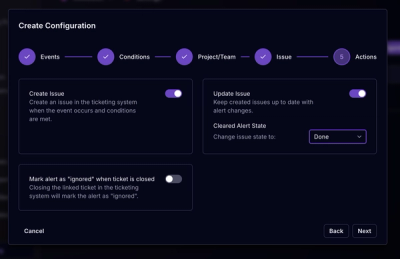
Socket for Jira Is Now Available
Socket for Jira lets teams turn alerts into Jira tickets with manual creation, automated ticketing rules, and two-way sync.
By Jeppe Hasseriis - Apr 20, 2026
transparent-proxy
Advanced tools
Real transparent HTTP-Proxy-Server. Upstream your requests whatever you want!
transparent-proxy extends the native net.createServer and it acts as a real transparent http-proxy.
This module was built on top of TCP-level to avoid header-stripping problem of nodejs http(s)-modules.
It allows to upstream client-request dynamically to other proxies, or to certain iFace, to spoof requests and more...
It supports Basic Proxy-Authentication.
Useful for debugging, crawling, security and more.
It works on Termux.
npm i transparent-proxy
const ProxyServer = require('transparent-proxy');

//init ProxyServer
const server = new ProxyServer();

//starting server on port 8080
server.listen(8080, '0.0.0.0', function () {
    console.log('TCP-Proxy-Server started!', server.address());
});
| Param | Type | Description |
|---|---|---|
| options | Object | The options object. |
| [options.auth] | Function | Activate/Handle Proxy-Authentication. Returns or solves to Boolean. |
| [options.upstream] | Function | The proxy to be used to upstreaming requests. Returns String. |
| [options.tcpOutgoingAddress] | Function | The localAddress to use while sending requests. Returns String |
| [options.injectData] | Function | The edited data to upstream. Returns Buffer or string |
| [options.injectResponse] | Function | The edited response to return to connected client. Returns Buffer or string |
| [options.keys] | Function | The keys to use while handshake. It will work only if intercept is true. Returns Object or false |
| [options.verbose] | Boolean | Activate verbose mode. |
| [options.intercept] | Boolean | Activate interception of encrypted communications. False as default. |
| [options.interceptOptions] | Object | The used options while intercepting HTTPs. As Default {server:{rejectUnauthorized:false,requestCert:false},client:{rejectUnauthorized: false,requestCert: false}} |
| [options.logger] | Logger | Must be an object implementing log(args[]) and error(args[]). Defaults to the inbuilt logger writing to the console if verbose is true. |
| [options.handleSni] | Function | Pass SNICallback to be added to the server. See SNICallback tls.createServer options |
upstream, tcpOutgoingAddress, injectData & injectResponse OptionsThe options are functions having follow parameters:
| Param | Type | Description |
|---|---|---|
| data | Buffer | The received data. |
| session | Session | Object containing info/data about Tunnel |
IP:PORT or USER:PWD@IP:PORT of used http-proxy. If 'localhost' is returned/resolved, then the host-self will be used as proxy.IP.Note: These functions will be executed before first tcp-socket-connection is established.
If you don't want to use the host of active instance self, then you need to upstream connections to another http-proxy.
This can be done with upstream attribute.
const ProxyServer = require('transparent-proxy');

const server = new ProxyServer({
    upstream: function () {
          return 'x.x.x.x:3128'; // upstream to other proxy
    }
});

//starting server on port 8080
server.listen(8080, '0.0.0.0', function () {
    console.log('TCP-Proxy-Server started!', server.address());
});
You can also use an async function to upstream your requests:
const ProxyServer = require('transparent-proxy');

const server = new ProxyServer({
    upstream: async function () {
         //make some async task before
         return 'x.x.x.x:3128'; // upstream to other proxy
    }
});

//starting server on port 8080
server.listen(8080, '0.0.0.0', function () {
    console.log('TCP-Proxy-Server started!', server.address());
});
auth FunctionThis activate basic authorization mechanism. The Auth-function will be executed while handling Proxy-Authentications.
| Param | Type | Description |
|---|---|---|
| username | String | The client username. |
| password | String | The client password |
| session | Session | Object containing info/data about Tunnel |
Note: It needs to return True/False or a Promise that resolves to boolean (isAuthenticated).
const ProxyServer = require('transparent-proxy');

const server = new ProxyServer({
    auth: function (username, password) {
        return username === 'bar' && password === 'foo';
    }
});

//starting server on port 8080
server.listen(8080, '0.0.0.0', function () {
    console.log('TCP-Proxy-Server started!', server.address());
});
The callbacks injectData & injectResponse could be used to intercept/spoof communication.
These functions are executed with the data and session arguments.
The boolean attribute intercept allows to break SSL-Communication between Source & Destination.
This will activate Security-Alarm by most used browsers.
const switchWith = 'My Super Spoofed UA!';
const server = new ProxyServer({
    intercept: true,
    verbose: true,
    injectData: (data, session) => {
        if (session.isHttps) {
            const modifiedData = data.toString()
                .replace(session.request.headers['user-agent'], switchWith); //replacing UA-Header-Value

            return Buffer.from(modifiedData);
        }
        return data;
    }
});
curl -x localhost:8080 -k http://ifconfig.io/ua
curl/7.83.1

curl -x localhost:8080 -k https://ifconfig.me/ua
My Super Spoofed UA!
keys FunctionThis function will work only if intercept is set to true.
If activated needs to return an Object {key:'String', cert:'String'} like native tls_connect_options.key & tls_connect_options.cert or false statement.
If no object is returned, then default keys will be used to update communication.
| Param | Type | Description |
|---|---|---|
| session | Session | Object containing info/data about Tunnel |
Note: This function will be executed before TLS-Handshake.
handleSNI FunctionIf passed a function, the proxy will call it to obtain the TLS secure context instead of using keys.
From tls.createServer two arguments will be passed when called: servername and callback. Callback is an error-first callback that takes two optional arguments: error and ctx. ctx, if provided, is a SecureContext instance.
tls.createSecureContext() can be used to get a proper SecureContext. If callback is called with a falsy ctx argument, the default secure context of the server will be used.
You can find an example here.
The Session-Instance is an Object containing info/data about Tunnel. It has following useful attributes and methods:
{boolean} isHttps - Is session encrypted.
{object} request - The Request-Object containing info about current request. Normally defined on both injectData & injectResponse Callbacks. Attributes exist only if Session is not encrypted.
{object} response - The Response-Object containing info about current response. Normally defined on injectResponse Callback. Attributes exist only if Session is not encrypted.
{buffer} rawResponse - The original body buffer.
{object} getTunnelStats() - Get Stats for this tunnel
{string} getId() - Get Own ID-Session
{boolean} isAuthenticated() - Is the session authenticated by user or not.
const ProxyServer = require('transparent-proxy');
const server = new ProxyServer();

//starting server on port 8080
server.listen(8080, '0.0.0.0', function () {
    console.log('Proxy-Server started!', server.address());
});

setInterval(function showOpenSockets() {
    const bridgedConnections = server.getBridgedConnections();
    console.log([new Date()], 'OPEN =>', Object.keys(bridgedConnections).length)
}, 2000);
This example upstreams only requests for ifconfig.me to another proxy, for all other requests will be used localhost.
const ProxyServer = require('transparent-proxy');

const server = new ProxyServer({
    upstream: function (data, session) {
        if (~(data.toString().indexOf('ifconfig.me'))) {
            return 'x.x.x.x:3128'; // upstream to other proxy
        } else {
            return 'localhost'; //upstream to localhost
        }
    },
});

//starting server on port 8080
server.listen(8080, '0.0.0.0', function () {
    console.log('TCP-Proxy-Server started!', server.address());
});
Testing with curl:
curl -x 127.0.0.1:8080 https://ifconfig.me
x.x.x.x
curl -x 127.0.0.1:8080 https://ifconfig.co
y.y.y.y
For more examples look here.
FAQs
Real transparent HTTP-Proxy-Server. Upstream your requests whatever you want!
The npm package transparent-proxy receives a total of 223 weekly downloads. As such, transparent-proxy popularity was classified as not popular.
We found that transparent-proxy demonstrated a not healthy version release cadence and project activity because the last version was released a year ago. It has 1 open source maintainer collaborating on the project.
Did you know?

Socket for GitHub automatically highlights issues in each pull request and monitors the health of all your open source dependencies. Discover the contents of your packages and block harmful activity before you install or update your dependencies.
Product
Socket for Jira lets teams turn alerts into Jira tickets with manual creation, automated ticketing rules, and two-way sync.
Company News
Socket won two 2026 Reppy Awards from RepVue, ranking in the top 5% of all sales orgs. AE Alexandra Lister shares what it's like to grow a sales career here.

Security News
NIST will stop enriching most CVEs under a new risk-based model, narrowing the NVD's scope as vulnerability submissions continue to surge.