

Security News
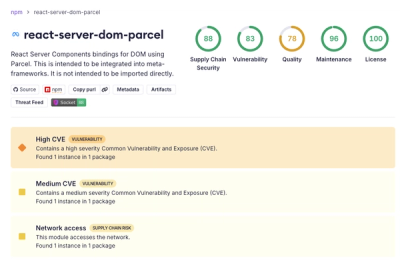
New React Server Components Vulnerabilities: DoS and Source Code Exposure
New DoS and source code exposure bugs in React Server Components and Next.js: what’s affected and how to update safely.
By Sarah Gooding - Dec 12, 2025
utils-logger-av
Advanced tools
v4.0.0
This is a package i made for myself but can surely be helpful to others, feel free to contribute if you like it.
npm install utils-logger-av
You basically have the Logger class and the FW (filewriter) class.
You can also import a
getStringedColorfunction that simply returns you a colored string
export interface ILogger {
    public static colors:Record<LogColors, string>;
    public static icons:Record<Icons, string>;

    ok(message:string): void;
    nok(message:string): void;
    fullOk(message:string): void;
    fullNok(...errors:any[]): void;

    base(coloredMessage:any, ...messages:any[]): void;
    white(coloredMessage:any, ...messages:any[]): void;
    green(coloredMessage:any,...messages:any[]): void;
    red(coloredMessage:any,...messages:any[]): void;
    yellow(coloredMessage:any,...messages:any[]): void;
    blue(coloredMessage:any,...messages:any[]): void;
    magenta(coloredMessage:any,...messages:any[]): void;
    cyan(coloredMessage:any,...messages:any[]): void;
    gray(coloredMessage:any,...messages:any[]): void;
    orange(coloredMessage:any,...messages:any[]): void;
    pink(coloredMessage:any,...messages:any[]): void;
    purple(coloredMessage:any,...messages:any[]): void;
    teal(coloredMessage:any,...messages:any[]): void;
    brown(coloredMessage:any,...messages:any[]): void;
    lime(coloredMessage:any,...messages:any[]): void;
    gold(coloredMessage:any,...messages:any[]): void;
    violet(coloredMessage:any,...messages:any[]): void;

    combo(firstString:[LogColors, string] | string, ...messages: string[]): void;
    file(message:string, type?:"log" | "error"): void;
    detail(coloredMessage:any, ...messages:any[]): void;
    error(coloredMessage:any,...errs:any[]): string | undefined;
    date(color?:LogColors): string;
}

// --- Default constructor values
protected logFilePath:string = null!;
protected readonly stopEveryLog:boolean = false;
protected readonly dateLocale:DateLocales = "it-IT";
protected readonly primaryColor:LogColors | null = null;
protected readonly isErrorStackFull:boolean = false;
protected readonly areIconsBeforeText:boolean = true;

export interface LoggerConstructor {
    logFilePath?:string,            // by calling the file() method and leaeving this undefined, there won't be any logs
    stopEveryLog?:boolean,          // if set to true, there won't be any more log.
    locale?: DateLocales,           // to set the locale timezone view
    primaryColor?:LogColors,        // set your color for the "base" method. default is white
    isErrorStackFull?:boolean       // if set to true, logError will log the full stack trace
    areIconsBeforeText?:boolean,
}
import { Logger, getStringedColor } from "utils-logger-av"
You can export the default class like
const log = new Logger({ primaryColor:"cyan" });
const c = getStringedColor;
const i = Logger.icons;
export { c, i, log };
Or creating a new class extending mine to add some custom utilities
class YourLogger extends Logger
{
    public yourCustomMethod = (message:any, type:FileLogType) => {
        const finalMessage = "CUSTOM-METHOD: " + message;
        this.base(finalMessage);
        this.file(finalMessage, type)
    }

    override fullNok(...errs: any[]): void
    {
        this.detail("Overriding fullNok and printing filePath: ", this.logFilePath);
        super.fullNok(...errs);
    }
}

const log = new YourLogger({ logFilePath: `${Configs.LOG_FOLDER}/logs.log` });
const c = getStringedColor;
const i = Logger.icons;
export { c, i, log };
You can now import the log object and call the related methods:
import { log } from "./your/filepath"; // I'm confident about your ide auto-import features

log.color("green", "Ciao")
log.base("Hello there, this is a log");
log.baseFile("Hello there", "log");
log.baseFile("An Error", "error");


log.orange("Another test", { test: 1, test2: true, prova: { test3: [ "Hello", 2, false] } }, false, 12.3);
log.white("This is white")
log.blue("This is blue")
log.brown("This is brown")
log.logError("This is an error", "err")
log.lime("This is lime")
log.teal("This is teal")
log.magenta("This is magenta")
protected readonly logFilePath:string;
protected readonly dateLocale:DateLocales = "it-IT";
constructor (logFilePath:string, locale?:DateLocales)
{
    this.logFilePath = logFilePath;
    if (locale) this.dateLocale = locale;
}

write = (message:string, type:FileLogType = "log") => void;
Use it to create micro-configurations for splitted log logics:
class BaseService extends FW
{
    protected readonly serviceName:string;
    constructor(serviceName:string) {
        super(`${Configs.LOG_FOLDER}/${serviceName}`);
        this.serviceName = serviceName;
    }

    protected writeLog = (message:string) => this.write(message);
    protected writeError = (message:string) => this.write(message, "error");
}

class MyService extends BaseService
{
    constructor()
    {
        super("Servizio_1");
    }

    firstServiceCustomMethod = () => {
        this.writeLog("Hi this is the first-service method")
    }
}

const serviceTest = new MyService();
serviceTest.firstServiceCustomMethod();
FAQs
Backend colored logs
We found that utils-logger-av demonstrated a healthy version release cadence and project activity because the last version was released less than a year ago. It has 1 open source maintainer collaborating on the project.
Did you know?

Socket for GitHub automatically highlights issues in each pull request and monitors the health of all your open source dependencies. Discover the contents of your packages and block harmful activity before you install or update your dependencies.
Security News
New DoS and source code exposure bugs in React Server Components and Next.js: what’s affected and how to update safely.

Security News
Socket CEO Feross Aboukhadijeh joins Software Engineering Daily to discuss modern software supply chain attacks and rising AI-driven security risks.
Security News
GitHub has revoked npm classic tokens for publishing; maintainers must migrate, but OpenJS warns OIDC trusted publishing still has risky gaps for critical projects.