

Product
Introducing Reports: An Extensible Reporting Framework for Socket Data
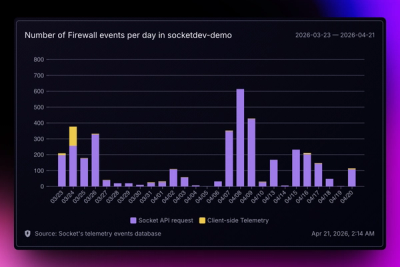
Explore exportable charts for vulnerabilities, dependencies, and usage with Reports, Socket’s new extensible reporting framework.
By André Staltz - Apr 21, 2026
Utilities for working with Windows Subsystem for Linux (WSL)
npm install wsl-utils
import {isWsl, powerShellPathFromWsl} from 'wsl-utils';

// Check if running in WSL
console.log('Is WSL:', isWsl);

// Get PowerShell path from WSL
console.log('PowerShell path:', await powerShellPathFromWsl());
//=> '/mnt/c/Windows/System32/WindowsPowerShell/v1.0/powershell.exe'
Type: boolean
Check if the current environment is Windows Subsystem for Linux (WSL).
Returns: Promise<string>
Get the PowerShell executable path in WSL environment.
Returns: Promise<string>
Get the PowerShell executable path for the current environment.
Returns WSL path if in WSL, otherwise returns Windows path.
Returns: Promise<boolean>
Check if PowerShell is accessible in the current environment.
This is useful to determine whether Windows integration features can be used. In sandboxed WSL environments or systems where PowerShell is not accessible, this will return false.
import {canAccessPowerShell} from 'wsl-utils';

if (await canAccessPowerShell()) {
	// Use Windows integration features
	console.log('PowerShell is accessible');
} else {
	// Fall back to Linux-native behavior
	console.log('PowerShell is not accessible');
}
Returns: Promise<string>
Get the default browser in WSL.
Returns a promise that resolves to the ProgID of the default browser (e.g., 'ChromeHTML', 'FirefoxURL').
import {wslDefaultBrowser} from 'wsl-utils';

const progId = await wslDefaultBrowser();
//=> 'ChromeHTML'
Returns: Promise<string>
Get the mount point for fixed drives in WSL.
Returns: Promise<string>
Convert a WSL Linux path to a Windows-accessible path.
URLs (strings starting with a protocol like https://) are returned unchanged.
import {convertWslPathToWindows} from 'wsl-utils';

// Convert a Linux path
const windowsPath = await convertWslPathToWindows('/home/user/file.html');
//=> '\\wsl.localhost\Ubuntu\home\user\file.html'

// URLs are not converted
const url = await convertWslPathToWindows('https://example.com');
//=> 'https://example.com'
Type: string
The WSL path to convert (e.g., /home/user/file.html).
Returns: Promise<string[]>
Convert multiple WSL Linux paths to Windows-accessible paths.
import {convertWslPathToWindows} from 'wsl-utils';

const windowsPaths = await convertWslPathToWindows([
	'/home/user/file.html',
	'/mnt/c/Users/file.txt',
	'https://example.com'
]);
//=> ['\\wsl.localhost\Ubuntu\home\user\file.html', 'C:\Users\file.txt', 'https://example.com']
Type: string[]
The WSL paths to convert.
Returns: boolean
Check if a Windows path is a UNC path (e.g., \\wsl.localhost\... or \\wsl$\...).
UNC paths indicate the file resides on the WSL Linux filesystem rather than a Windows drive.
import {isUncPath} from 'wsl-utils';

isUncPath('\\\\wsl.localhost\\Ubuntu\\home\\user');
//=> true

isUncPath('C:\\Users\\file.txt');
//=> false
Type: string
The Windows path to check.
Returns: Promise<boolean>
Check if a WSL path maps to the Windows filesystem.
This converts the path and checks if it's on a Windows drive (e.g., /mnt/c/... → C:\...) rather than the Linux filesystem (e.g., /home/... → \\wsl$\...).
import {isPathOnWindowsFilesystem} from 'wsl-utils';

await isPathOnWindowsFilesystem('/mnt/c/Users/file.txt');
//=> true

await isPathOnWindowsFilesystem('/home/user/file.txt');
//=> false
Type: string
The WSL path to check.
Returns: Promise<string>
Convert a Windows path to a WSL Linux path.
import {convertWindowsPathToWsl} from 'wsl-utils';

const wslPath = await convertWindowsPathToWsl('C:\\Users\\file.txt');
//=> '/mnt/c/Users/file.txt'
Type: string
The Windows path to convert.
Returns: Promise<string[]>
Convert multiple Windows paths to WSL Linux paths.
import {convertWindowsPathToWsl} from 'wsl-utils';

const wslPaths = await convertWindowsPathToWsl([
	'C:\\Users\\file.txt',
	'D:\\Projects\\app'
]);
//=> ['/mnt/c/Users/file.txt', '/mnt/d/Projects/app']
Type: string[]
The Windows paths to convert.
FAQs
Utilities for working with Windows Subsystem for Linux (WSL)
The npm package wsl-utils receives a total of 23,443,108 weekly downloads. As such, wsl-utils popularity was classified as popular.
We found that wsl-utils demonstrated a healthy version release cadence and project activity because the last version was released less than a year ago. It has 1 open source maintainer collaborating on the project.
Did you know?

Socket for GitHub automatically highlights issues in each pull request and monitors the health of all your open source dependencies. Discover the contents of your packages and block harmful activity before you install or update your dependencies.
Product
Explore exportable charts for vulnerabilities, dependencies, and usage with Reports, Socket’s new extensible reporting framework.
Product
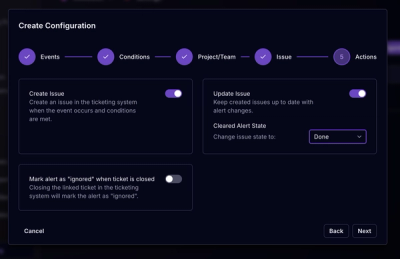
Socket for Jira lets teams turn alerts into Jira tickets with manual creation, automated ticketing rules, and two-way sync.
Company News
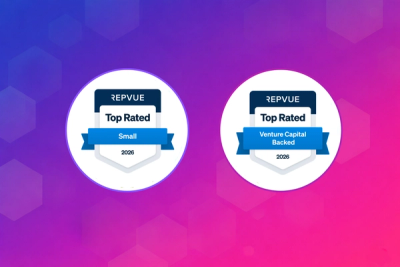
Socket won two 2026 Reppy Awards from RepVue, ranking in the top 5% of all sales orgs. AE Alexandra Lister shares what it's like to grow a sales career here.