

Product
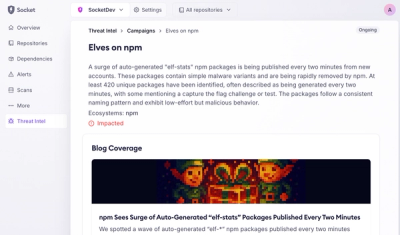
Introducing Supply Chain Attack Campaigns Tracking in the Socket Dashboard
Campaign-level threat intelligence in Socket now shows when active supply chain attacks affect your repositories and packages.
By Philipp Burckhardt - Jan 21, 2026
atalaya
Advanced tools

Atalaya is a lightweight toolkit that helps you keep PyTorch experiments organised. It provides:
Writer built on top of tensorboardX with handy helpers for scalars, models, CSV exports, and optional integrations with Weights & Biases, Neptune, Comet, and ClearML;info.json metadata snapshots (command, Python version, Git details) so you can replay runs later;terminal helper for structured CLI output with timestamps;Timer utility to track wall-clock timing for blocks of code or functions;The writer uses tensorboardX as its event backend, so you get native TensorBoard support while still being able to plug in third-party experiment trackers such as Weights & Biases, Neptune, ClearML, or Comet.
| Integration | Status |
|---|---|
| TensorBoardX | Works (core backend) |
| Weights & Biases | Works (Writer.with_wandb) |
| Neptune | Not fully validated yet (Writer.with_neptune) |
| ClearML | Not fully validated yet (Writer.with_clearml) |
| Comet ML | Not fully validated yet (Writer.with_comet) |
Install the core package from PyPI:
pip install atalaya
Extras are available if you want to enable third-party integrations:
# Enable Weights & Biases support
pip install atalaya[wandb]

# Install everything (Neptune, Comet, ClearML, matplotlib, seaborn)
pip install atalaya[all]
from atalaya.writer import Writer

writer = Writer(
    name="baseline",
    project="my-awesome-project",
    logdir="logs",
    add_time=True,
    save_as_csv=True,
    output_catcher=True,
    log_git_info=True,
)

# Optional: sync logs with Weights & Biases
writer.with_wandb(group="experiments", entity="my-team")

for epoch in range(10):
    metrics = {"loss": 0.1 * epoch, "accuracy": 0.5 + 0.05 * epoch}
    writer.add_scalars(metrics, global_step=epoch, prefix="train")

    # WandB-style convenience API
    writer.log({"train/loss": metrics["loss"]}, step=epoch)

    # Log entire models to track parameter and gradient histograms
    writer.add_models(
        {"encoder": encoder, "decoder": decoder},
        global_step=epoch,
        log_type="all",  # "parameters", "gradients", or "all"
    )

writer.close()
CSV logging is enabled when save_as_csv=True, and calling output_catcher=True mirrors everything printed to the console into log.txt within the run folder.
Every run writes an info.json file with the launch command, Python version, and other metadata in the log directory. When log_git_info is enabled and a Git repository is detected, the same file also includes Git details plus ready-to-run checkout/clone commands so experiments can be reproduced. You can merge your own metadata into the file via the info parameter (for example info={"dataset": "cifar10"}).
writer.with_wandb(group="experiments", entity="my-team")
writer.with_neptune(entity="my-workspace")
Install the matching extras first (for example poetry add atalaya[wandb] or pip install atalaya[neptune]).
from atalaya.time_manager import Timer

timer = Timer("training")

with timer:
    run_training_loop()

timer.report(report_type="total_with_stats")  # prints coloured summary to the terminal
from atalaya.terminal import terminal

# Optional: persist terminal output without a Writer output catcher
terminal.set_log_file("logs/terminal.log")

# Override colours either by name or raw ANSI code
terminal.set_named_color("orange", "\033[38;5;208m")
terminal.set_color("warning", "orange")

terminal.print_info("Loading data...")
terminal.print_warning("Loss is plateauing...", color="orange")
terminal.print_ok("Training finished successfully!")
Messages are timestamped with the process uptime by default.
When you enable Writer(..., output_catcher=True) the log file is handled automatically, so calling set_log_file is not required.
The example/ directory ships with a small PyTorch multi-layer perceptron that demonstrates writer usage end-to-end:
python example/mlp.py
Logs are saved in example/logs/, and the script shows how to combine Writer, Timer, and the terminal helper in a real training loop.
This project is managed with Poetry.
# Install dependencies (add --with dev to use Poe tasks)
poetry install --with dev

# Clean previous builds and publish to PyPI
poe publish

# Or run the Poetry command directly
# poetry publish --build
The package metadata (version, dependencies, classifiers) lives in pyproject.toml.
FAQs
Flexible experiment logging helpers for PyTorch projects.
We found that atalaya demonstrated a healthy version release cadence and project activity because the last version was released less than a year ago. It has 1 open source maintainer collaborating on the project.
Did you know?

Socket for GitHub automatically highlights issues in each pull request and monitors the health of all your open source dependencies. Discover the contents of your packages and block harmful activity before you install or update your dependencies.
Product
Campaign-level threat intelligence in Socket now shows when active supply chain attacks affect your repositories and packages.

Research
Malicious PyPI package sympy-dev targets SymPy users, a Python symbolic math library with 85 million monthly downloads.

Security News
Node.js 25.4.0 makes require(esm) stable, formalizing CommonJS and ESM compatibility across supported Node versions.