

Product
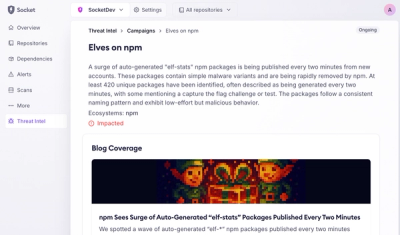
Introducing Supply Chain Attack Campaigns Tracking in the Socket Dashboard
Campaign-level threat intelligence in Socket now shows when active supply chain attacks affect your repositories and packages.
By Philipp Burckhardt - Jan 21, 2026
betterpath
Advanced tools
betterpath, or "bp", is an adaptation of the classic Twisted FilePath type
and interface. bp provides a simple, robust, well-tested object abstraction
over file paths, generalizing the concept of file paths beyond filesystems.
bp exposes an interface, bp.abstract.IFilePath, for file paths, and
provides the following concrete implementations:
bp.filepath.FilePath, for the root filesystembp.zippath.ZipPath, for ZIP archivesbp.memory.MemoryPath, for in-memory temporary filesystemsIn addition, there are combining abstract file paths which can be wrapped around other file paths:
bp.readonly.ReadOnlyPath, for read-only filesystemsAPI documentation is available at http://betterpath.rtfd.org/.
The venerable champ, os.path has been the cause of (and solution to) most
of Python's path problems over the years.
Pros
* In the standard library

Cons
pathlib hopes to carve a path towards greatness through PEP 428.
Pros
* Convenient ``__div__()`` overloading

Cons
The Old Way
::

    def save(base, fragments, data):
        # `fragments` could contain unsafe paths!
        if ".." in fragments or "." in fragments:
            raise ValueError("Unsafe paths!")
        path = os.path.join(os.path.abspath(base), os.sep.join(fragments))
        # Alternatively: path = os.path.join(os.path.abspath(base), *fragments)
        # I hope that this doesn't fail mid-write! Also, did the directories
        # exist? I think so, yes.
        with open(path, "wb") as handle:
            handle.write(data)

The New Way
::
def save(base, fragments, data):
    path = base.descendant(fragments)
    path.parent().makeDirs()
    path.setContent(data)
FAQs
Path manipulation library
We found that betterpath demonstrated a healthy version release cadence and project activity because the last version was released less than a year ago. It has 1 open source maintainer collaborating on the project.
Did you know?

Socket for GitHub automatically highlights issues in each pull request and monitors the health of all your open source dependencies. Discover the contents of your packages and block harmful activity before you install or update your dependencies.
Product
Campaign-level threat intelligence in Socket now shows when active supply chain attacks affect your repositories and packages.

Research
Malicious PyPI package sympy-dev targets SymPy users, a Python symbolic math library with 85 million monthly downloads.

Security News
Node.js 25.4.0 makes require(esm) stable, formalizing CommonJS and ESM compatibility across supported Node versions.