

Security News
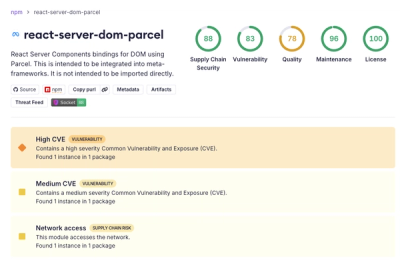
New React Server Components Vulnerabilities: DoS and Source Code Exposure
New DoS and source code exposure bugs in React Server Components and Next.js: what’s affected and how to update safely.
By Sarah Gooding - Dec 12, 2025
brokolisql
Advanced tools
BrokoliSQL is a Python-based command-line tool designed to facilitate the conversion of structured data files—such as CSV, Excel, JSON, and XML—into SQL INSERT statements. It solves common problems faced during data import, transformation, and database seeding by offering a flexible, extensible, and easy-to-use interface.
Universal Data-to-SQL Converter
BrokoliSQL is a Python-based command-line tool designed to facilitate the conversion of structured data files—such as CSV, Excel, JSON, and XML—into SQL INSERT statements. It solves common problems faced during data import, transformation, and database seeding by offering a flexible, extensible, and easy-to-use interface.
--dialect option.CREATE TABLE statement based on input data.INSERT.The execution process is straightforward:
Name Id → Name_ID) for SQL compatibility.INTEGER, TEXT, etc.).INSERT INTO statements (and optionally CREATE TABLE).Install from PyPI:
pip install brokolisql
Make sure you have Python 3 installed:
python --version
If you're working with the source code, install dependencies with:
pip install -r requirements.txt
brokolisql --input data.csv --output output.sql --table users
Use a specific SQL dialect:
brokolisql --input data.csv --output output.sql --table users --dialect mysql
Generate a CREATE TABLE statement:
brokolisql --input data.csv --output output.sql --table users --create-table
Use batch inserts for better performance:
brokolisql --input data.csv --output output.sql --table users --batch-size 100
Specify input format explicitly:
brokolisql --input data.xml --output output.sql --table users --format xml
Apply Python-based transformations:
brokolisql --input data.csv --output output.sql --table users --transform transforms.json
transforms.json:{
"transformations": [
{
"type": "rename_columns",
"mapping": {
"FIRST_NAME": "GIVEN_NAME",
"LAST_NAME": "SURNAME",
"PHONE_1": "PRIMARY_PHONE",
"PHONE_2": "SECONDARY_PHONE"
}
},
{
"type": "add_column",
"name": "FULL_NAME",
"expression": "FIRST_NAME + ' ' + LAST_NAME"
},
{
"type": "add_column",
"name": "SUBSCRIPTION_AGE_DAYS",
"expression": "(pd.Timestamp('today') - pd.to_datetime(df['SUBSCRIPTION_DATE'])).dt.days"
},
{
"type": "filter_rows",
"condition": "COUNTRY in ['USA', 'Canada', 'Norway', 'UK', 'Germany']"
},
{
"type": "apply_function",
"column": "EMAIL",
"function": "lower"
},
{
"type": "apply_function",
"column": "WEBSITE",
"function": "lower"
},
{
"type": "replace_values",
"column": "COUNTRY",
"mapping": {
"USA": "United States",
"UK": "United Kingdom"
}
},
{
"type": "drop_columns",
"columns": ["INDEX"]
},
{
"type": "add_column",
"name": "EMAIL_DOMAIN",
"expression": "EMAIL.str.split('@').str[1]"
},
{
"type": "sort",
"columns": ["COUNTRY", "CITY", "GIVEN_NAME"],
"ascending": true
}
]
}
This enables flexible pre-processing logic during data conversion, such as cleaning strings, formatting dates, or extracting information.
If running directly from source:
PYTHONPATH=. python brokolisql/cli.py --input <path_to_input_file> --output <path_to_output_file> --table <table_name>
Example:
PYTHONPATH=. python brokolisql/cli.py --input data.csv --output commands.sql --table products
brokolisql/
├── assets
│   └── banner.txt
├── cli.py
├── dialects
│   ├── base.py
│   ├── generic.py
│   ├── __init__.py
│   ├── mysql.py
│   ├── oracle.py
│   ├── postgres.py
│   ├── sqlite.py
│   └── sqlserver.py
├── examples
│   ├── customers-10000.csv
│   ├── customers-100.csv
│   ├── output.sql
│   └── transforms.json
├── exceptions
│   ├── base.py
│   └── __init__.py
├── output
│   └── output_writer.py
├── services
│   ├── normalizer.py
│   ├── sql_generator.py
│   └── type_inference.py
├── setup.py
├── transformers
│   ├── __init__.py
│   └── transform_engine.py
└── utils
    └── file_loader.py
We welcome contributions to improve BrokoliSQL. To contribute:
Fork the repository.
Clone it to your machine.
Create a feature branch:
git checkout -b my-feature
Make your changes following PEP 8 standards.
Add or update tests.
Commit and push your changes:
git add .
git commit -m "feat(minor): add X support"
git push origin my-feature
Open a pull request describing your changes and why they are useful.
BrokoliSQL is licensed under the GNU GPL-3.0. See the LICENSE file for more information.
BrokoliSQL streamlines the process of converting structured data into clean, executable SQL. Whether you're migrating legacy data, seeding databases for development, or automating ingestion workflows, BrokoliSQL is a flexible and reliable tool that adapts to your needs. With support for Python-powered transformations and multiple database dialects, it brings power and simplicity to your data operations.
If you encounter any bugs, have suggestions, or would like to contribute, feel free to open an issue or submit a pull request.
FAQs
BrokoliSQL is a Python-based command-line tool designed to facilitate the conversion of structured data files—such as CSV, Excel, JSON, and XML—into SQL INSERT statements. It solves common problems faced during data import, transformation, and database seeding by offering a flexible, extensible, and easy-to-use interface.
We found that brokolisql demonstrated a healthy version release cadence and project activity because the last version was released less than a year ago. It has 1 open source maintainer collaborating on the project.
Did you know?

Socket for GitHub automatically highlights issues in each pull request and monitors the health of all your open source dependencies. Discover the contents of your packages and block harmful activity before you install or update your dependencies.
Security News
New DoS and source code exposure bugs in React Server Components and Next.js: what’s affected and how to update safely.

Security News
Socket CEO Feross Aboukhadijeh joins Software Engineering Daily to discuss modern software supply chain attacks and rising AI-driven security risks.
Security News
GitHub has revoked npm classic tokens for publishing; maintainers must migrate, but OpenJS warns OIDC trusted publishing still has risky gaps for critical projects.