


Product
Introducing Data Exports
Export Socket alert data to your own cloud storage in JSON, CSV, or Parquet, with flexible snapshot or incremental delivery.
By Ola Adekola - Apr 23, 2026
causy
Advanced tools
[!WARNING] causy is a prototype. Please report any issues and be mindful when using it in production.
causy is a command line tool that allows you to apply causal inference methods like causal discovery and causal effect estimation. You can adjust causal discovery algorithms with easy to use, extend and maintain pipelines. causy is built based on pytorch which allows you to run the algorithms on CPUs as well as GPUs.
causy workspaces allow you to manage your data sets, algorithm adjustments, and (hyper-)parameters for your experiments.
causy UI allows you to look at your resulting graphs in the browser and gain further insights into every step of the algorithms.
You can find the documentation here.
Currently, we support python 3.11 and 3.12. To install causy run
pip install causy
Causy can be used with workspaces via CLI or via code.
See options for causy workspace
causy workspace --help
Create a new workspace and start the process to configure your pipeline, data loader and experiments interactively. Your input data should be a json file stored in the same directory.
causy workspace init
Add an experiment
causy workspace experiment add your_experiment_name
Update a variable in the experiment
causy workspace experiment update-variable your_experiment_name your_variable_name your_variable_value
Run multiple experiments
causy workspace execute
Compare the graphs of the experiments with different variable values via a matrix plot
causy workspace diff
Compare the graphs in the UI, switch between different experiments and visualize the causal discovery process
causy ui
Use a default algorithm
from causy.algorithms import PC
from causy.graph_utils import retrieve_edges

model = PC()
model.create_graph_from_data(
    [
        {"a": 1, "b": 0.3},
        {"a": 0.5, "b": 0.2}
    ]
)
model.create_all_possible_edges()
model.execute_pipeline_steps()
edges = retrieve_edges(model.graph)

for edge in edges:
    print(
        f"{edge[0].name} -> {edge[1].name}: {model.graph.edges[edge[0]][edge[1]]}"
    )
Currently, causy supports the following algorithms:
causy.algorithms.PCcausy.algorithms.ParallelPCDetailed information about the pipeline steps can be found in the API Documentation.
We recommend using poetry to manage the dependencies. To install poetry follow the instructions on https://python-poetry.org/docs/#installation.
Install dependencies
poetry install
Execute tests
poetry run python -m unittest
Funded by the Prototype Fund from March 2024 until September 2024
FAQs
Causal discovery made easy.
We found that causy demonstrated a healthy version release cadence and project activity because the last version was released less than a year ago. It has 1 open source maintainer collaborating on the project.
Did you know?

Socket for GitHub automatically highlights issues in each pull request and monitors the health of all your open source dependencies. Discover the contents of your packages and block harmful activity before you install or update your dependencies.
Product
Export Socket alert data to your own cloud storage in JSON, CSV, or Parquet, with flexible snapshot or incremental delivery.
Research
/Security News
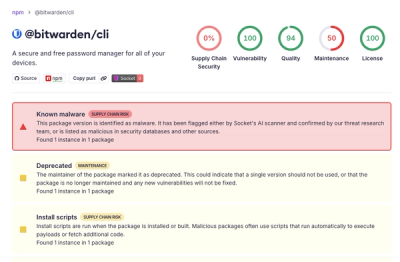
Bitwarden CLI 2026.4.0 was compromised in the Checkmarx supply chain campaign after attackers abused a GitHub Action in Bitwarden’s CI/CD pipeline.

Research
/Security News
Docker and Socket have uncovered malicious Checkmarx KICS images and suspicious code extension releases in a broader supply chain compromise.