

Product
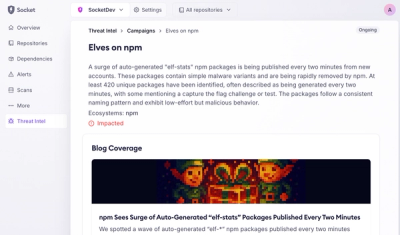
Introducing Supply Chain Attack Campaigns Tracking in the Socket Dashboard
Campaign-level threat intelligence in Socket now shows when active supply chain attacks affect your repositories and packages.
By Philipp Burckhardt - Jan 21, 2026
dlcli
Advanced tools
.. _readme:
Quick Example_install dlcli using pip
.. code-block:: none
pip install dlcli
set your org, account and api key by creating ~/dlcli.yaml
.. code-block:: none
---
account: account_name
key: key_from_account_settings
org: orgname
url: https://api.outlyer.com/v1
Or you can update the file interactively.
.. code-block:: none
dlcli set org acme-ltd
.. code-block:: none
dlcli set account staging
.. code-block:: none
dlcli set key xxxxxxxxx-xxxx-xxxx-xxxx-xxxxxxxxxxxx
these get stored in ~/dlcli.yaml so the details only need to be changed when you are switching orgs or accounts
now verify you have a successful connection
.. code-block:: none
dlcli status
then get a list of all of your agents
.. code-block:: none
dlcli get agents
fun! this is a work in progress so if you want to collaborate please raise PR's
Dataloop CLI Tool_dlcli commands can be thought of as a series of nested commands, with each stage having its own options and flags.
.. code-block:: none
dlcli [FLAGS] COMMAND [FLAGS] SUBCOMMAND [FLAGS]
The square braces indicate optional elements. Some commands have flags, some do not. Some of those flags are optional, some are mandatory per the command. See the list of commands and flags for more information.
The first thing to know is that help is never far away. You can use the --help flag at any stage to discover which flags are available:
.. code-block:: none
dlcli --help
.. code-block:: none
dlcli COMMAND --help
.. code-block:: none
dlcli COMMAND SUBCOMMAND --help
Understand that using the --help flag in between two nested commands will result in the previous level --help output being shown.
dlcli --help COMMAND will have the same output as dlcli --help, and likewise, dlcli COMMAND --help SUBCOMMAND will have the same output as dlcli COMMAND --help.
The top-level help output looks like this:
.. code-block:: none $ dlcli --help Usage: dlcli [OPTIONS] COMMAND [ARGS]...
Dataloop Command Line Tool

See https://www.dataloop.io


Options:
--debug            Debug mode
--loglevel TEXT    Log level
--logfile TEXT     log file
--version          Show the version and exit.
--help             Show this message and exit.

Commands:
agents      Dataloop Agents
Note that all available flags and commands for this level are shown. This pattern is repeated at each successive level of --help
Using the API outside of dlcli_You can use the API code outside of the command line utility.
.. code-block:: python
from dlcli import api

settings = {
    'url': 'https://api.outlyer.com/v1',
    'org': 'org_name',
    'account': 'account_name',
    'key': 'api_key',
}

print api.agents.get_agents(**settings)
Where org_name, account_name and api_key need to be updated with your personal settings.
FAQs
Command line utility for Outlyer
We found that dlcli demonstrated a healthy version release cadence and project activity because the last version was released less than a year ago. It has 2 open source maintainers collaborating on the project.
Did you know?

Socket for GitHub automatically highlights issues in each pull request and monitors the health of all your open source dependencies. Discover the contents of your packages and block harmful activity before you install or update your dependencies.
Product
Campaign-level threat intelligence in Socket now shows when active supply chain attacks affect your repositories and packages.

Research
Malicious PyPI package sympy-dev targets SymPy users, a Python symbolic math library with 85 million monthly downloads.

Security News
Node.js 25.4.0 makes require(esm) stable, formalizing CommonJS and ESM compatibility across supported Node versions.