


Security News
Deno 2.6 + Socket: Supply Chain Defense In Your CLI
Deno 2.6 introduces deno audit with a new --socket flag that plugs directly into Socket to bring supply chain security checks into the Deno CLI.
By Sarah Gooding - Dec 12, 2025
esteria-api-client
Advanced tools
A Rust-based client library for sending SMS messages via the Esteria API (https://esteria.eu). This project provides:
The client supports advanced features like scheduled sending, delivery reports, flash SMS, test mode, and custom encodings.
Install the Python package directly:
pip install esteria-api-client
This installs the Python bindings, which include the underlying Rust library.
Add the library to your Cargo.toml:
[dependencies]
esteria-api-client = "0.1.0"  # Replace with the latest version
To install the CLI globally:
cargo install esteria-api-client --features cli
Note: The cli feature enables the command-line tool, and python enables Python bindings (used for building wheels).
Clone the repository:
git clone https://github.com/yourusername/esteria-api-client.git
cd esteria-api-client
Build the Rust library and CLI:
cargo build --features cli
For Python bindings, ensure you have maturin installed (for building wheels):
pip install maturin
maturin develop  # Builds and installs locally for development
To build a PyPI wheel:
maturin build --release
The client supports these env vars for convenience:
ESTERIA_API_BASE_URL: API endpoint (default: https://api.esteria.eu).ESTERIA_API_KEY: Your API key.The CLI tool (esteria-api-client) allows sending SMS from the terminal.
Basic example:
esteria-api-client \
  --api-url https://api.esteria.eu \
  --api-key YOUR_API_KEY \
  --sender "MySender" \
  --number "+1234567890" \
  --text "Hello, world!"
Full options:
esteria-api-client --help
Output:
Send SMS via Esteria API

Usage: esteria-api-client [OPTIONS] --api-url <API_URL> --api-key <API_KEY> --sender <SENDER> --number <NUMBER> --text <TEXT>

Options:
  -u, --api-url <API_URL>      API base URL (e.g., https://api.esteria.eu)
  -k, --api-key <API_KEY>      API key for authentication
  -s, --sender <SENDER>        Sender name or number
  -n, --number <NUMBER>        Recipient phone number (with or without +)
  -t, --text <TEXT>            Message text to send
      --time <TIME>            Schedule time (RFC3339 format, e.g., 2024-12-31T23:59:59Z)
      --dlr-url <DLR_URL>      Delivery report URL
      --expired <EXPIRED>      Expiration time in minutes
      --user-key <USER_KEY>    User key for tracking
      --debug                  Enable debug mode
      --nolog                  Disable logging
      --flash                  Send as flash SMS
      --test                   Test mode (don't actually send)
      --nobl                   No blacklist check
      --convert                Convert characters
      --encoding <ENCODING>    Encoding: default, 8bit, or udh [default: 8bit]
  -h, --help                   Print help
  -V, --version                Print version
On success, it prints the message ID (e.g., Message ID: 12345).
Import and use the SmsClient class:
import asyncio
from esteria_api_client import SmsClient, SmsFlags, PyEncoding

async def main():
    client = SmsClient("https://api.esteria.eu")

    # Basic send
    result = await client.send_sms(
        api_key="YOUR_API_KEY",
        sender="MySender",
        number="+1234567890",
        text="Hello from Python!"
    )
    print(result)  # Message ID on success

    # With options
    flags = SmsFlags.debug() | SmsFlags.flash()
    result = await client.send_sms(
        api_key="YOUR_API_KEY",
        sender="MySender",
        number="+1234567890",
        text="Scheduled flash SMS",
        time=1735689599,  # Unix timestamp
        dlr_url="https://your-callback-url.com",
        expired=60,  # Expires in 60 minutes
        flag_debug=True,
        flag_flash=True,
        user_key="my-tracking-key",
        use_8bit=False,  # Use default encoding
        udh=True  # UDH encoding
    )
    print(result)

# Run the async function
asyncio.run(main())
SmsFlags: Bitflags for options (e.g., SmsFlags.debug(), SmsFlags.flash()). Combine with |.PyEncoding: Constants like PyEncoding.DEFAULT, PyEncoding.EIGHT_BIT, PyEncoding.UDH.RuntimeError on failure with details.Note: The time parameter is a Unix timestamp (seconds since epoch).
Use the SmsClient and SmsRequest structs:
use esteria_api_client::{SmsClient, SmsRequest, SmsFlags, Encoding};
use chrono::Utc;

#[tokio::main]
async fn main() -> Result<(), Box<dyn std::error::Error>> {
    let client = SmsClient::new("https://api.esteria.eu".to_string());

    let request = SmsRequest::new(
        "YOUR_API_KEY",
        "MySender",
        "+1234567890",
        "Hello from Rust!"
    )
    .with_flags(SmsFlags::DEBUG | SmsFlags::FLASH)
    .with_encoding(Encoding::Udh)
    .with_time(Utc::now())  // Schedule for now (or future)
    .with_dlr_url("https://your-callback-url.com")
    .with_expired(60)
    .with_user_key("my-tracking-key");

    match client.send_sms(request).await {
        Ok(code) => println!("Message ID: {}", code),
        Err(e) => eprintln!("Error: {}", e),
    }

    Ok(())
}
SmsFlags: Bitflags (e.g., SmsFlags::DEBUG).Encoding: Enum for Default, EightBit, Udh.SmsError variants for handling.If sending fails, the client returns detailed errors based on Esteria's response codes:
esteria.rs)cli for the command-line tool or python for bindings via Cargo.reqwest for HTTP, chrono for dates, clap for CLI, pyo3 for Python, and bitflags for flags.env_logger (init in CLI).cargo test. Use --flag-test for API test mode.For issues or suggestions, open a GitHub issue.
This project is not affiliated with Esteria.eu. Ensure you have an active Esteria account and API key.
FAQs
A Rust client library for Esteria API with Python bindings
We found that esteria-api-client demonstrated a healthy version release cadence and project activity because the last version was released less than a year ago. It has 1 open source maintainer collaborating on the project.
Did you know?

Socket for GitHub automatically highlights issues in each pull request and monitors the health of all your open source dependencies. Discover the contents of your packages and block harmful activity before you install or update your dependencies.
Security News
Deno 2.6 introduces deno audit with a new --socket flag that plugs directly into Socket to bring supply chain security checks into the Deno CLI.
Security News
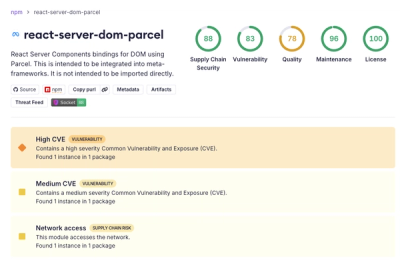
New DoS and source code exposure bugs in React Server Components and Next.js: what’s affected and how to update safely.

Security News
Socket CEO Feross Aboukhadijeh joins Software Engineering Daily to discuss modern software supply chain attacks and rising AI-driven security risks.