

Security News
New React Server Components Vulnerabilities: DoS and Source Code Exposure
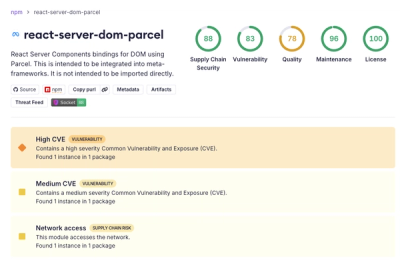
New DoS and source code exposure bugs in React Server Components and Next.js: what’s affected and how to update safely.
By Sarah Gooding - Dec 12, 2025
flowdb
Advanced tools
The AI-Native Database for Agents, Automations, and Speed.
FlowDB is a Hybrid Vector-JSON Database designed for the age of AI. It replaces the complex "Postgres + Pinecone + Docker + Glue Code" stack with a single, lightweight Python package.
It is MCP-Native, meaning LLMs (like Claude) can read, write, and search your database directly without you writing a single line of API wrapper code.
Traditional databases (SQL) are built for accounting. They require rigid schemas, migrations, and complex setup. FlowDB is built for Agents. It assumes that:
JOINs, use a SQL database.pip install flowdb
FlowDB is configured via a .env file in your project root or via Environment Variables.
| Variable | Description | Required? | Default |
|---|---|---|---|
OPENAI_API_KEY | Your OpenAI Key for auto-vectorization. | Yes | None |
FLOWDB_API_KEY | Secures the DB. If set, clients must provide this key. | No | None (Open Access) |
FLOWDB_PATH | Where data files are stored on disk. | No | ./flow_data |
FLOWDB_VECTORIZER | Provider to use (openai or mock). | No | auto |
Example .env file:
OPENAI_API_KEY=sk-proj-12345...
FLOWDB_API_KEY=my-super-secret-password
FLOWDB_PATH=./my_db_storage
FLOWDB_VECTORIZER=openai
You need a running server to store data. You have two ways to run it.
The easiest way to start developing locally.
# Starts the API at http://localhost:8000
flowdb start
The robust way to deploy to DigitalOcean, Railway, or AWS.
docker-compose.yml
services:
  flowdb:
    image: python:3.11-slim
    # We use 'sh -c' so we can chain commands with &&
    command: >
      sh -c "pip install flowdb-ai && flowdb start --host 0.0.0.0"
    ports:
      - "8000:8000"
    volumes:
      - ./flow_data:/app/flow_data
    environment:
      - OPENAI_API_KEY=${OPENAI_API_KEY}
      - FLOWDB_API_KEY=${FLOWDB_API_KEY}
FlowDB comes with a Pythonic Client SDK. It feels like using a local dictionary, but it talks to your high-performance server.
from flowdb import FlowDB
from pydantic import BaseModel

# Connects to localhost:8000 by default
# Reads FLOWDB_API_KEY from env automatically if present
db = FlowDB()

# Or connect to a remote production server
# db = FlowDB(url="http://164.x.x.x:8000", api_key="secret")
FlowDB uses Pydantic to validate your data on read/write.
class Ticket(BaseModel):
    id: str
    title: str
    status: str
    description: str
This saves the JSON AND automatically generates a vector embedding for the description and title.
tickets = db.collection("tickets", Ticket)

# Upsert (Insert or Update)
new_ticket = Ticket(
    id="t-100",
    title="Login Broken",
    status="open",
    description="User cannot reset password on mobile."
)
tickets.upsert(new_ticket)
Find records by meaning, not just keywords.
# Finds the ticket above because "password reset" is related to "login"
results = tickets.search("Issues with authentication", limit=1)

print(results[0].title)
# Output: "Login Broken"
# Get by ID
ticket = tickets.read("t-100")

# Delete
tickets.delete("t-100")

# List all collections
print(db.list_collections())
# Output: ['tickets', 'users']
FlowDB is MCP-Native. This allows Claude Desktop to natively "see", "search", and "edit" your database without any custom glue code.
What this enables: You can ask Claude: "Check the 'tickets' collection for any high-priority bugs regarding login issues, and summarize them for me."
We use fastmcp to bridge Claude (Stdio) to FlowDB (HTTP).
pip install fastmcp
Edit your config file:
~/Library/Application Support/Claude/claude_desktop_config.json%APPDATA%\Claude\claude_desktop_config.jsonUpdate it like this:
{
  "preferences": {
    "menuBarEnabled": false,
    "quickEntryShortcut": "off"
  },
  "mcpServers": {
    "flowdb": {
      "command": "/Users/<user>/.pyenv/shims/fastmcp", // path-to-fastmcp
      "args": [
        "run",
        "http://:<API_KEY>@localhost:8000/mcp/sse"
      ]
    }
  }
}
Note on Security: We pass the API Key in the URL format
http://:PASSWORD@HOST(Basic Auth style). ReplaceYOUR_API_KEYwith the key from your.envfile. If you haven't set a key (Dev Mode), just usehttp://localhost:8000/mcp/sse.
FlowDB is perfect for low-code automation because it accepts raw JSON. It acts as the "Long Term Memory" for your workflows.
In N8n:
POSThttp://your-server:8000/v1/users/upsertAuthorization: Bearer YOUR_KEY).data field.Apache 2.0 License. Built for the AI Community.
FAQs
The AI-Native Database: JSON + Vectors + MCP
We found that flowdb demonstrated a healthy version release cadence and project activity because the last version was released less than a year ago. It has 1 open source maintainer collaborating on the project.
Did you know?

Socket for GitHub automatically highlights issues in each pull request and monitors the health of all your open source dependencies. Discover the contents of your packages and block harmful activity before you install or update your dependencies.
Security News
New DoS and source code exposure bugs in React Server Components and Next.js: what’s affected and how to update safely.

Security News
Socket CEO Feross Aboukhadijeh joins Software Engineering Daily to discuss modern software supply chain attacks and rising AI-driven security risks.
Security News
GitHub has revoked npm classic tokens for publishing; maintainers must migrate, but OpenJS warns OIDC trusted publishing still has risky gaps for critical projects.