


Security News
Deno 2.6 + Socket: Supply Chain Defense In Your CLI
Deno 2.6 introduces deno audit with a new --socket flag that plugs directly into Socket to bring supply chain security checks into the Deno CLI.
By Sarah Gooding - Dec 12, 2025
fuzzyset
Advanced tools
fuzzyset is a data structure that performs something akin to fulltext search against data to determine likely misspellings and approximate string matching.
The usage is simple. Just add a string to the set, and ask for it later
by using either .get or []::
a = fuzzyset.FuzzySet() a.add("michael axiak") a.get("micael asiak") [(0.8461538461538461, u'michael axiak')]
The result will be a list of (score, mached_value) tuples.
The score is between 0 and 1, with 1 being a perfect match.
For roughly 15% performance increase, there is also a Cython-implemented
version called cfuzzyset. So you can write the following, akin to
cStringIO and cPickle::
try:
    from cfuzzyset import cFuzzySet as FuzzySet
except ImportError:
    from fuzzyset import FuzzySet
Adding to the data structure
First let's look at adding a string, 'michaelich' to an empty set. We first break apart the string into n-grams (strings of length
n). So trigrams of 'michaelich' would look like::

    '-mi'
    'mic'
    'ich'
    'cha'
    'hae'
    'ael'
    'eli'
    'lic'
    'ich'
    'ch-'

Note that fuzzyset will first normalize the string by removing non word characters except for spaces and commas and force
everything to be lowercase.

Next the fuzzyset essentially creates a reverse index on those grams. Maintaining a dictionary that says::

     'mic' -> (1, 0)
     'ich' -> (2, 0)
     ...

And there's a list that looks like::

    [(3.31, 'michaelich')]

Note that we maintain this reverse index for *all* grams from ``gram_size_lower`` to ``gram_size_upper`` in the constructor.
This becomes important in a second.

Retrieving
~~~~~~~~~~

To search the data structure, we take the n-grams of the query string and perform a reverse index look up. To illustrate,
let's consider looking up ``'michael'`` in our fictitious set containing ``'michaelich'`` where the ``gram_size_upper``
and ``gram_size_lower`` parameters are default (3 and 2 respectively).

We begin by considering first all trigrams (the value of ``gram_size_upper``). Those grams are::

   '-mi'
   'mic'
   'ich'
   'cha'
   'el-'

Then we create a list of any element in the set that has *at least one* occurrence of a trigram listed above. Note that
this is just a dictionary lookup 5 times. For each of these matched elements, we compute the `cosine similarity`_ between
each element and the query string. We then sort to get the most similar matched elements.

If ``use_levenshtein`` is false, then we return all top matched elements with the same cosine similarity.

If ``use_levenshtein`` is true, then we truncate the possible search space to 50, compute a score based on the levenshtein
distance (so that we handle transpositions), and return based on that.

In the event that none of the trigrams matched, we try the whole thing again with bigrams (note though that if there are no matches,
the failure to match will be quick). Bigram searching will always be slower because there will be a much larger set to order.

.. _cosine similarity: http://en.wikipedia.org/wiki/Cosine_similarity


Install
--------

``pip install fuzzyset2``

Afterwards, you can import the package simply with::

    try:
        from cfuzzyset import cFuzzySet as FuzzySet
    except ImportError:
        from fuzzyset import FuzzySet


License
-------

BSD

Author
--------

-  Mike Axiak <mike@axiak.net>
-  Adrian Altenhoff <adrian.altenhoff@inf.ethz.ch>
FAQs
Unknown package
We found that fuzzyset demonstrated a healthy version release cadence and project activity because the last version was released less than a year ago. It has 1 open source maintainer collaborating on the project.
Did you know?

Socket for GitHub automatically highlights issues in each pull request and monitors the health of all your open source dependencies. Discover the contents of your packages and block harmful activity before you install or update your dependencies.
Security News
Deno 2.6 introduces deno audit with a new --socket flag that plugs directly into Socket to bring supply chain security checks into the Deno CLI.
Security News
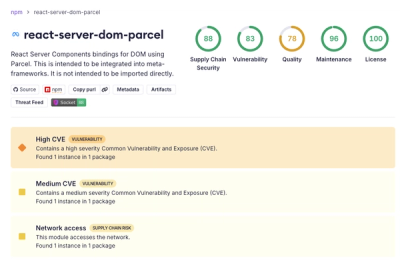
New DoS and source code exposure bugs in React Server Components and Next.js: what’s affected and how to update safely.

Security News
Socket CEO Feross Aboukhadijeh joins Software Engineering Daily to discuss modern software supply chain attacks and rising AI-driven security risks.