

Security News
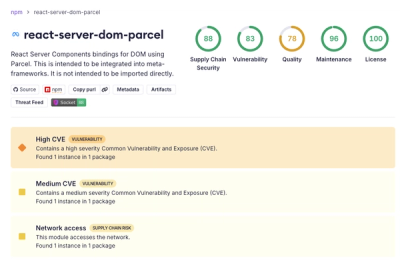
New React Server Components Vulnerabilities: DoS and Source Code Exposure
New DoS and source code exposure bugs in React Server Components and Next.js: what’s affected and how to update safely.
By Sarah Gooding - Dec 12, 2025
graflo
Advanced tools
A framework for transforming tabular (CSV, SQL) and hierarchical data (JSON, XML) into property graphs and ingesting them into graph databases (ArangoDB, Neo4j)
A framework for transforming tabular (CSV, SQL) and hierarchical data (JSON, XML) into property graphs and ingesting them into graph databases (ArangoDB, Neo4j, TigerGraph).
⚠️ Package Renamed: This package was formerly known as
graphcast.






graflo works with property graphs, which consist of:
The Schema defines how your data should be transformed into a graph and contains:
Resources are your data sources that can be:
Full documentation is available at: growgraph.github.io/graflo
pip install graflo
from suthing import FileHandle

from graflo import Schema, Caster, Patterns
from graflo.db.connection.onto import ArangoConfig

schema = Schema.from_dict(FileHandle.load("schema.yaml"))

# Option 1: Load config from docker/arango/.env (recommended)
conn_conf = ArangoConfig.from_docker_env()

# Option 2: Load from environment variables
# Set: ARANGO_URI, ARANGO_USERNAME, ARANGO_PASSWORD, ARANGO_DATABASE
conn_conf = ArangoConfig.from_env()

# Option 3: Load with custom prefix (for multiple configs)
# Set: USER_ARANGO_URI, USER_ARANGO_USERNAME, USER_ARANGO_PASSWORD, USER_ARANGO_DATABASE
user_conn_conf = ArangoConfig.from_env(prefix="USER")

# Option 4: Create config directly
# conn_conf = ArangoConfig(
#     uri="http://localhost:8535",
#     username="root",
#     password="123",
#     database="mygraph",  # For ArangoDB, 'database' maps to schema/graph
# )
# Note: If 'database' (or 'schema_name' for TigerGraph) is not set,
# Caster will automatically use Schema.general.name as fallback

from graflo.util.onto import FilePattern
import pathlib

# Create Patterns with file patterns
patterns = Patterns()
patterns.add_file_pattern(
    "work",
    FilePattern(regex="\Sjson$", sub_path=pathlib.Path("./data"), resource_name="work")
)

# Or use resource_mapping for simpler initialization
# patterns = Patterns(
#     _resource_mapping={
#         "work": "./data/work.json",
#     }
# )

schema.fetch_resource()

caster = Caster(schema)

caster.ingest(
    output_config=conn_conf,  # Target database config
    patterns=patterns,  # Source data patterns
)
To install requirements
git clone git@github.com:growgraph/graflo.git && cd graflo
uv sync --dev
Spin up Arango from arango docker folder by
docker-compose --env-file .env up arango
Neo4j from neo4j docker folder by
docker-compose --env-file .env up neo4j
and TigerGraph from tigergraph docker folder by
docker-compose --env-file .env up tigergraph
To run unit tests
pytest test
Contributions are welcome! Please feel free to submit a Pull Request.
FAQs
A framework for transforming tabular (CSV, SQL) and hierarchical data (JSON, XML) into property graphs and ingesting them into graph databases (ArangoDB, Neo4j)
We found that graflo demonstrated a healthy version release cadence and project activity because the last version was released less than a year ago. It has 1 open source maintainer collaborating on the project.
Did you know?

Socket for GitHub automatically highlights issues in each pull request and monitors the health of all your open source dependencies. Discover the contents of your packages and block harmful activity before you install or update your dependencies.
Security News
New DoS and source code exposure bugs in React Server Components and Next.js: what’s affected and how to update safely.

Security News
Socket CEO Feross Aboukhadijeh joins Software Engineering Daily to discuss modern software supply chain attacks and rising AI-driven security risks.
Security News
GitHub has revoked npm classic tokens for publishing; maintainers must migrate, but OpenJS warns OIDC trusted publishing still has risky gaps for critical projects.