

Product
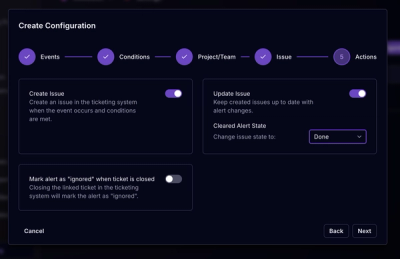
Socket for Jira Is Now Available
Socket for Jira lets teams turn alerts into Jira tickets with manual creation, automated ticketing rules, and two-way sync.
By Jeppe Hasseriis - Apr 20, 2026
hccpy
Advanced tools
Hierachical Condition Categories Python Package.
This module implements the Hierachical Condition Categories that are used for adjusting risks for the Medicare population. The original SAS implementation can be found here.
The latest version is 0.1.9 which was released on 05/13/2023.
Currently, hccpy supports:
Note that hccpy does not have support for ICD-9.
Installing from the source:
$ git clone git@github.com:yubin-park/hccpy.git
$ cd hccpy
$ python setup.py develop
Or, simply using pip:
$ pip install hccpy
hccpy/ : The package source code is located here.
data/: The raw data files directly downloaded from the National Burequ of Economics Research
_AGESEXV2.py: a Python re-write of the AGESEXV2.TXT SAS script._V2218O1M.py: a Python re-write of the V2218O1M.TXT SAS script._V2218O1P.py: a Python re-write of the V2219O1P.TXT SAS script._V22I0ED2.py: a Python re-write of the V22I0ED2.TXT SAS script._V2318P1M.py: a Python re-write of the V2318P1M.TXT SAS script._V2419P1M.py: a Python re-write of the V2419P1M.TXT SAS script.hcc.py: the main module that combines the various logical components for CMS-HCChhshcc.py: the main module for HHS-HCCutils.py: utility functions for reading data filestests/: test scripts to check the validity of the outputs.LICENSE.txt: Apache 2.0.README.md: This README file.setup.py: a set-up script.hccpy is really simple to use.
Please see some examples below:
To import the HCCEngine class from hccpy:
>>> import json
>>> from hccpy.hcc import HCCEngine
>>> he = HCCEngine()
>>> print(he.profile.__doc__)
Returns the HCC risk profile of a given patient information.

        Parameters
        ----------
        dx_lst : list of str
                 A list of ICD10 codes for the measurement year.
        age : int or float
              The age of the patient.
        sex : str
              The sex of the patient; {"M", "F"}
        elig : str
               The eligibility segment of the patient.
               Allowed values are as follows:
               - "CFA": Community Full Benefit Dual Aged
               - "CFD": Community Full Benefit Dual Disabled
               - "CNA": Community NonDual Aged
               - "CND": Community NonDual Disabled
               - "CPA": Community Partial Benefit Dual Aged
               - "CPD": Community Partial Benefit Dual Disabled
               - "INS": Long Term Institutional
               - "NE": New Enrollee
               - "SNPNE": SNP NE
        orec: str
              Original reason for entitlement code.
              - "0": Old age and survivor's insurance
              - "1": Disability insurance benefits
              - "2": End-stage renal disease
              - "3": Both DIB and ESRD
        medicaid: bool
                  If the patient is in Medicaid or not.
>>>
To get a HCC profile from a list of diagnosis codes (in ICD-10):
>>> rp = he.profile(["E1169", "I5030", "I509", "I211", "I209", "R05"])
>>> print(json.dumps(rp, indent=2))
{
  "risk_score": 1.3139999999999998,
  "details": {
    "CNA_M70_74": 0.379,
    "CNA_HCC85": 0.323,
    "CNA_HCC88": 0.14,
    "CNA_HCC18": 0.318,
    "CNA_HCC85_gDiabetesMellit": 0.154,
    "CNA_DIABETES_CHF": 0.0
  },
  "hcc_lst": [
    "HCC85",
    "HCC88",
    "HCC18"
  ],
  "hcc_map": {
    "I5030": "HCC85",
    "I209": "HCC88",
    "E1169": "HCC18",
    "I509": "HCC85"
  },
  "parameters": {
    "age": 70,
    "sex": "M",
    "elig": "CNA",
    "medicaid": false,
    "disabled": 0,
    "origds": 0
  }
}
>>>
Please use "V28" when initializing the engine.
>>> from hccpy.hcc import HCCEngine
>>> he = HCCEngine("28")
Also, see the test_v23() examples in tests/hcc_tests.py.
You can add normalization factors and coding intensity factors to directly calculate the adjusted risk score.
By default, these two parameters are set as:
cif = 0.059, # coding intensity factor.
norm_params={
  "C": 1.015, # community/institution models
  "D": 1.022, # ESRD Dialysis
  "G": 1.028 # ESRD Graft
}
You can overwrite these parameters. For example, this setting below would not adjust the raw risk score.
HCCEngine(version="28", cif = 0, norm_params={"C": 1})
To see the adjusted risk scores,
>>> from hccpy.hcc import HCCEngine
>>> he = HCCEngine("28")
>>> rp = he.profile(["E1169", "I5030", "I509", "I211", "I209", "R05"],
                    age=70, sex="M", elig="CNA")
>>> rp["risk_score_adj"]
Also, see the test_norm_factors() examples in tests/hcc_tests.py.
If a member is new, then provide the elig="NE" in the input:
>>> rp = he.profile([], elig="NE", age=65)
>>> print(json.dumps(rp, indent=2))
{
  "risk_score": 0.514,
  "details": {
    "NE_NMCAID_NORIGDIS_NEM65": 0.514
  },
  "hcc_lst": [],
  "hcc_map": {},
  "parameters": {
    "age": 65,
    "sex": "M",
    "elig": "NE_NMCAID_NORIGDIS_NE",
    "medicaid": false,
    "disabled": 0,
    "origds": 0
  }
}
>>>
If a member has a different eligibility status, change the eligibility as follows (e.g. institutionalized member):
>>> rp = he.profile(["E1169", "I5030", "I509", "I209"], elig="INS")
>>> print(json.dumps(rp, indent=2))
{
  "risk_score": 2.6059999999999994,
  "details": {
    "INS_M70_74": 1.323,
    "INS_HCC88": 0.497,
    "INS_HCC18": 0.441,
    "INS_HCC85": 0.191,
    "INS_HCC85_gDiabetesMellit": 0.0,
    "INS_DIABETES_CHF": 0.154
  },
  "hcc_lst": [
    "HCC88",
    "HCC18",
    "HCC85"
  ],
  "hcc_map": {
    "I209": "HCC88",
    "E1169": "HCC18",
    "I509": "HCC85",
    "I5030": "HCC85"
  },
  "parameters": {
    "age": 70,
    "sex": "M",
    "elig": "INS",
    "medicaid": false,
    "disabled": 0,
    "origds": 0
  }
}
To get the description, hierarchy parents and children of a HCC:
>>> hcc_doc = he.describe_hcc("HCC19")  # either "HCC19", "hcc19" or "19"
>>> print(json.dumps(hcc_doc, indent=2))
{
  "description": "Diabetes without Complication",
  "children": [],
  "parents": [
    "HCC17",
    "HCC18"
  ]
}
Not all claims are eligible for risk adjustment. For professional claims, a certain set of CPT codes is required to be eligible, while for institutional claims, a certain set of bill types is needed. This module provides an easy interface for determining if a certain claim is eligible for risk adjustment or not.
NOTE: This function uses CPT codes, and this requires AMA CPT license. Once you carefully review the license, you need to download a data file.
>>> from hccpy.raeligible import RAEligible
>>> rae = RAEligible()
>>> rae.load(fn="CY2019Q2_CPTHCPCS_CMS_20190425.csv")
>>> rae.is_eligible(pr_lst=["C5271"])
True
>>> rae.is_eligible(pr_lst=["C5270"])
False
>>>
NOTE: The data file (CY2019Q2_CPTHCPCS_CMS_20190425.csv) should be located in the same folder.
python -m build
twine upload dist/*
Apache 2.0
FAQs
hccpy is a Python implementation of HCC
We found that hccpy demonstrated a healthy version release cadence and project activity because the last version was released less than a year ago. It has 1 open source maintainer collaborating on the project.
Did you know?

Socket for GitHub automatically highlights issues in each pull request and monitors the health of all your open source dependencies. Discover the contents of your packages and block harmful activity before you install or update your dependencies.
Product
Socket for Jira lets teams turn alerts into Jira tickets with manual creation, automated ticketing rules, and two-way sync.
Company News
Socket won two 2026 Reppy Awards from RepVue, ranking in the top 5% of all sales orgs. AE Alexandra Lister shares what it's like to grow a sales career here.

Security News
NIST will stop enriching most CVEs under a new risk-based model, narrowing the NVD's scope as vulnerability submissions continue to surge.