

Product
Introducing Reachability for PHP
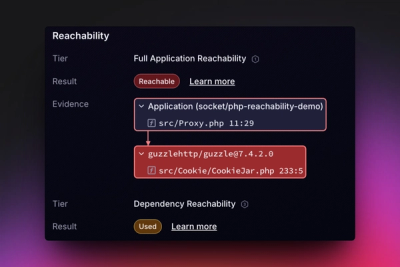
Reachability analysis for PHP is now available in experimental, helping teams identify which vulnerabilities are actually exploitable.
By Benjamin Barslev - Apr 24, 2026
hiPhive
Advanced tools
hiPhive is a tool for efficiently extracting high-order force constants from atomistic simulations, most commonly density functional theory calculations.
A detailed description of the functionality provided as well as an extensive tutorial can be found in the user guide <https://hiphive.materialsmodeling.org/>.
Complete examples of using hiphive for force constants extraction can be found in the hiphive-examples repository <https://gitlab.com/materials-modeling/hiphive-examples/>.
hiPhive is written in Python, which allows easy integration with countless first-principles codes and analysis tools accessible in Python, and allows for a simple and intuitive user interface. For example using the following snippet one can train a force constant potential:
.. code-block:: python
cs = ClusterSpace(primitive_cell, cutoffs) sc = StructureContainer(cs, list_of_training_structure) opt = Optimizer(sc.get_fit_data()) opt.train() fcp = ForceConstantPotential(cs, opt.parameters)
after which it can be used in various ways, e.g., for generating phonon dispersions, computing phonon lifetimes, or running molecular dynamics simulations.
For questions and help please use the hiphive discussion forum on matsci.org <https://matsci.org/hiphive>.
hiPhive and its development are hosted on gitlab <https://gitlab.com/materials-modeling/hiphive>.
hiPhive can be installed via pip::
pip3 install hiphive
or via conda <https://anaconda.org/conda-forge/hiphive>_::
conda install -c conda-forge hiphive
hiPhive requires Python3 and invokes functionality from several external libraries including the
atomic simulation environment <https://wiki.fysik.dtu.dk/ase>,
scikit-learn <http://scikit-learn.org/>,
spglib <https://phonopy.github.io/spglib/>,
SymPy <http://www.sympy.org/en/index.html>, and
trainstation <https://trainstation.materialsmodeling.org/>.
Please consult the installation section of the user guide <https://hiphive.materialsmodeling.org/installation.html> for details.
hiPhive has been developed at the Department of Physics <https://www.chalmers.se/en/departments/physics/Pages/default.aspx>_ of Chalmers University of Technology <https://www.chalmers.se/>_ (Gothenburg, Sweden) in the Condensed Matter and Materials Theory division <http://www.materialsmodeling.org>_.
When using hiPhive in your research please cite the following paper:
| Fredrik Eriksson, Erik Fransson, and Paul Erhart
| The Hiphive Package for the Extraction of High‐Order Force Constants by Machine Learning
| Adv. Theory. Sim., 1800184 (2019)
| doi: 10.1002/adts.201800184 <https://doi.org/10.1002/adts.201800184>_
Please consult the Credits <https://hiphive.materialsmodeling.org/credits>_ page of the documentation for additional references.
FAQs
High-order force constants for the masses
We found that hiPhive demonstrated a healthy version release cadence and project activity because the last version was released less than a year ago. It has 2 open source maintainers collaborating on the project.
Did you know?

Socket for GitHub automatically highlights issues in each pull request and monitors the health of all your open source dependencies. Discover the contents of your packages and block harmful activity before you install or update your dependencies.
Product
Reachability analysis for PHP is now available in experimental, helping teams identify which vulnerabilities are actually exploitable.
Product
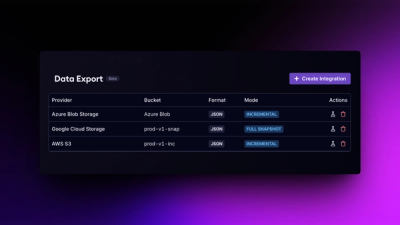
Export Socket alert data to your own cloud storage in JSON, CSV, or Parquet, with flexible snapshot or incremental delivery.
Research
/Security News
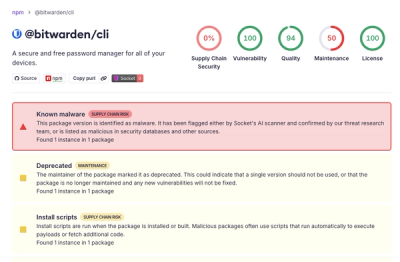
Bitwarden CLI 2026.4.0 was compromised in the Checkmarx supply chain campaign after attackers abused a GitHub Action in Bitwarden’s CI/CD pipeline.