

Security News
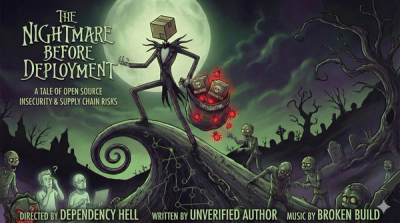
The Nightmare Before Deployment
Season’s greetings from Socket, and here’s to a calm end of year: clean dependencies, boring pipelines, no surprises.
By Ahmad Nassri - Dec 16, 2025
influxpy
Advanced tools
Python logging handler for sending messages to InfluxDB using the line protocol over UDP.
influxpy

Python logging handler that sends messages to InfluxDB via UDP using the line protocol. There is decidedly no support for the HTTP input.
The code was heavily inspired by and based on graypy.
import logging
import influxpy

my_logger = logging.getLogger("test_logger")
my_logger.setLevel(logging.DEBUG)

handler = influxpy.UDPHandler("localhost", 8089, "influxpy_logs",
                              global_tags={"app": "example"})
my_logger.addHandler(handler)

my_logger.debug("Hello InfluxDB.")
Tracebacks are added as full messages::
try:
    puff_the_magic_dragon()
except NameError:
    my_logger.debug("No dragons here.", exc_info=1)
The UDP Input for InfluxDB has to be enabled in order to make use of this library.
# influxdb.conf:
...
[[udp]]
enabled = true
bind-address = ":8089"
database = "udp"
Also take note of the InfluxDB UDP documentation.
influxpy.UDPHandler:
socket.getfqdn() instead of socket.gethostname() to set the source host.The following tags will be added to every message:
host, level, level_name, logger
The host is set to socket.gethostname(), but can be changed
by setting fqdn, or overriding it completly by providing localname.
level is the syslog level mapped to this message. level_name is
the respective Python logging level name (INFO, ERROR, etc.).
The logger tag is simply the name of the Python logger.
It is possible to pass global_tags and thereby configure a set of
static tags that are added to every message. For example, the following
will put datacenter=us-west and app=snakeoil as global tags.
handler = influxpy.UDPHandler("127.0.0.1", 8089, "",
                              global_tags={
                                  "datacenter": "us-west",
                                  "app": "snakeoil"})
message, full_message
The full_message field is added only to messages for which an exception
traceback is available. That is, when using logger.exception()
or setting exec_info=1 explicitly.
When debugging_fields is set to True, the following fields are added
additionally:
file, function, line, pid, process_name, thread_name
When extra_fields is set to True, any extra fields on the LogRecord
instance are sent to InfluxDB. Adding extra fields can be achieved by
passing the extra keyword argument to a logger call, or using
logging.LoggerAdapter. See the Python logging documentation for
more information.
my_logger.debug("Login successful.", extra={"username": "John"})
my_logger.info("It is warm.", extra={"temperature": 26.3})
my_logger.warn("Disk Report.", extra={"disk_utilization": 73.4,
                                      "disk_free_space_mb": 63129})
This allows to conveniently add timeseries information that can be visualized using Grafana.
It should be easy to integrate influxpy with Django's logging settings.
FAQs
Python logging handler for sending messages to InfluxDB using the line protocol over UDP.
We found that influxpy demonstrated a healthy version release cadence and project activity because the last version was released less than a year ago. It has 1 open source maintainer collaborating on the project.
Did you know?

Socket for GitHub automatically highlights issues in each pull request and monitors the health of all your open source dependencies. Discover the contents of your packages and block harmful activity before you install or update your dependencies.
Security News
Season’s greetings from Socket, and here’s to a calm end of year: clean dependencies, boring pipelines, no surprises.

Research
/Security News
Impostor NuGet package Tracer.Fody.NLog typosquats Tracer.Fody and its author, using homoglyph tricks, and exfiltrates Stratis wallet JSON/passwords to a Russian IP address.

Security News
Deno 2.6 introduces deno audit with a new --socket flag that plugs directly into Socket to bring supply chain security checks into the Deno CLI.