


Security News
Deno 2.6 + Socket: Supply Chain Defense In Your CLI
Deno 2.6 introduces deno audit with a new --socket flag that plugs directly into Socket to bring supply chain security checks into the Deno CLI.
By Sarah Gooding - Dec 12, 2025
jdbl
Advanced tools
A json based database library, RAM running and including basic read-write lock.
TODO:
jdb means json based database, but with some fixed structure.
jdbl made its own file format, .jdb.
A .jdb file's data is a database(db) itself. Its each key is a table(tb) name, and the value is a table data.
Seems like this:
// db1.jdb
{
    "tb1": {...},
    "tb2": {...}
}
As said above, the value of each key of jdb is a table data. A table data is a json format data too, with two fixed keys: columns and rows.
The value of columns is a list of columns' infos, and the value of rows is a list of rows' datas.
Seems like this:
// db1.jdb
{
    "tb1": {
        "columns": [...],
        "rows": [...],
    },
    "tb2": {
        "columns": [...],
        "rows": [...],
    }
}
For understanding better, let's see rows structure first.
rows is a list of row data, it is a list of dict. And each row data is a dict, with attribute name as key, and attribute value as value. You can think a row data is descrbibing like: A person with name "Alice", age 18.
So rows datas seems like this:
...
    "rows": [
        {"id": "32132654", "name": "Alice", "age": 18, ...},
        {"id": "65653251", "name": "Jerry", "age": 19, ...},
        ...
    ],
...
Each attribute name would have a corresponding column info in columns. As you can see below.
columns is a list of column infos, it is a list of dict too. Each column info is a dict, with column's info name as key, and column's info value as value.
There are two fixed info names are fixed.
name: the name of the column.rname: the readable name of the column.And any other info names are custom info names, you can define them by yourself. The jdbl library would make sure that every row data attribute name is in the columns list.
Seems like this:
...
    "columns": [
        {"name": "id", "rname": "ID", ...},
        {"name": "name", "rname": "Person's name", ...},
        {"name": "age", "rname": "Person's age", ...},
    ],
...
This jdbl library helps handle .jdb file, and it provides some functions to operate the database.
You can install it by pip:
pip install jdbl
And import it:
from jdbl import jdb_handler
In order to avoid data corruption for multi-threaded, multi-processed environment, jdbl provides read-write lock directly. It means when you used(read or write) one jdb file, the file would be locked up.
To make the api more readable, the function is named use and un_use.
use function is used to lock the jdb file, and un_use function is used to unuse the jdb file.
# lock the jdb file
jdb_handler.use("db1")

# unlock the jdb file
jdb_handler.un_use("db1")
When you use a jdb, you should make sure that you unlock it after you finish using it. Otherwise next time you use the same jdb, it would be block for five seconds and print a warning.
As it is a json format with fixed structure, you can use json library to get datas directly. But jdbl provides some functions to make it more readable.
get_tb_data function is used to get the table data of a table.
tb_data = jdb_handler.get_tb_data("db1", "tb1")
query_row function is used to query the rows that with some conditions. For now, it searches rows by col_name and col_value provided.
rows = jdb_handler.query_rows("db1", "tb1", "name", "Alice")
This would return a list of row data dict that with name attribute value is "Alice".
As it is a json format with fixed structure, you can use json library to write datas directly. But jdbl provides some functions to make it more readable.
add_rows function is used to add rows to a table. And it has upsert mode. Which would just update the row if it exists, or add the row if it doesn't exist.
row_datas = [
    {"id": "32132654", "name": "Alice", "age": 18, ...},
    {"id": "65653251", "name": "Jerry", "age": 19, ...},
    ...
]
jdb_handler.add_rows("db1", "tb1", row_datas, "name", upsert_mode=True)
This would add the rows to tb1 table in db1 database. If the row with name attribute value is "Alice" exists, it would be updated. Otherwise it would be added.
As said above, normally you need to use a jdb and do something with it, then you need to un_use it. It is for fast RAM running when you need to do many operations to one jdb. But for some one time operation like "reading the table and do nothing else", the use-do-un_use steps are a little bit annoying. So jdbl provides some one-time functions to make it more convenient.
Here're some one-time functions like:
get_tb_data_oncequery_rows_onceadd_rows_onceThey are the same as the normal functions, but you don't need to use and un_use the jdb yourself, the function would do it for you.
FAQs
A json based database library, RAM running and including basic read-write lock.
We found that jdbl demonstrated a healthy version release cadence and project activity because the last version was released less than a year ago. It has 1 open source maintainer collaborating on the project.
Did you know?

Socket for GitHub automatically highlights issues in each pull request and monitors the health of all your open source dependencies. Discover the contents of your packages and block harmful activity before you install or update your dependencies.
Security News
Deno 2.6 introduces deno audit with a new --socket flag that plugs directly into Socket to bring supply chain security checks into the Deno CLI.
Security News
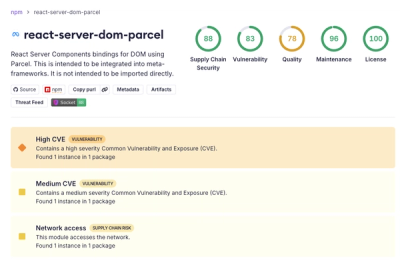
New DoS and source code exposure bugs in React Server Components and Next.js: what’s affected and how to update safely.

Security News
Socket CEO Feross Aboukhadijeh joins Software Engineering Daily to discuss modern software supply chain attacks and rising AI-driven security risks.