


Security News
Deno 2.6 + Socket: Supply Chain Defense In Your CLI
Deno 2.6 introduces deno audit with a new --socket flag that plugs directly into Socket to bring supply chain security checks into the Deno CLI.
By Sarah Gooding - Dec 12, 2025
jsondbupload
Advanced tools
Module enables a user to insert records into a database from a json file and also enables insertion into tables with foreign keys. Hence, if you need to table A first, then key the primary keys from that to table B, this is possible from JsonDBUpload!
When you have a new application there are times where you need to insert some initial set of records. Or there maybe a time where you need to synchronise data selectively between data stores of sorts. This is where this module can be of use. It can help to insert records in any relational database which has a connection to it via sqlaclchemy
The module takes in an argument of a json file (or a list-dictionary), and then proceeds to insert records one by one. The json file must contain the table name, and label and foreign keys.
There are two key paramaters:
JSONDBUpload is avaialble through PyPi or you may use git:
pip install jsondbupoad
Or, through git:
git clone https://github.com/pub12/jsondbupload.git
The module is relatively easy to use. All that is required is a file, and a database session. The file format is as follows:
[
	{
		"table_name":"<table name>",
		"foreign_keys":[ { "<field name in current table>":"<table name of foreign table>.<field name>"} ],
		"data":[
					{"<field name>":"<field value>", ... },
					....
		]
	}
]
There are three key fields:
Here's a working example to update 3 tables. Firstly this is the sqlalchmey schema:
class Author(db.Model):
	__tablename__ = 'author'
	id = db.Column(db.Integer(), primary_key=True)
	name = db.Column(db.Integer() )

class Book(db.Model):
	__tablename__ = 'book'
	id = db.Column(db.Integer(), primary_key=True)
	name = db.Column(db.Integer() )
	author_id = db.Column( db.Integer()  , db.ForeignKey( 'author.id'  ) )
	_author = db.relationship("Author", backref=db.backref("author" ), lazy='joined')


class Bookset(db.Model):
	__tablename__ = 'bookset'
	id = db.Column(db.Integer(), primary_key=True)
	name = db.Column(db.Integer() )
And here's the json data to be used, this is in a file called db_upload_file.json (this can be any filename of course):
[
	{
		"table_name":"author",
		"data":[
					{"id":"AA_1", "name":"James"  },
					{"id":"AA_2", "name":"Moneypenny" }
		]
	},
	{
		"table_name":"book",
		"foreign_keys":[ { "author_id":"author.id"} ],
		"data":[
					{"id":"BB_1", "author_id":"AA_1", "name":"Never say Never"  },
					{"id":"BB_2", "author_id":"AA_2", "name":"Goldeneye" }
		]
	},
	{
		"table_name":"bookset",
		"data":[
					{"id":"", "name":"Best of Bond"  }
		]
	}
]
In this example, we have:
author with two rows. Please note, that in the database schema the field id is a primary key with automatic values so the entries will be ignored.book has a foreign key linkage where author_id is supposed to link to table book.id and the temporary values are linked to the table author by the foreign_keys description.bookset is much simpler where the name field is specified, and the primary key id has no entry as any value given to it will be ignored anyway as it is a primary key.Finally, this is the code:
from jsondbupload import JsonDBUpload
from flask import Flask
from flask_sqlalchemy import SQLAlchemy, Model

from mclogger import MCLogger

#Define the table methods
class Author(db.Model):
	__tablename__ = 'author'
	id = db.Column(db.Integer(), primary_key=True)
	name = db.Column(db.Integer() )

class Book(db.Model):
	__tablename__ = 'book'
	id = db.Column(db.Integer(), primary_key=True)
	name = db.Column(db.Integer() )
	author_id = db.Column( db.Integer()  , db.ForeignKey( 'author.id'  ) )
	_author = db.relationship("Author", backref=db.backref("author" ), lazy='joined')


class Bookset(db.Model):
	__tablename__ = 'bookset'
	id = db.Column(db.Integer(), primary_key=True)
	name = db.Column(db.Integer() )

#Instantiate flask
app = Flask(__name__)
app.config['SQLALCHEMY_DATABASE_URI'] = 'sqlite:///test.db'
app.config['SQLALCHEMY_TRACK_MODIFICATIONS'] = False
db = SQLAlchemy(app)

#Create logger - this is from https://pypi.org/project/mclogger/
logger = MCLogger( 'test_log.text').getLogger()

#>>>> Two lines to ulaod json data!  It will also do the commit to the database.  The logger is optional and will show on screen what's happening under the hood.
j2db = JsonDBUpload( db, logger )
j2db.update_tables_from_file(  'db_upload_file.json' )
#>>>>>

#After inserts, this will print out the records updated
auth_list = db.session.query( Author ).all()
for item in auth_list:
	print( item.name )
Create instance of the JsonDBUpload instance.
logging or any sub-class of that such as mclogger. If provided, it'll show a color log in the console of all the insertsUpdate the database tables specfied in a given json file
Update the database tables specfied in a given list of dictionaries
[
	{
		"table_name":"<table name>",
		"foreign_keys":[ { "<field name in current table>":"<table name of foreign table>.<field name>"} ],
		"data":[
					{"<field name>":"<field value>", ... },
					....
		]
	}
]
FAQs
Insert records to relational database from json file
We found that jsondbupload demonstrated a healthy version release cadence and project activity because the last version was released less than a year ago. It has 1 open source maintainer collaborating on the project.
Did you know?

Socket for GitHub automatically highlights issues in each pull request and monitors the health of all your open source dependencies. Discover the contents of your packages and block harmful activity before you install or update your dependencies.
Security News
Deno 2.6 introduces deno audit with a new --socket flag that plugs directly into Socket to bring supply chain security checks into the Deno CLI.
Security News
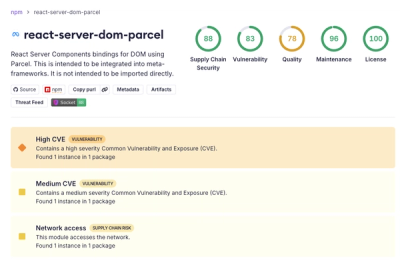
New DoS and source code exposure bugs in React Server Components and Next.js: what’s affected and how to update safely.

Security News
Socket CEO Feross Aboukhadijeh joins Software Engineering Daily to discuss modern software supply chain attacks and rising AI-driven security risks.