

Security News
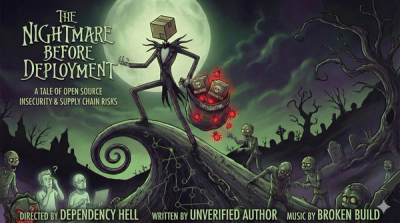
The Nightmare Before Deployment
Season’s greetings from Socket, and here’s to a calm end of year: clean dependencies, boring pipelines, no surprises.
By Ahmad Nassri - Dec 16, 2025
klfuncutil
Advanced tools
"Functional Programming" distinguishes between:
Data should be treated as immutable. For example, if an element is added to a list, a new "list" object is created. The source remains unchanged. This corresponds to the behavior of strings in Python. The situation is different with the "Collection" objects in Python. The classes:
can be changed "in place". "tuple" and "set" cannot, however. The module "collection.py" provides the functions:
which can be used to edit:
in the same way. The source remains unchanged in each case. The result is always a new object of the same class as the source.
Functions - or "pure functions" are used to implement business rules. The result depends only on the input parameters of the function. The iterators, which are also frequently used in functional programming, lead to surprising effects.
Example:
def get_even_num(list_of_numbers):
return filter(lambda x: x % 2 == 0, list_of_numbers)
# Create iterator; return even numbers only
coll_even_num = get_even_num([1,2,3,4,5,6,7,8])
# get sum; sum is a "pure function"
print(sum(coll_even_num))
print(sum(coll_even_num))
The output is:
20
0
The result is quickly explained: the function "sum" used up the iterator "coll_even_num" with the first call. With the second call, this iterator no longer returns any values - the result is "0". If you run the example shown above with an object of the class "list", a different result is returned:
def get_even_num_as_list(list_of_numbers):
return list(filter(lambda x: x % 2 == 0, list_of_numbers))

# Create iterator; return even numbers only
coll_even_num = get_even_num([1,2,3,4,5,6,7,8])
# get sum; sum is a "pure function"
print(sum(coll_even_num))
print(sum(coll_even_num))
The output is:
20
20
An important feature of Python is generic algorithms. These (like the "sum" function) can work with different input data such as:
The "iterator.py" module provides the "decorators":
These can be used on functions that return "iterators".
The "decorator" is used to package the "iterator" in a class that returns a new "iterator" every time the function __iter__() is called. "restartable_t" and "restartable_m" use different methods to
get a new "iterator":
"restartable_t" and "restartable_m" cannot, of course, perform miracles - they merely compensate for the unexpected behavior of the "iterator". "restartable_t" does this at the expense of runtime - "restartable_m" at the expense of storage space.
Example:
from klfuncutil.iterator import restartable_t

@restartable_t
def get_even_num(list_of_numbers):
return filter(lambda x: x % 2 == 0, list_of_numbers)

# Create iterator; return even numbers only
coll_even_num = get_even_num([1,2,3,4,5,6,7,8])
# getsum; sum is a "pure function"
print(sum(coll_even_num))
print(sum(coll_even_num))
The output is:
 20
 20
https://github.com/nuuk42/klfuncutil.git
Use: pip install klfuncutil
FAQs
Utilities for functional programming
We found that klfuncutil demonstrated a healthy version release cadence and project activity because the last version was released less than a year ago. It has 1 open source maintainer collaborating on the project.
Did you know?

Socket for GitHub automatically highlights issues in each pull request and monitors the health of all your open source dependencies. Discover the contents of your packages and block harmful activity before you install or update your dependencies.
Security News
Season’s greetings from Socket, and here’s to a calm end of year: clean dependencies, boring pipelines, no surprises.

Research
/Security News
Impostor NuGet package Tracer.Fody.NLog typosquats Tracer.Fody and its author, using homoglyph tricks, and exfiltrates Stratis wallet JSON/passwords to a Russian IP address.

Security News
Deno 2.6 introduces deno audit with a new --socket flag that plugs directly into Socket to bring supply chain security checks into the Deno CLI.