







Company News
Socket Has Acquired Secure Annex
Socket has acquired Secure Annex to expand extension security across browsers, IDEs, and AI tools.
By Feross Aboukhadijeh - Apr 28, 2026
lammps-step
Advanced tools
.. image:: https://img.shields.io/github/issues-pr-raw/molssi-seamm/lammps_step :target: https://github.com/molssi-seamm/lammps_step/pulls :alt: GitHub pull requests
.. image:: https://github.com/molssi-seamm/lammps_step/workflows/CI/badge.svg :target: https://github.com/molssi-seamm/lammps_step/actions :alt: Build Status
.. image:: https://codecov.io/gh/molssi-seamm/lammps_step/branch/master/graph/badge.svg :target: https://codecov.io/gh/molssi-seamm/lammps_step :alt: Code Coverage
.. image:: https://github.com/molssi-seamm/lammps_step/workflows/CodeQL/badge.svg :target: https://github.com/molssi-seamm/lammps_step/security/code-scanning :alt: Code Quality
.. image:: https://github.com/molssi-seamm/lammps_step/workflows/Release/badge.svg :target: https://molssi-seamm.github.io/lammps_step/index.html :alt: Documentation Status
.. image:: https://img.shields.io/pypi/v/lammps_step.svg :target: https://pypi.python.org/pypi/lammps_step :alt: PyPi VERSION
A SEAMM plug-in for LAMMPS, a forcefield-based molecular dynamics code.
This plug-in provides a graphical user interface (GUI) for setting up complex simulations using LAMMPS. It uses a sub-flowchart that provides steps such as constant pressure and temperature (NPT) dynamics which give access to the functionality in LAMMPS in a more consistent and understandable way than the inscrutable fixes that LAMMPS uses.
These sub-flowcharts mirror the main flowchart in form and function and can use the same variables such as temperature and pressure that are accessible anywhere in the flowcharts. This allows "programming" a LAMMPS workflow in the same familiar way that SEAMM uses to represent the overall workflow.
Use of any forcefield supported by the forcefield plug-in:
Molecular statics: minimization
Molecular dynamics: NVE, NVT, and NPT with any of the approaches supported in LAMMPS
Automatic statistical analysis of averages from MD
Using property values to drive MD. Rather than running MD for a length of time, automatically run long enough to determine a set of properties within given error bars.
This package was created with Cookiecutter_ and the molssi-seamm/cookiecutter-seamm-plugin_ project template.
.. _Cookiecutter: https://github.com/audreyr/cookiecutter
.. _molssi-seamm/cookiecutter-seamm-plugin: https://github.com/molssi-seamm/cookiecutter-seamm-plugin
Developed by the Molecular Sciences Software Institute (MolSSI_),
which receives funding from the National Science Foundation_ under
award ACI-1547580
.. _MolSSI: https://www.molssi.org
.. _National Science Foundation: https://www.nsf.gov
2026.3.26 -- Bugfix: MDI stress not calculated and error catching * MDI requires an option in fix mdi/qm for it to request the virial; it is not automatic for e.g. NPT calculations. The code now adds the keywords for periodic calculations but not molecular ones. * Added code to catch errors in the analysis of the GPU performance in cases where data is missing or cannot be interpreted correctly, so that calculation continues without error. * Fixed an issue returning the stdout and stderr from the LAMMPS/MDI calculation. LAMMPS logs to stdout and MDI to stderr to keep the streams separate.
2026.3.24 -- Bugfix: Issues calculating the stress and its sign. * Added an option to the fix mdi/qm line to ensure that MDI calculates the stress. * Fixed the sign issue in the stress between LAMMPS and MDI.
2026.3.23 -- Improved the performance output and results for MD
2026.3.22.1 -- Fixed issue running LAMMPS using a conda environment * Fixed a problem running LAMMPS directly in a conda environment, due to the construction of the command line having an error.
2026.3.22 -- Added support for MDI and GPUs, mainly for MLFFs * Added monitoring of GPU utilization and memory utilization * Added more output about the performance of the run to the job output. * Added the ability to run MACE MLFFs using MDI. This avoids needing a GPU version of LAMMPS that supports ML-IAP, making it much easier to run these MLFFs.
2026.2.25 -- Added support for ML-IAP forcefields. * Handle forcefields with the extension .pt and containing 'mliap' in their name using ML-IAP.
2026.1.28 -- Bugfix: Fixed error in analysis of non-periodic molecules * Recent additions to the analysis introduced a bug for non-periodic systems, where in some circumstances the code crashed due to interpreting the cell info in LAMMPS dump files.
2026.1.8 -- Improved handling of atom position and velocity trajectories. * Added the time and units for the time to the atomic poisition and velocity trajectories used in e.g. diffusivity to ensure the correct times are used.
2025.12.9 -- Enhancements: Running on GPUs and output from minimization * Ensured that at least 1 GPU is used when running using PyTorch potentials. This allows running from the commmand-line or locally in addition to using SLURM, which already worked. * Added the cell parameters, volume, and density, plus the change in each, whne running minimizations. These are now results that can be stores in tables and saved in variables.
2025.11.22 -- Bugfixes: volume units and converting pressure units. * Fixed the incorrect units for volume in the metadata for LAMMPS. * Fixed a crash caused by LAMMPS storing large pressures as integers, not floating point numbers.
2025.11.19.1 -- Bugfix: Properties not handled in MD runs * Due to an inadvertant error in the previous release, properties were not placed in local variables, tables or as properties on the configuration if requested.
2025.11.19 -- Enhancements to properties and storing trajectories in the database
This release enhances the LAMMPS step with property calculations and trajectory storage
capabilities. The main focus is adding formation energy calculations (DfE0) using
tabulated element energies, storing stress as a 6-component Voigt vector, and
enabling trajectory import into the database as system configurations.

* Added formation energy (DfE0) and atomization energy calculations using tabulated
  reference data for atomic energies
* Implemented trajectory save functionality to store MD trajectories as
  configurations in the database
* Reorganized stress tensor output to follow Voigt ordering (Sxx, Syy, Szz, Syz,
  Sxz, Sxy) and added stress vector property
2025.11.9 -- Bugfix: Error with units in trajectories when using OpenKIM
 This release adds support for volume units across all LAMMPS unit systems to fix
 a bug in trajectory analysis when using OpenKIM potentials that use "metal" units.
 The changes enable proper unit conversion for volume quantities during trajectory
 analysis. Key changes are

 * Added "volume" definitions to all seven LAMMPS unit systems
 * Added volume dimensionality mappings in the unit conversion dictionaries
 * Implemented unit conversion logic in trajectory analysis to convert from LAMMPS
   units to SEAMM units
2025.11.6 -- Bugfix: Error in writing extxyz trajectory files. * Fixed the condition check from "Pxx" to "Sxx" to properly detect stress data * Corrected the case of the stress component variable from 'sxy' to 'Sxy' for consistency
2025.11.5 -- Bugfix: Fixed errors with trajectories using OpenKIM potentials
2025.9.24 -- Bugfix: Error with cell angles for sheared cells
2025.9.21.1 -- Added cell angle parameters to properties
2025.9.21 -- Bugfix: error in NPT dynamics
2025.9.20 -- Completed handling of stress in NPT dynamics
2025.9.2 -- Bugfix: error in the stress parameters in the GUI
2025.8.27 -- Added cell optimization to minimization step
2025.8.21 -- Added stress and improved graph handling
2025.8.2 -- Initial pass at trajectories.
2025.7.23 -- Added a complete description of number of cores used.
2025.6.25 -- Bugfix: ReaxFF memory allocation
2025.6.23 -- Bugfix: handling of GPUs and KOKKOS arguments
2025.6.21 -- Added support for MACE PyTorch potentials.
2025.5.27 -- Bugfix: error in formatting forcefield parameters
2025.5.26 -- Added more metadata to the structure.dat file.
2025.5.7 -- Bugfix: error if not saving configuration in minimization
2025.4.9 -- Adding support for ReaxFF forcefields.
2025.3.17.1 -- Bugfix: Incorrect handling of Dreiding hydrogen bonds
2025.3.17 -- Bugfix: LAMMPS installer did not have correct conda environment
2025.3.16 -- Added Dreiding forcefield and support for structure handling
2025.2.7 -- Installation issue
2024.8.22 -- Bugfix: error in number of cores.
2024.7.31 -- Bugfix and improvements for parallel runs
2024.7.25 -- Bugfix and improvements
2024.7.21.1 -- Minor internal change for GUI
2024.7.21 -- Improved handling of trajectories and results
2024.6.28.1 -- Internal release to fix issue making Docker image.
2024.6.28 -- Added energy and forces to properties
2024.3.22 -- Corrected issue with e.g. heat flux calculations
2024.3.21 -- Switched to new installation scheme
2024.1.18 -- Restructured to support running in containers.
2023.11.7 -- Bugfix: properties that are constant
2023.11.6 -- Bugfix in thermal conductivity
2023.9.6 -- Corrected issues with final coordinates; added velocities
2023.8.31 -- Bugfix: not reading structure correctly after dynamics
2023.8.27 -- Added support for tabulated angle potentials.
2023.8.21 -- Bugfix: x-axes length on graphics incorrect
2023.6.17 -- Bugfix: more centroid/stress/atom issues
2023.4.24 -- Support for thermal conductivity
2023.4.9 -- Hid the warning from pymbar
2023.4.6 -- Better forcefield handling.
2023.2.6 -- Added handling of OPLS-AA forcefield
2022.10.31 -- Bugfix: properties with commas Properties with commas in their name in data/properties.csv need to have quotes to protect the property name!
2022.10.27 -- Added properties
pymbar because the names of methods were changed.pymbar2021.2.11 (11 February 2021)
2021.2.4.1 (4 February 2021) Internal patch to fix CI; no changes for users.
2021.2.4 (4 February 2021) Updated for compatibility with the new system classes in MolSystem 2021.2.2 release.
2020.12.4 (4 December 2020) Internal: switching CI from TravisCI to GitHub Actions, and in the process moving documentation from ReadTheDocs to GitHub Pages where it is consolidated with the main SEAMM documentation.
2020.11.2 (2 November 2020) Updated to be compatible with the new command-line argument handling.
2020.10.13 (13 October 2020) Added capability to run MD until a set of user-selected properties are converged to requested accuracy.
2020.9.25 (25 September 2020) Updated to be compatible with the new system classes in MolSystem.
2020.8.2.1 (2 August 2020) Bugfix: Fixed problem with nonbonds and charges just introduced.
2020.8.2 (2 August 2020)
Bugfix: Corrected the time units when using metal units with
e.g. EAM potentials.
2020.8.1 (1 August 2020) Added support for OpenKIM potentials.
0.9.4 (29 May 2020) Cleaned up the output for the statistical analysis.
0.9.3 (29 May 2020) Fixed issue with settings for bins in LAMMPS for small nonperiodic systems with just a few atoms.
0.9.2 (25 May 2020) Switched to using PYMBAR for detecting covergence to equilibrium for MD runs. This is a more robust solution than the previous approach.
0.9.1 (24 May 2020) Support for rigid water models, such as TIP-3P.
0.9 (15 April 2020) Support for plots in the dashboard of properties from MD. Added option to produce local HTML for the above plots.
0.8.2 (2020-01-25)
0.7.1 (18 December 2019) Fixed problem with assigning charges to the system.
0.7.0 (17 December 2019) General clean-up of code and output.
0.6 (8 September 2019)
0.5.2 (31 August 2019) Defined the correct requirements for installation.
0.5.1 (30 August 2019) Bugfix: corrected the name of the LAMMPS executable.
0.5.0 (30 August 2019) Added ability to use serial or parallel versions of LAMMPS based on an environment variable.
0.3.1 (27 August 2019) Added initial, fairly reasonable output.
0.2.1 (29 July 2019) First release on PyPI.
FAQs
A SEAMM plug-in for LAMMPS, a forcefield-based molecular dynamics code.
We found that lammps-step demonstrated a healthy version release cadence and project activity because the last version was released less than a year ago. It has 1 open source maintainer collaborating on the project.
Did you know?

Socket for GitHub automatically highlights issues in each pull request and monitors the health of all your open source dependencies. Discover the contents of your packages and block harmful activity before you install or update your dependencies.
Company News
Socket has acquired Secure Annex to expand extension security across browsers, IDEs, and AI tools.

Research
/Security News
Socket is tracking cloned Open VSX extensions tied to GlassWorm, with several updated from benign-looking sleepers into malware delivery vehicles.
Product
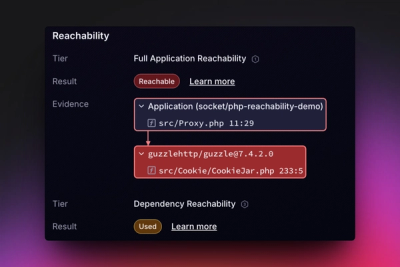
Reachability analysis for PHP is now available in experimental, helping teams identify which vulnerabilities are actually exploitable.