



Security News
Deno 2.6 + Socket: Supply Chain Defense In Your CLI
Deno 2.6 introduces deno audit with a new --socket flag that plugs directly into Socket to bring supply chain security checks into the Deno CLI.
By Sarah Gooding - Dec 12, 2025
libsms
Advanced tools


The SMS(Simulating Microbial Systems) API allows users to design, run, and analyze reproducible simulations of dynamic cellular processes in Escherichia coli. This tool aims to allow users to configure, run, and introspect simulations of the vEcoli(Vivarium-Ecoli) model. The SMS API uniquely acts as both a server and client, using FastAPI, Uvicorn, and Marimo to serve a REST API as well as host Marimo user interfaces. The full comprehensive REST API documentation is available at https://sms.cam.uchc.edu/redoc. Please refer to the aforementioned documentation for the complete details of the request query parameters and body data required for each outlined endpoint.
Server-side sits kubernetes cluster containing a containerized ASGI(Asynchronous Server Gateway Interface) application using Python and FastAPI which is hosted and available at https://sms.cam.uchc.edu/. An API router of endpoints is assigned for each API in this project's scope and available by name in the request url. The primary modes of interaction exist within the "/wcm" and "/core" endpoint routers. For example, the primary single-cell API ("core") endpoints are hosted at https://sms.cam.uchc.edu/core. A more generalized, Nextflow-based group of endpoints that is actively being developed is available at https://sms.cam.uchc.edu/wcm. Internally it uses a simulation service that dynamically creates and dispatches SLURM job scripts which are executed through an authenticated connection with a given HPC(High Performance Computing) environment.
The /wcm endpoint router enables the design, execution, and introspection of simulations using vEcoli's Nextflow API. This is the preferred mode of interaction with the SMS API, as it enables users to customize simulation configurations, create variants, run analysis, and execute a "batch" of one or many ecoli simulation jobs. A typical end-to-end SMS API /wcm workflow consists of the following:
This project’s “client” behavior is leveraged by the utilization of Marimo(python) components rather than a traditional javascript-based frontend framework. A static HTML Jinja template is served as an extension of the FastAPI/Uvicorn backend server enabling interactive simulation introspection. There exists a user interface for each router within the set of routers exposed by the REST API. The user interface makes calls to the REST API to enable non-programmatic interaction with the aforementioned endpoints. This UI is accessible by navigating to https://sms.cam.uchc.edu/.
FAQs
Interacting with the Simulating Microbial Systems (SMS Atlantis) API
We found that libsms demonstrated a healthy version release cadence and project activity because the last version was released less than a year ago. It has 1 open source maintainer collaborating on the project.
Did you know?

Socket for GitHub automatically highlights issues in each pull request and monitors the health of all your open source dependencies. Discover the contents of your packages and block harmful activity before you install or update your dependencies.
Security News
Deno 2.6 introduces deno audit with a new --socket flag that plugs directly into Socket to bring supply chain security checks into the Deno CLI.
Security News
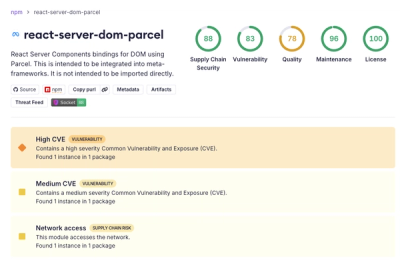
New DoS and source code exposure bugs in React Server Components and Next.js: what’s affected and how to update safely.

Security News
Socket CEO Feross Aboukhadijeh joins Software Engineering Daily to discuss modern software supply chain attacks and rising AI-driven security risks.