


Security News
Deno 2.6 + Socket: Supply Chain Defense In Your CLI
Deno 2.6 introduces deno audit with a new --socket flag that plugs directly into Socket to bring supply chain security checks into the Deno CLI.
By Sarah Gooding - Dec 12, 2025
litellm
Advanced tools


Call all LLM APIs using the OpenAI format [Bedrock, Huggingface, VertexAI, TogetherAI, Azure, OpenAI, Groq etc.]





LiteLLM manages:
completion, embedding, and image_generation endpoints['choices'][0]['message']['content']LiteLLM Performance: 8ms P95 latency at 1k RPS (See benchmarks here)
Jump to LiteLLM Proxy (LLM Gateway) Docs
Jump to Supported LLM Providers
🚨 Stable Release: Use docker images with the -stable tag. These have undergone 12 hour load tests, before being published. More information about the release cycle here
Support for more providers. Missing a provider or LLM Platform, raise a feature request.

pip install litellm
from litellm import completion
import os

## set ENV variables
os.environ["OPENAI_API_KEY"] = "your-openai-key"
os.environ["ANTHROPIC_API_KEY"] = "your-anthropic-key"

messages = [{ "content": "Hello, how are you?","role": "user"}]

# openai call
response = completion(model="openai/gpt-4o", messages=messages)

# anthropic call
response = completion(model="anthropic/claude-sonnet-4-20250514", messages=messages)
print(response)
{
    "id": "chatcmpl-1214900a-6cdd-4148-b663-b5e2f642b4de",
    "created": 1751494488,
    "model": "claude-sonnet-4-20250514",
    "object": "chat.completion",
    "system_fingerprint": null,
    "choices": [
        {
            "finish_reason": "stop",
            "index": 0,
            "message": {
                "content": "Hello! I'm doing well, thank you for asking. I'm here and ready to help with whatever you'd like to discuss or work on. How are you doing today?",
                "role": "assistant",
                "tool_calls": null,
                "function_call": null
            }
        }
    ],
    "usage": {
        "completion_tokens": 39,
        "prompt_tokens": 13,
        "total_tokens": 52,
        "completion_tokens_details": null,
        "prompt_tokens_details": {
            "audio_tokens": null,
            "cached_tokens": 0
        },
        "cache_creation_input_tokens": 0,
        "cache_read_input_tokens": 0
    }
}
Note: LiteLLM also supports the Responses API (
litellm.responses())
Call any model supported by a provider, with model=<provider_name>/<model_name>. There might be provider-specific details here, so refer to provider docs for more information
from litellm import acompletion
import asyncio

async def test_get_response():
    user_message = "Hello, how are you?"
    messages = [{"content": user_message, "role": "user"}]
    response = await acompletion(model="openai/gpt-4o", messages=messages)
    return response

response = asyncio.run(test_get_response())
print(response)
LiteLLM supports streaming the model response back, pass stream=True to get a streaming iterator in response.
Streaming is supported for all models (Bedrock, Huggingface, TogetherAI, Azure, OpenAI, etc.)
from litellm import completion

messages = [{"content": "Hello, how are you?", "role": "user"}]

# gpt-4o
response = completion(model="openai/gpt-4o", messages=messages, stream=True)
for part in response:
    print(part.choices[0].delta.content or "")

# claude sonnet 4
response = completion('anthropic/claude-sonnet-4-20250514', messages, stream=True)
for part in response:
    print(part)
{
    "id": "chatcmpl-fe575c37-5004-4926-ae5e-bfbc31f356ca",
    "created": 1751494808,
    "model": "claude-sonnet-4-20250514",
    "object": "chat.completion.chunk",
    "system_fingerprint": null,
    "choices": [
        {
            "finish_reason": null,
            "index": 0,
            "delta": {
                "provider_specific_fields": null,
                "content": "Hello",
                "role": "assistant",
                "function_call": null,
                "tool_calls": null,
                "audio": null
            },
            "logprobs": null
        }
    ],
    "provider_specific_fields": null,
    "stream_options": null,
    "citations": null
}
LiteLLM exposes pre defined callbacks to send data to Lunary, MLflow, Langfuse, DynamoDB, s3 Buckets, Helicone, Promptlayer, Traceloop, Athina, Slack
from litellm import completion

## set env variables for logging tools (when using MLflow, no API key set up is required)
os.environ["LUNARY_PUBLIC_KEY"] = "your-lunary-public-key"
os.environ["HELICONE_API_KEY"] = "your-helicone-auth-key"
os.environ["LANGFUSE_PUBLIC_KEY"] = ""
os.environ["LANGFUSE_SECRET_KEY"] = ""
os.environ["ATHINA_API_KEY"] = "your-athina-api-key"

os.environ["OPENAI_API_KEY"] = "your-openai-key"

# set callbacks
litellm.success_callback = ["lunary", "mlflow", "langfuse", "athina", "helicone"] # log input/output to lunary, langfuse, supabase, athina, helicone etc

#openai call
response = completion(model="openai/gpt-4o", messages=[{"role": "user", "content": "Hi 👋 - i'm openai"}])
Track spend + Load Balance across multiple projects
The proxy provides:
pip install 'litellm[proxy]'
$ litellm --model huggingface/bigcode/starcoder

#INFO: Proxy running on http://0.0.0.0:4000
[!IMPORTANT] 💡 Use LiteLLM Proxy with Langchain (Python, JS), OpenAI SDK (Python, JS) Anthropic SDK, Mistral SDK, LlamaIndex, Instructor, Curl
import openai # openai v1.0.0+
client = openai.OpenAI(api_key="anything",base_url="http://0.0.0.0:4000") # set proxy to base_url
# request sent to model set on litellm proxy, `litellm --model`
response = client.chat.completions.create(model="gpt-3.5-turbo", messages = [
    {
        "role": "user",
        "content": "this is a test request, write a short poem"
    }
])

print(response)
Connect the proxy with a Postgres DB to create proxy keys
# Get the code
git clone https://github.com/BerriAI/litellm

# Go to folder
cd litellm

# Add the master key - you can change this after setup
echo 'LITELLM_MASTER_KEY="sk-1234"' > .env

# Add the litellm salt key - you cannot change this after adding a model
# It is used to encrypt / decrypt your LLM API Key credentials
# We recommend - https://1password.com/password-generator/
# password generator to get a random hash for litellm salt key
echo 'LITELLM_SALT_KEY="sk-1234"' >> .env

# Start
docker compose up
UI on /ui on your proxy server
Set budgets and rate limits across multiple projects
POST /key/generate
curl 'http://0.0.0.0:4000/key/generate' \
--header 'Authorization: Bearer sk-1234' \
--header 'Content-Type: application/json' \
--data-raw '{"models": ["gpt-3.5-turbo", "gpt-4", "claude-2"], "duration": "20m","metadata": {"user": "ishaan@berri.ai", "team": "core-infra"}}'
{
    "key": "sk-kdEXbIqZRwEeEiHwdg7sFA", # Bearer token
    "expires": "2023-11-19T01:38:25.838000+00:00" # datetime object
}
docker-compose up db prometheuspython -m venv .venvsource .venv/bin/activatepip install -e ".[all]"python litellm/proxy_cli.pyui/litellm-dashboardnpm installnpm run dev to start the dashboardFor companies that need better security, user management and professional support
This covers:
We welcome contributions to LiteLLM! Whether you're fixing bugs, adding features, or improving documentation, we appreciate your help.
This requires poetry to be installed.
git clone https://github.com/BerriAI/litellm.git
cd litellm
make install-dev    # Install development dependencies
make format         # Format your code
make lint           # Run all linting checks
make test-unit      # Run unit tests
make format-check   # Check formatting only
For detailed contributing guidelines, see CONTRIBUTING.md.
LiteLLM follows the Google Python Style Guide.
Our automated checks include:
All these checks must pass before your PR can be merged.
FAQs
Library to easily interface with LLM API providers
We found that litellm demonstrated a healthy version release cadence and project activity because the last version was released less than a year ago. It has 1 open source maintainer collaborating on the project.
Did you know?

Socket for GitHub automatically highlights issues in each pull request and monitors the health of all your open source dependencies. Discover the contents of your packages and block harmful activity before you install or update your dependencies.
Security News
Deno 2.6 introduces deno audit with a new --socket flag that plugs directly into Socket to bring supply chain security checks into the Deno CLI.
Security News
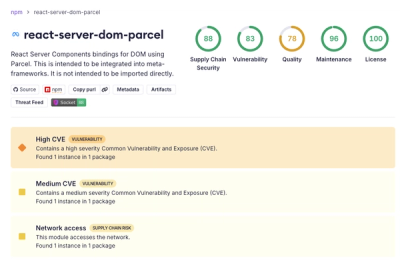
New DoS and source code exposure bugs in React Server Components and Next.js: what’s affected and how to update safely.

Security News
Socket CEO Feross Aboukhadijeh joins Software Engineering Daily to discuss modern software supply chain attacks and rising AI-driven security risks.