


Security News
Deno 2.6 + Socket: Supply Chain Defense In Your CLI
Deno 2.6 introduces deno audit with a new --socket flag that plugs directly into Socket to bring supply chain security checks into the Deno CLI.
By Sarah Gooding - Dec 12, 2025
llama-index
Advanced tools







LlamaIndex (GPT Index) is a data framework for your LLM application. Building with LlamaIndex typically involves working with LlamaIndex core and a chosen set of integrations (or plugins). There are two ways to start building with LlamaIndex in Python:
Starter: llama-index. A starter Python package that includes core LlamaIndex as well as a selection of integrations.
Customized: llama-index-core. Install core LlamaIndex and add your chosen LlamaIndex integration packages on LlamaHub
that are required for your application. There are over 300 LlamaIndex integration
packages that work seamlessly with core, allowing you to build with your preferred
LLM, embedding, and vector store providers.
The LlamaIndex Python library is namespaced such that import statements which
include core imply that the core package is being used. In contrast, those
statements without core imply that an integration package is being used.
# typical pattern
from llama_index.core.xxx import ClassABC  # core submodule xxx
from llama_index.xxx.yyy import (
    SubclassABC,
)  # integration yyy for submodule xxx

# concrete example
from llama_index.core.llms import LLM
from llama_index.llms.openai import OpenAI
LlamaIndex.TS (Typescript/Javascript)
NOTE: This README is not updated as frequently as the documentation. Please check out the documentation above for the latest updates!
We need a comprehensive toolkit to help perform this data augmentation for LLMs.
That's where LlamaIndex comes in. LlamaIndex is a "data framework" to help you build LLM apps. It provides the following tools:
LlamaIndex provides tools for both beginner users and advanced users. Our high-level API allows beginner users to use LlamaIndex to ingest and query their data in 5 lines of code. Our lower-level APIs allow advanced users to customize and extend any module (data connectors, indices, retrievers, query engines, reranking modules), to fit their needs.
Interested in contributing? Contributions to LlamaIndex core as well as contributing integrations that build on the core are both accepted and highly encouraged! See our Contribution Guide for more details.
New integrations should meaningfully integrate with existing LlamaIndex framework components. At the discretion of LlamaIndex maintainers, some integrations may be declined.
Full documentation can be found here
Please check it out for the most up-to-date tutorials, how-to guides, references, and other resources!
# custom selection of integrations to work with core
pip install llama-index-core
pip install llama-index-llms-openai
pip install llama-index-llms-replicate
pip install llama-index-embeddings-huggingface
Examples are in the docs/examples folder. Indices are in the indices folder (see list of indices below).
To build a simple vector store index using OpenAI:
import os

os.environ["OPENAI_API_KEY"] = "YOUR_OPENAI_API_KEY"

from llama_index.core import VectorStoreIndex, SimpleDirectoryReader

documents = SimpleDirectoryReader("YOUR_DATA_DIRECTORY").load_data()
index = VectorStoreIndex.from_documents(documents)
To build a simple vector store index using non-OpenAI LLMs, e.g. Llama 2 hosted on Replicate, where you can easily create a free trial API token:
import os

os.environ["REPLICATE_API_TOKEN"] = "YOUR_REPLICATE_API_TOKEN"

from llama_index.core import Settings, VectorStoreIndex, SimpleDirectoryReader
from llama_index.embeddings.huggingface import HuggingFaceEmbedding
from llama_index.llms.replicate import Replicate
from transformers import AutoTokenizer

# set the LLM
llama2_7b_chat = "meta/llama-2-7b-chat:8e6975e5ed6174911a6ff3d60540dfd4844201974602551e10e9e87ab143d81e"
Settings.llm = Replicate(
    model=llama2_7b_chat,
    temperature=0.01,
    additional_kwargs={"top_p": 1, "max_new_tokens": 300},
)

# set tokenizer to match LLM
Settings.tokenizer = AutoTokenizer.from_pretrained(
    "NousResearch/Llama-2-7b-chat-hf"
)

# set the embed model
Settings.embed_model = HuggingFaceEmbedding(
    model_name="BAAI/bge-small-en-v1.5"
)

documents = SimpleDirectoryReader("YOUR_DATA_DIRECTORY").load_data()
index = VectorStoreIndex.from_documents(
    documents,
)
To query:
query_engine = index.as_query_engine()
query_engine.query("YOUR_QUESTION")
By default, data is stored in-memory.
To persist to disk (under ./storage):
index.storage_context.persist()
To reload from disk:
from llama_index.core import StorageContext, load_index_from_storage

# rebuild storage context
storage_context = StorageContext.from_defaults(persist_dir="./storage")
# load index
index = load_index_from_storage(storage_context)
We use poetry as the package manager for all Python packages. As a result, the
dependencies of each Python package can be found by referencing the pyproject.toml
file in each of the package's folders.
cd <desired-package-folder>
pip install poetry
poetry install --with dev
By default, llama-index-core includes a _static folder that contains the nltk and tiktoken cache that is included with the package installation. This ensures that you can easily run llama-index in environments with restrictive disk access permissions at runtime.
To verify that these files are safe and valid, we use the github attest-build-provenance action. This action will verify that the files in the _static folder are the same as the files in the llama-index-core/llama_index/core/_static folder.
To verify this, you can run the following script (pointing to your installed package):
#!/bin/bash
STATIC_DIR="venv/lib/python3.13/site-packages/llama_index/core/_static"
REPO="run-llama/llama_index"

find "$STATIC_DIR" -type f | while read -r file; do
    echo "Verifying: $file"
    gh attestation verify "$file" -R "$REPO" || echo "Failed to verify: $file"
done
Reference to cite if you use LlamaIndex in a paper:
@software{Liu_LlamaIndex_2022,
author = {Liu, Jerry},
doi = {10.5281/zenodo.1234},
month = {11},
title = {{LlamaIndex}},
url = {https://github.com/jerryjliu/llama_index},
year = {2022}
}
FAQs
Interface between LLMs and your data
We found that llama-index demonstrated a healthy version release cadence and project activity because the last version was released less than a year ago. It has 2 open source maintainers collaborating on the project.
Did you know?

Socket for GitHub automatically highlights issues in each pull request and monitors the health of all your open source dependencies. Discover the contents of your packages and block harmful activity before you install or update your dependencies.
Security News
Deno 2.6 introduces deno audit with a new --socket flag that plugs directly into Socket to bring supply chain security checks into the Deno CLI.
Security News
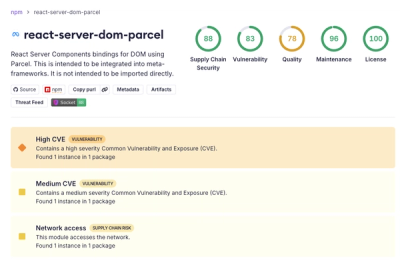
New DoS and source code exposure bugs in React Server Components and Next.js: what’s affected and how to update safely.

Security News
Socket CEO Feross Aboukhadijeh joins Software Engineering Daily to discuss modern software supply chain attacks and rising AI-driven security risks.